
Aave’s Dominance and Recent Contributor Exits: A Comprehensive Analysis
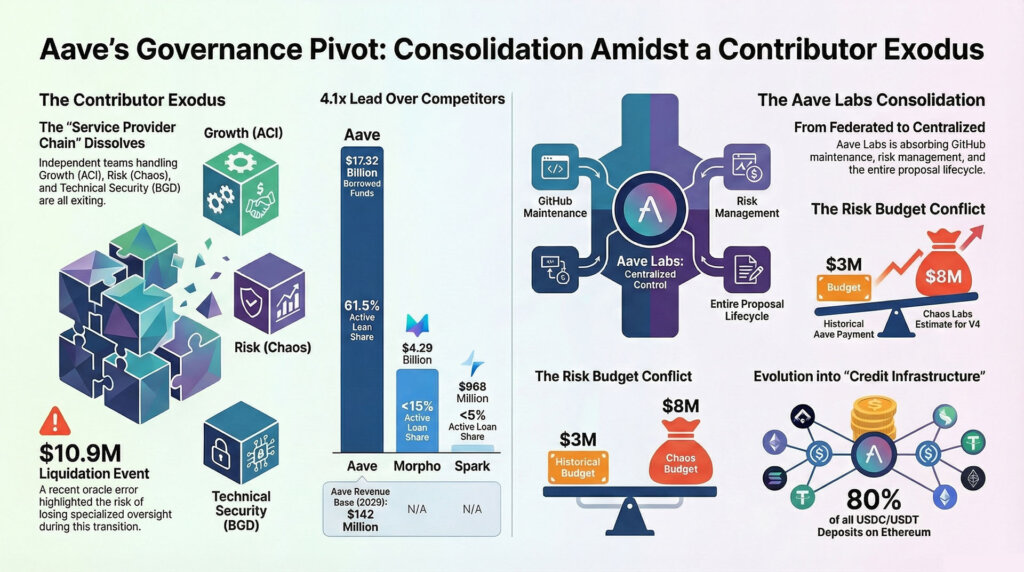
Aave, a preeminent player in the decentralized finance (DeFi) lending ecosystem, currently commands significant market presence, as evidenced by DefiLlama’s reporting of a total value locked (TVL) amounting to approximately $24.51 billion, alongside borrowed funds totaling $17.526 billion. Such figures underscore Aave’s substantial lead over its closest competitor, Morpho, which exhibits a borrowing capacity roughly 4.1 times lower at $4.29 billion, while Spark, the next largest player, lags further behind with $967.52 million in borrowed funds.
As of the end of 2025, Aave maintained a commanding 61.5% share of the active loan market and a 52.4% share of the lending TVL, according to its internal metrics. However, recent developments indicate a seismic shift within its operational framework as three prominent independent contributor teams associated with Aave’s governance, code development, and risk management have either announced their departure or initiated wind-down processes within a span of less than two months.
Recent Departures and Their Implications
On February 20, BGD Labs disclosed its decision to cease contributions, citing a misalignment with the current operational environment, with off-boarding set to commence by April 1. Shortly thereafter, on March 3, ACI announced it would not pursue renewal and would instead wind down operations over the subsequent four months. Subsequently, on April 6, Chaos Labs articulated its intent to conclude its engagement voluntarily, having overseen risk management across Aave V2 and V3 since November 2022.
Aave’s governance documentation delineates a structured operating model wherein ACI was responsible for growth initiatives, Chaos Labs managed risk assessments, and BGD provided technical and security verification services. Additionally, LlamaRisk and the Protocol Guardian were designated as risk guardians within this framework. Notably, ACI has asserted that every significant initiative necessitated the full utilization of this service-provider chain.
The sequential exits of these contributors elucidate a concerning pattern that jeopardizes the integrity of Aave’s established operational model at a critical juncture.
Operational Challenges: The Governance Conflict Intensified
On March 10, an oracle misconfiguration involving CAPO resulted in a deviation of approximately 2.85% below market for the effective wrapped staked Ether (wstETH) exchange rate. This anomaly precipitated approximately $10.938 million in liquidations across thirty-four accounts and generated around $26.6 million in liquidation volume. While Aave’s post-mortem analysis confirmed the absence of bad debt, it proposed reimbursement totaling 512.19 ETH—a financial burden amounting to 358.56 ETH for the Decentralized Autonomous Organization (DAO), thus transcending mere governance concerns.
Chaos Labs specifically cited the transition from V3 to V4 as exacerbating operational burdens due to the need for comprehensive risk management during this critical overlap phase between legacy systems and newly implemented architectures. The V4 protocol is now live on the Ethereum mainnet and incorporates three liquidity hubs with intentionally conservative caps while maintaining V3 in operation.
Chaos further contended that managing concurrent operations between a well-established version and an innovative hub-and-spoke model necessitates significantly enhanced risk tooling and staffing—estimating that an adequate risk budget would amount to no less than $8 million compared to its historical allocation of $3 million amidst Aave’s projected revenue base of approximately $142 million for 2025.
This incident underscores the validity of Chaos Labs’ argument; even minor configuration errors can inflict substantial financial damage on users.
Strategic Absorption by Aave Labs
In response to these challenges, Aave Labs is expeditiously mobilizing resources to bridge operational gaps left by departing contributors. The “Aave Will Win” ARFC proposes that Aave Labs undertake responsibilities previously held by external contributors—including governance tooling, DAO GitHub maintenance, Guardian coordination, CAPO pricing management, bridge adapter maintenance, governance technical reviews, and much of the proposal lifecycle alongside incentive infrastructure linked to BGD and ACI.
The rationale behind this consolidation posits that reliance on external entities should be minimized; instead, operational stability should be maintained within a singular entity—Aave Labs itself.
V4 underwent rigorous scrutiny over approximately 345 cumulative days involving four separate audit firms and independent researchers; notably no critical or high-severity findings were reported in public contests or published assessments.
Aave also maintains over $250 million in Umbrella first-loss coverage despite BGD’s departure from its principal contributor role—BGD has offered a two-month advisory retainer lasting until May 31 to facilitate continued security oversight during this transition period.
LlamaRisk will sustain its engagement with Aave while new risk-agent frameworks assign Risk Guardian responsibilities jointly between LlamaRisk and the Protocol Guardian.
The consolidation strategy is predicated upon creating a streamlined set of accountabilities under Aave Labs that enhances efficiency and delineates clearer lines of responsibility—a proposition that will only hold merit if Labs can navigate through this phase without further operational mishaps during the concurrent functioning of V3 and V4 protocols.
| Function | Previous Lead | Current / Proposed Replacement | Significance |
|---|---|---|---|
| Growth / Governance Coordination | ACI | Aave Labs absorbing parts | Proposal flow; ecosystem coordination |
| Risk Management | Chaos Labs | LlamaRisk / Protocol Guardian / Labs Transition | Parameter setting; monitoring; incident prevention |
| Technical / Security Verification | BGD | Aave Labs + BGD Advisory Retainer through May 31 | Implementation review; security checks |
| CAPO Pricing / Governance Tooling / GitHub / Bridge Maintenance | BGD + ACI Linked Workflow | Aave Labs | Operational continuity during V3/V4 overlap |
The Bullish Scenario: Potential for Continued Market Dominance
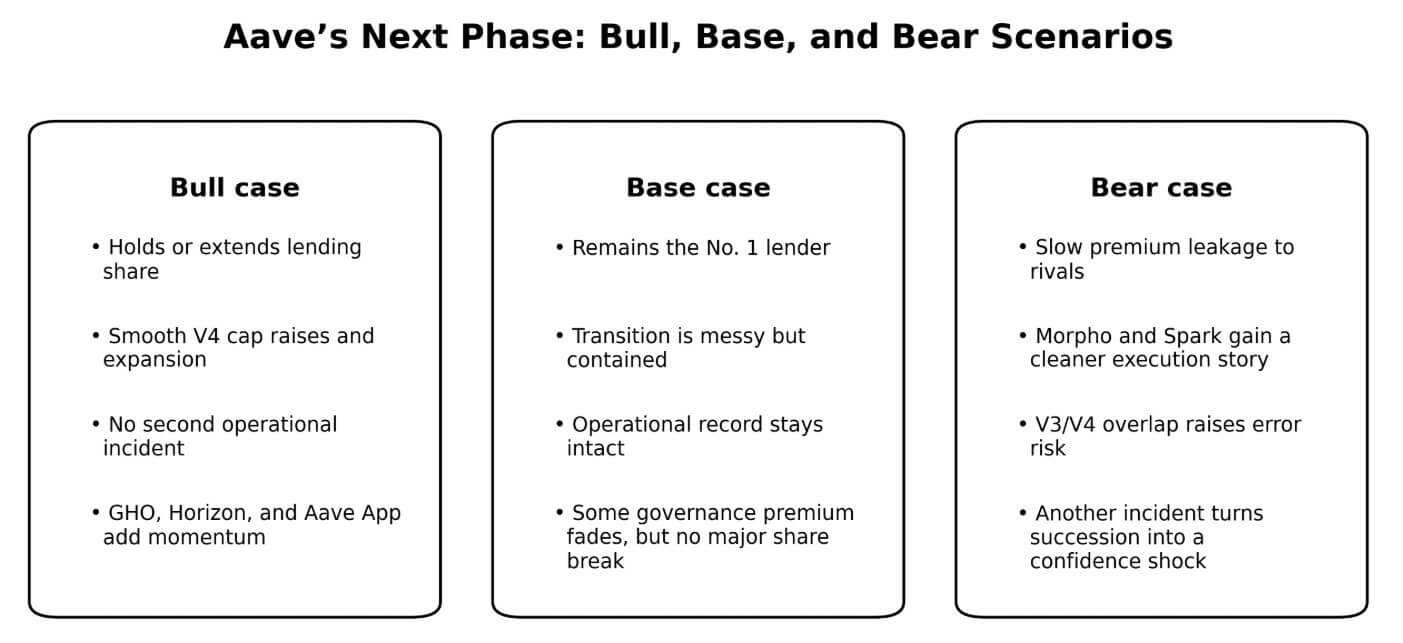
If Aave’s consolidation strategy successfully mitigates operational risks inherent in ongoing transitions while capitalizing on emerging opportunities within DeFi markets—valued at an estimated $27.68 billion in active loans as of March—it may maintain or even expand its lending market share where it currently holds approximately 59.79% according to Token Terminal data.
The pathway forward hinges upon several critical factors including:
- Smooth execution of capital raises associated with V4;
- No recurrence of operational incidents;
- Sustained growth trajectory for GHO stablecoin;
- Increased traction across various platforms such as Aave Pro and Horizon;
- Augmented functionality via the Aave App alongside MiCA-authorized fiat ramp through Push.
The protocol’s extensive integrations coupled with robust developer tooling capabilities enhance liquidity depth while establishing significant switching costs for large borrowers considering alternatives.
Ave’s resilience was notably demonstrated during February’s market correction when it successfully managed approximately $429 million in liquidations across over twelve thousand transactions without incident—a testament to its operational robustness amid potential stressors.
This historical performance reinforces confidence in its capability to navigate through complex governance transitions without undermining operational integrity.
Moreover, as Aave evolves beyond mere lending application functionality—holding over 80% of USDT and USDC deposits along with roughly $20 billion in stablecoin deposits—the protocol increasingly resembles credit infrastructure for on-chain dollar markets rather than simply a lending platform. This strategic positioning fosters arguments pertaining to durability irrespective of fluctuations tied to individual contributor departures.
The Bearish Scenario: Risks Associated with Contributor Exits
The collective departures of these key contributors pose significant risks as they previously constituted the operational backbone linking risk models directly into production environments.
- Chaos Labs: Responsible for pricing every loan on Aave since November 2022 without material bad debt instances;
- BGD: Maintained crucial technical architecture alongside security review processes;
- ACI: Oversaw governance flow coupled with growth coordination initiatives.
Aave Labs now faces the formidable challenge of absorbing these critical functions while ensuring seamless interactivity across parameters updates amidst simultaneous governance proposal submissions—a dynamic intersection highlighted during March’s CAPO incident that resulted from configuration-layer decisions made under prior operating models—culminating in an unintended yet consequential financial impact exceeding eight figures due solely to an approximate deviation rate of just under three percent.
Citing concerns regarding increased operational complexity associated with V4 implementation—Chaos posits that expanding surface area raises susceptibility to similar errors moving forward while historically allocated risk budgets may prove insufficient given heightened demands placed upon them by evolving operational frameworks.
If Aave Labs fails to replicate sufficient operational density reflective of previous federated models encompassing governance execution alongside parameter oversight—mistrust may emerge among stakeholders leading Morpho and Spark to gain competitive advantages predicated solely upon execution efficacy amidst perceived instability surrounding contributor transitions.
Morpho currently boasts a total value locked (TVL) figure standing at $7.337 billion alongside borrowed funds reaching $4.29 billion while strategically structuring expansion efforts around modular architectures distinct from Aave’s unified liquidity model—thus differentiating their competitive positioning within an increasingly crowded marketplace.
The existing borrowing gap approximating four-to-one remains substantial; however gradual premium erosion may influence capital allocations over time favoring alternatives perceived as less encumbered by ongoing governance transitions—a dynamic exacerbated by current developments surrounding GHO stablecoin introduction alongside other novel initiatives such as Horizon and Pro offerings which expand potential engagement avenues even amidst diminishing contributor resources available within core operations.
If an incident occurs under Version Four before demonstrating competency across all operational facets—perceptions surrounding governance transitions could shift dramatically resulting not only in diminished confidence but potentially catalyzing adverse pricing dynamics affecting overall valuation metrics linked directly back towards contributor narratives associated historically with prior iterations governed federatively rather than wholly centralized under singular control mechanisms implemented by emerging leadership structures focused primarily upon optimizing performance against competitor benchmarks amidst shifting market landscapes driven largely through user adoption trends influenced heavily by perceptions surrounding reliability throughout transitional phases experienced within broader DeFi ecosystems overall.