

preferred on

An Analytical Examination of Ray Dalio’s Geopolitical and Monetary Discourse
Overview of Dalio’s Thesis
Ray Dalio’s essay published in TIME on April 9, serves as a pivotal exploration of the interrelation between geopolitical tensions and monetary systems. Within the text, Dalio articulates a disconcerting forecast indicating an impending collapse of the current monetary order, alongside potential upheavals in domestic political structures and the broader geopolitical landscape.
Dalio posits that while the immediate catalyst for these anticipated changes is the escalating conflict with Iran, the underlying assertion is more profound: investors are allegedly underestimating the extent and depth of the transitions already in motion. This mispricing may lead to significant ramifications for asset valuation and investor strategy moving forward.
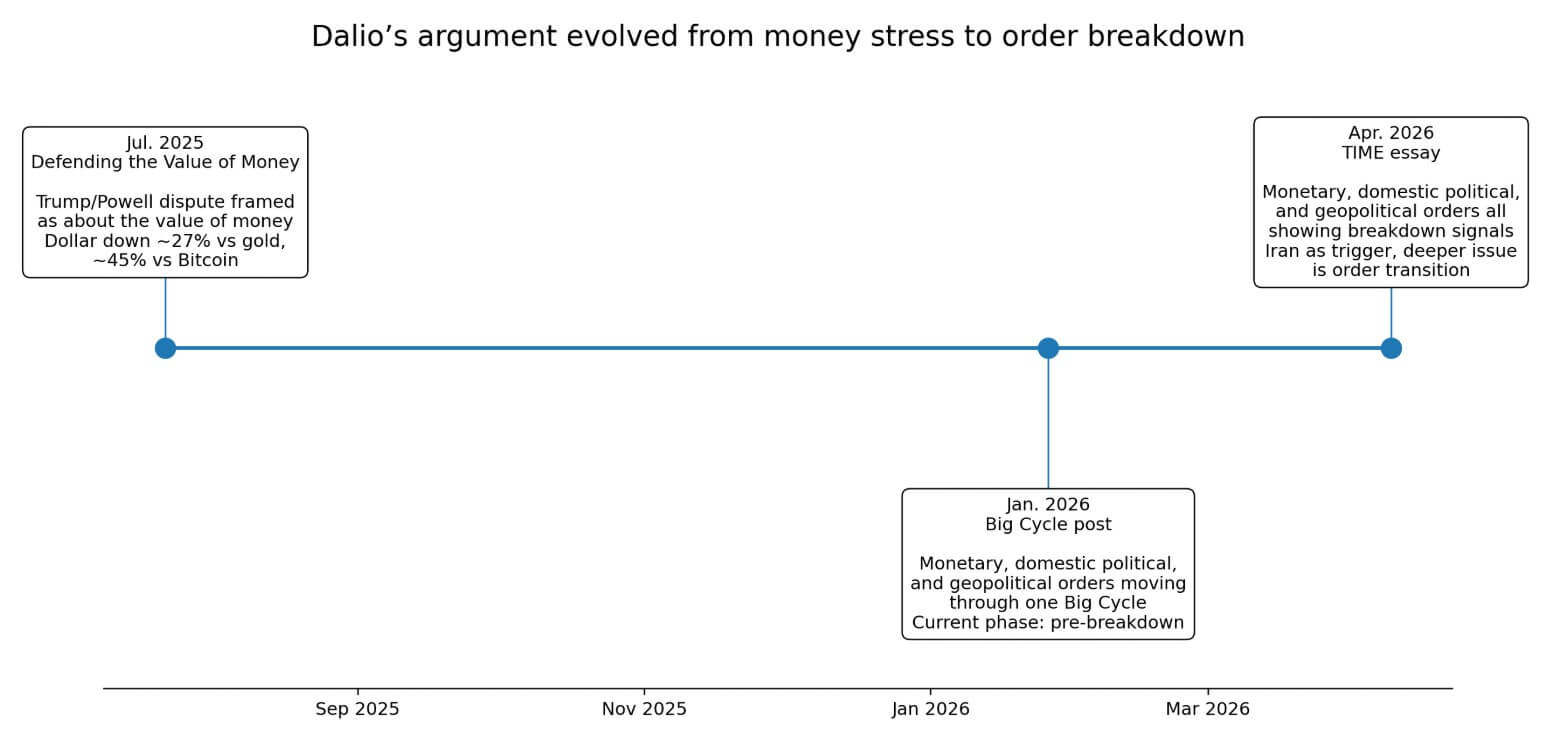
In his previous writings, including the July 2025 essay titled “Defending the Value of Money,” Dalio examined the contentious relationship between former President Donald Trump and Federal Reserve Chair Jerome Powell, framing it as fundamentally a debate over monetary value. He elucidated that when debt burdens escalated excessively, a conventional response involved reducing real interest rates and devaluing currencies. Notably, he reported that during this period, the U.S. dollar had depreciated approximately 27% against gold and a staggering 45% against Bitcoin since the preceding summer.
By January 2026, he expanded upon this narrative, suggesting through a LinkedIn post that all three orders—monetary, domestic political, and international geopolitical—were traversing a singular “Big Cycle,” with the current phase signifying a pre-breakdown transition. His April warning represents yet another chapter in this extensive argument.
Implications for Hard Money Assets
As the analytical lens shifts from immediate war-induced shocks to broader monetary-order transitions, investors must critically evaluate which assets will maintain their intrinsic value amidst an environment where debt instruments are perceived as increasingly unreliable and fiat systems face growing political exposure.
In his June 2025 LinkedIn essay titled “How Countries Go Broke,” Dalio delineated an allocation strategy advocating for reduced exposure to debt assets while favoring an overweight position in gold supplemented by a minor allocation to Bitcoin. In October 2025, he further reinforced this hierarchy in his TIME essay “Gold Is the Safest Money,” categorically designating gold as the monetary asset least susceptible to devaluation or confiscation.
The rationale behind Bitcoin’s inclusion in this framework lies in its inherent scarcity and autonomy, operating independently of any issuing authority, central bank, or state balance sheet. In an environment where Dalio anticipates increasing pressure on fiat systems due to ongoing debasement concerns, these characteristics become increasingly salient for investors seeking exposure to alternative monetary instruments outside traditional paradigms.
The empirical observation that the dollar depreciated by 45% against Bitcoin within a span of roughly one year lends tangible support to this theoretical construct. However, Bitcoin’s performance during periods of acute market stress raises questions regarding its aspirational status as a monetary asset compared to gold.
Gold’s Preeminence in Times of Crisis
On April 7, amid heightened tensions related to Iran, gold experienced an increase in value while Bitcoin saw a decline approaching 2%, mirroring broader trends across risk assets. While this singular session does not substantiate a definitive conclusion regarding asset behavior during crisis conditions, it is consistent with established patterns observed throughout the conflict period: gold rises due to safe-haven demand whereas Bitcoin aligns more closely with equities and technology stocks.
Notably, Bitcoin’s recovery above $70,000 in February coincided with a rebound in tech stock performance. Dalio’s characterization distinctly encapsulates this divergence; he refers to gold as “the safest money,” contrasting it with his description of Bitcoin as “a bit of Bitcoin.”
The comparative attributes reveal significant disparities:
– **Historical Precedent**: Gold possesses approximately 5,000 years of established monetary history compared to Bitcoin’s comparatively nascent existence.
– **Institutional Depth**: Gold commands substantial credibility among central banks as a reserve asset; conversely, Bitcoin lacks comparable institutional endorsement at scale.
– **Market Behavior During Crisis**: Gold traditionally rises during periods of geopolitical tension while Bitcoin correlates more closely with riskier assets.
A recent survey reported by Reuters indicated that nearly 70% of central banks now identify geopolitics as their foremost global risk—a marked increase from 35% in 2024. Approximately 75% of these institutions hold gold reserves, with nearly 40% considering augmenting their allocations.
China’s central bank notably expanded its gold reserves for the seventeenth consecutive month as of March. These trends illustrate an institutional preference for gold that Bitcoin has yet to replicate at any significant level.
| Attribute | Gold | Bitcoin |
|---|---|---|
| Dalio’s Wording | “Safest money” | “A bit of Bitcoin” |
| Role in Portfolio | Core hard-money allocation | Smaller satellite allocation |
| Behavior in Acute Stress | Rallied amidst rising Iran tensions | Dropped nearly 2% alongside risk assets |
| Institutional Depth | Reserve-manager asset with credibility | Emerging base but relatively shallow |
| Central Bank Demand | Yes | No meaningful participation noted |
| Historical Monetary Track Record | ~5,000 years of use | Short modern history (not yet established) |
| Regulatory Certainty | Higher degree of regulatory clarity | Lesser degree of certainty and stability |
| Volatility Profile | Lower volatility characteristics | Higher volatility spectrum observed |
| Best Fit in Dalio Framework | First-round refuge asset | Forward-looking non-sovereign money bet |
The Macro Context Underpinning Dalio’s Argument
The practical implications surrounding Dalio’s thesis came into sharper focus during the same week as his publication. Kristalina Georgieva, Managing Director of the International Monetary Fund (IMF), articulated concerns that ongoing conflict would likely catalyze rising prices while concurrently suppressing economic growth—even if resolved swiftly. Similarly, Ajay Banga, President of the World Bank, echoed sentiments indicating that some level of subdued growth alongside escalated inflation would persist irrespective of how promptly hostilities concluded.
UBS subsequently adjusted its anticipated timeline for Federal Reserve interest rate cuts to September and December due to elevated energy prices which would likely maintain inflationary pressures and marginally inhibit economic output.
This confluence of observations delineates a macroeconomic regime characterized by specific implications for portfolio construction; namely that slower growth coupled with persistent inflation compresses returns on duration-sensitive instruments while extending periods of pressure on leveraged balance sheets. In such an environment, assets devoid of duration risk or credit risk occupy a structurally favorable position relative to scenarios characterized by easing financial conditions and normalized growth trajectories.
The World Gold Council reported that total demand for gold surpassed 5,000 tons for the first time in 2025—an increase attributed primarily to soaring investment demand which rose by 84%, alongside substantial inflows into exchange-traded funds (ETFs). With gold prices surging by approximately 64% during that year and projections suggesting potential ascendance toward $6,000 per ounce seem plausible within this evolving framework.
These data points collectively substantiate Dalio’s assertion regarding an ongoing re-monetization of gold within institutional markets—an evolution that has not yet found parallel expression within Bitcoin’s market dynamics which remain marked by greater volatility and shallower institutional engagement.
The Potential Trajectories Ahead for Asset Valuations
In an optimistic scenario for Bitcoin, market dynamics might shift from merely adjusting for conflict-related shocks toward recalibrating valuations based on emerging monetary order realities. Investors who have absorbed insights from IMF growth forecasts alongside World Bank inflation expectations may begin reassessing portfolio compositions conducive to chronic debasement scenarios.
Bitcoin’s fixed supply structure coupled with its position independent from sovereign balance sheets—alongside Dalio’s explicit endorsement within relevant investment frameworks—provides a credible entry point into this evolving narrative. The documented depreciation of the dollar against both gold and Bitcoin serves as empirical evidence supporting claims that this repricing may already be underway despite initial hesitance among institutional participants.
Conversely, should energy price shocks coupled with tighter financial conditions dominate prevailing market forces (the bear case), Bitcoin may continue exhibiting correlation with technology equities alongside general risk sentiment fluctuations while gold captures safe-haven allocations driven by geopolitical fragmentation.
| Scenario | Trigger Event | Gold Valuation Response | Bitcoin Valuation Response | (Best) Interpretation Outcome |
|---|---|---|---|---|
| Bull Case for Bitcoin | A transition from war-induced pricing adjustments towards broader monetary repricing. | (Expected) Continued strength. | (Anticipated) Gains relevance as non-sovereign currency. | (Ideal) Bitcoin begins behaving increasingly like hard money. |
| Base Case Scenario Bull Case for Bitcoin – (cont.)Bull Case for Bitcoin – (cont.)Bull Case for Bitcoin – (cont.)Bull Case for Bitcoin – (cont.)Bull Case for Bitcoin – (cont.)Bull Case for Bitcoin – (cont.)Bull Case for Bitcoin – (cont.)Bull Case for Bitcoin – (cont.)Bull Case for Bitcoin – (cont.)Sustainable
Continuous Innovative Sustainable Continuous Innovative Sustainable Continuous Innovative . . . . . . . . . . . . . . . . . . The imperative conclusion emerges: investors seeking robust hard-money protection are inclined towards assets backed by thousands of years of historical precedent along with demonstrable direct central bank demand—thus relegating Bitcoin primarily to a higher-beta satellite position within portfolios designed for eventual repricing dynamics yet lacking initial safety appeal during crises. The documented correlation between Bitcoin’s price movements and technology equities vis-à-vis gold’s performance amid safe-haven demand throughout current conflict periods substantiates this trajectory’s plausibility. Ray Dalio’s categorizations serve as an unambiguous framework; gold remains unequivocally designated “the safest money,” whilst Bitcoin is relegated merely to “a bit of Bitcoin.” Such hierarchical distinctions provide critical context within which investors may navigate impending transitions amidst evolving monetary landscapes. 

Popular News
|