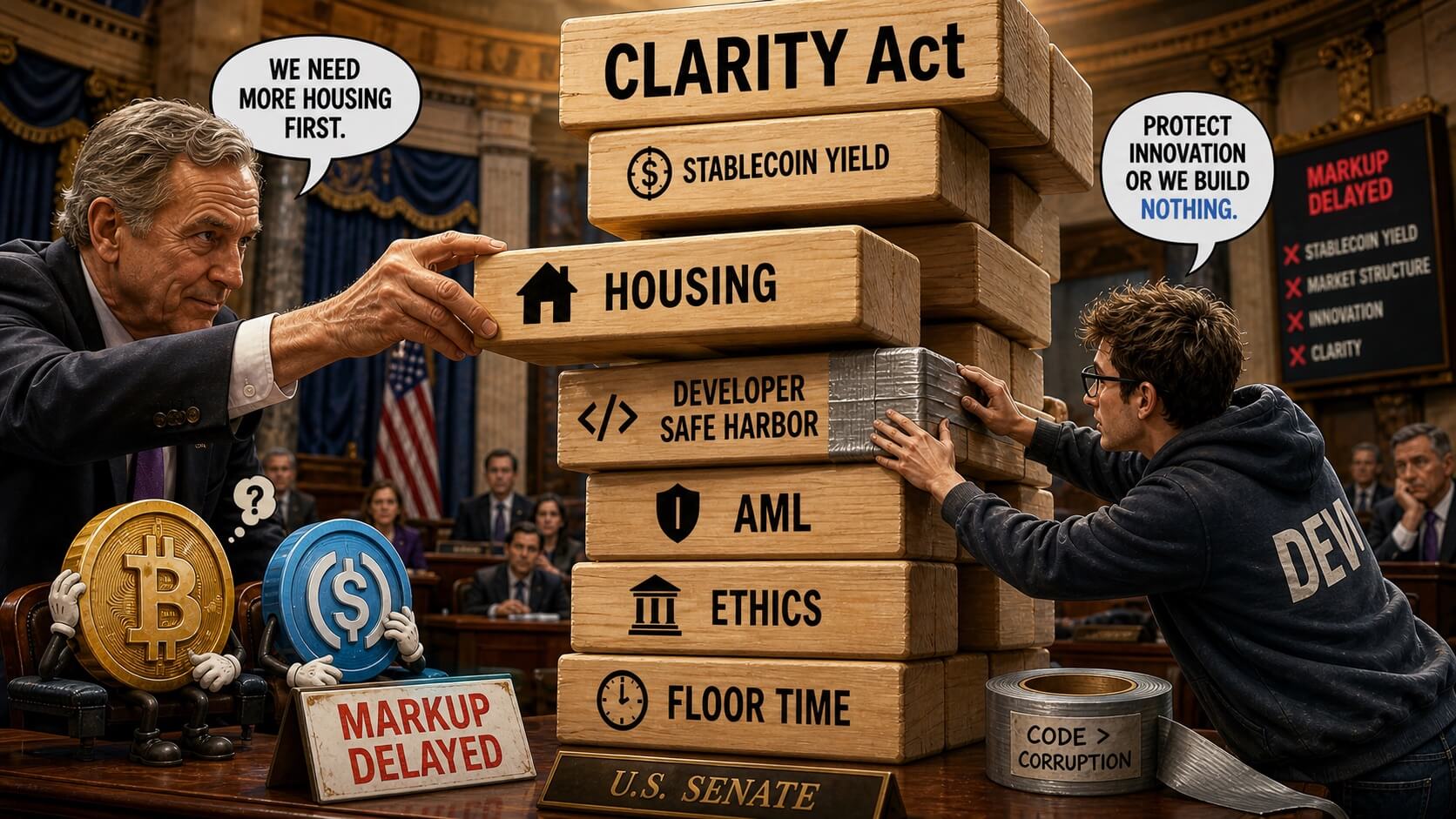
Analysis of the Current Landscape Surrounding the CLARITY Act
The legislative progression of the CLARITY Act has recently transitioned from a protracted stalemate concerning stablecoin yields to a more complex array of political and regulatory challenges. Central to this evolution is the interplay between Senator John Kennedy’s dissatisfaction regarding housing policy and the unresolved protections for software developers, alongside the imperative for Senate Banking Committee Chairman Tim Scott to consolidate Republican support.
Resolution of Stablecoin Yield Conflict
The impasse surrounding stablecoin yield has been mitigated through the collaborative efforts embodied in the Tillis-Alsobrooks compromise. This pivotal agreement delineates a framework whereby stablecoin rewards may be contingent upon user engagement and platform activity, while simultaneously prohibiting passive yield accrual on dormant balances. Such a stipulation effectively curtails the capacity of crypto firms to emulate traditional high-yield savings accounts, thereby addressing banking sector concerns regarding potential deposit flight.
– **Core Components of the Compromise:**
– Allowance for yield incentives based on user engagement.
– Prohibition of passive yield on idle balances.
Despite this compromise facilitating a resolution to one of the most conspicuous policy disputes, its efficacy in securing bipartisan markup remains contingent upon Scott’s ability to forge a cohesive coalition. Scott has articulated his ambition to attain unanimous Republican endorsement—seeking “thirteen of thirteen Republicans”—prior to advancing to a bipartisan markup session projected for May.
Kennedy’s Housing Frustration as a Political Lever
Senator John Kennedy’s reluctance to extend his support for the CLARITY Act is intricately linked to his grievances with the White House over the stalled 21st Century ROAD to Housing Act. The Build Now Act, which Kennedy championed, successfully navigated Senate approval but faces an incomplete reconciliation process with the House. As Kennedy occupies a critical vote that Scott requires, his leverage over the timeline of the CLARITY Act is substantial.
– **Key Stakeholders:**
– Senator John Kennedy
– House leadership
– The White House
Kennedy’s insistence on progress in housing legislation serves as a necessary precondition for his support, thus intertwining non-crypto issues with cryptocurrency regulatory advancements.
Republican Vote Cohesion and Its Implications
Tim Scott’s strategic objective of uniting all thirteen Senate Banking Republicans prior to embarking on bipartisan negotiations underscores the importance of Republican cohesion in facilitating legislative progress. A unified Republican front not only simplifies the markup process but also enhances the likelihood of attracting Democratic co-sponsors later in the legislative journey.
– **Significance of Full GOP Unity:**
– Eases procedural hurdles during markup.
– Strengthens Democratic engagement and support.
Unresolved Protections for Software Developers
One of the most consequential yet under-explored elements within the ongoing negotiations pertains to protections for noncustodial software developers. The framework established by the Blockchain Regulatory Certainty Act and related Section 1960 provisions seeks to exempt these developers from certain compliance obligations—a measure deemed critical by industry stakeholders for fostering domestic development in decentralized finance (DeFi).
However, law enforcement agencies have voiced concerns regarding potential loopholes that could undermine anti-money laundering (AML) protocols. The ongoing discourse within Senate Banking circles reflects a profound struggle to delineate boundaries between software development and financial service operation, with implications that could substantially affect compliance obligations depending on how Congress elects to classify these entities.
Ethics and Anti-Money Laundering Concerns
The specter of ethical scrutiny and AML objections continues to loom over deliberations surrounding the CLARITY Act, posing risks that could rekindle opposition even in light of recent compromises. Divergent perspectives among Democrats, law enforcement officials, and banking critics may further complicate efforts towards achieving bipartisan consensus.
Time Constraints and Legislative Calendar Pressures
The temporal landscape confronting the CLARITY Act is becoming increasingly constricted. Legislative delays extending beyond mid-May may severely diminish prospects for summer floor action, thereby jeopardizing what remains of this legislative cycle’s opportunities.
Galaxy Digital has assessed the likelihood of passage at approximately 50%, with probabilities diminishing markedly if markup is postponed beyond mid-May. Concurrently, approval odds on platforms such as Polymarket have reflected fluctuations, indicating rising investor sentiment regarding potential enactment by 2026.
– **Key Considerations:**
– A successful unanimous Republican committee vote could facilitate smoother passage through subsequent stages.
– Each week’s delay compresses available time for House coordination and conference negotiations.
The global context exacerbates these pressures; international competitors like Hong Kong are actively advancing their regulatory frameworks by awarding stablecoin issuer licenses, while Europe’s Markets in Crypto-Assets (MiCA) regulation is set to take full effect by July 1. The urgency for legislative clarity within the U.S. market is palpable.
The Path Forward: Navigating Political and Regulatory Challenges
The path forward necessitates that Tim Scott adeptly secures adequate movement on housing issues to appease Kennedy while simultaneously crafting software developer provisions that strike a delicate balance between industry needs and law enforcement concerns. Success in these endeavors could pave the way for achieving bipartisan support prior to June and maintaining momentum towards a summer floor vote.
Conversely, failure to address these multifaceted challenges risks further delays in legislative action, undermining Washington’s credibility as a facilitator of domestic capital formation. This erosion could catalyze an exodus of stablecoin innovation and developer activity towards jurisdictions with established regulatory frameworks.
In conclusion, while recent developments have broken certain deadlocks within the CLARITY Act discussions, myriad challenges remain that will test lawmakers’ resolve and negotiation skills. The interplay between political maneuvering and substantive policy discussions will ultimately determine whether this legislation can advance through an increasingly complex landscape.