
Market Dynamics of Bitcoin Amidst Macroeconomic Influences
In a notable uptick, Bitcoin recently ascended to its apex since the sell-off observed in early February, attributed primarily to the latest data on United States producer prices. The marginal increase in producer prices was less than anticipated by economists, suggesting a complex interplay of macroeconomic factors. This upward movement in Bitcoin’s value coincided with easing oil prices and a resurgence in equity markets, contributing to a broader recovery in risk assets across the financial spectrum.
As reported by CryptoSlate, Bitcoin’s value surged beyond the $76,000 threshold during the initial hours of U.S. trading, leading to an impressive augmentation of approximately $110 billion in market capitalization for the entire cryptocurrency ecosystem within a 24-hour timeframe.
The prevailing sentiment of market optimism is significantly influenced by evolving expectations regarding the monetary policy posture of the Federal Reserve, further compounded by unforeseen developments in ongoing geopolitical tensions.
US Equities Experience Robust Growth Amid Short-Seller Liquidations
It is noteworthy that this relief rally was not limited solely to the cryptocurrency sector. According to Bull Theory, a macroeconomic analysis platform, traditional financial markets exhibited similar enthusiasm in response to the inflation data, resulting in nearly $1.4 trillion being added to U.S. indices over a span of two days.
- The technology-heavy Nasdaq Composite Index experienced a remarkable increase of 2.85%, contributing approximately $960 billion in value.
- The Russell 2000 index, which represents small-cap stocks, surged by 3%.
- The S&P 500 Index advanced by 2.12%, positioning itself within 100 points of achieving a new historical benchmark.
Simultaneously, optimism surrounding stability in the Middle East catalyzed a significant decline in global energy markets, with West Texas Intermediate (WTI) crude oil prices plummeting by 6%, ultimately settling at $93 per barrel.
The sudden influx of bullish momentum proved detrimental for bearish traders positioned against a digital asset recovery. Data from CoinGlass, a derivatives market analytics provider, indicated that the rapid appreciation in Bitcoin prices instigated a cascading wave of liquidations. In just one hour, over $100 million worth of leveraged positions were eliminated, propelling total market liquidations beyond the $650 million mark and predominantly affecting short-sellers.
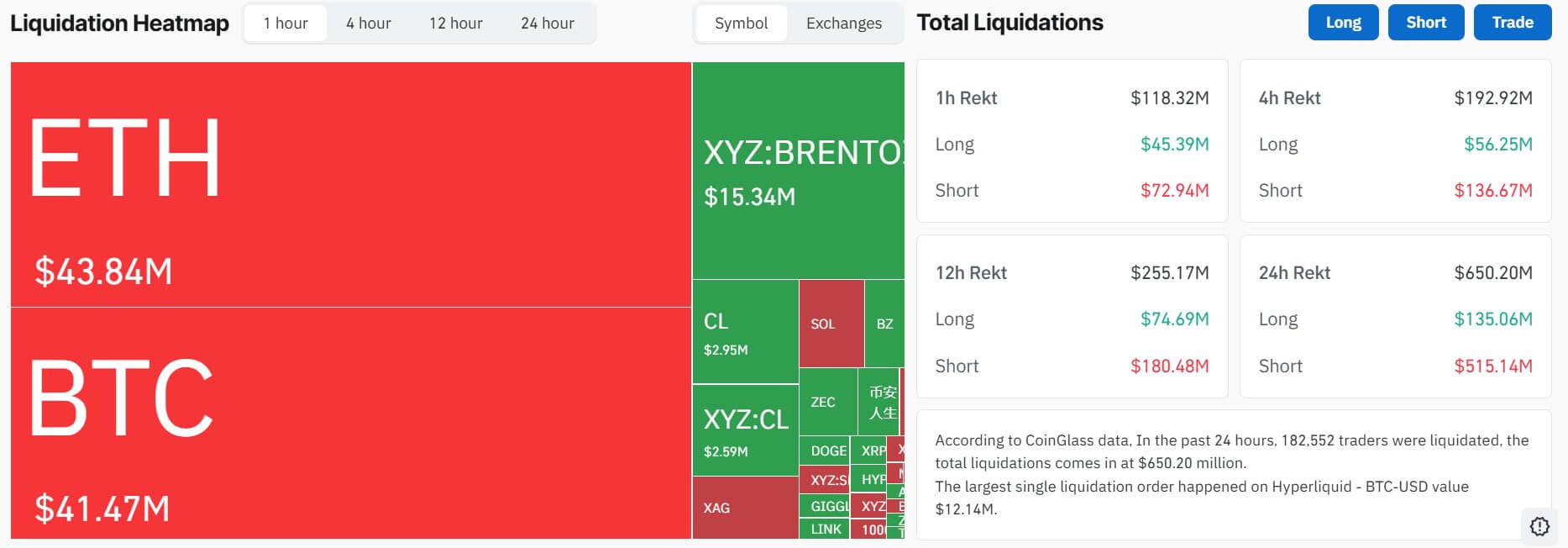
Short-sellers incurred estimated losses amounting to $514.94 million, marking the highest level of liquidations recorded since the heightened volatility observed earlier in February. Joao Wedson, CEO of blockchain analytics firm Alphractal, articulated this phenomenon succinctly:
“Most of the bears were liquidated today! Exactly on April 14th, which is curiously a peculiar and fractal day for Bitcoin!”
Inflation Metrics Indicate Potential Shifts in Monetary Policy
The primary impetus for the prevailing risk-on environment can be traced back to the recent release of the March Producer Price Index (PPI) by the U.S. Bureau of Labor Statistics. This data revealed an uptick in wholesale inflation that fell short of Wall Street’s expectations.
According to the report:
- The headline PPI advanced by 4% year-over-year in March, underperforming relative to consensus estimates of 4.7%.
- This marks a notable acceleration from February’s annual increase of 3.6%, representing the highest growth rate recorded over three years.
- On a month-over-month basis, PPI rose by only 0.5%, aligning with February’s pace but significantly below economist forecasts of a 1.1% surge.
- The core PPI, which excludes volatile food and energy sectors, remained unchanged at an annual rate of 3.8%, also falling short of market expectations set at 4.2%.
Market participants have linked rising inflation figures to geopolitical tensions stemming from the US-Iran conflict, which has exerted upward pressure on energy prices and reignited concerns regarding inflationary surges. In environments characterized by persistent or accelerating inflation data, the Federal Reserve faces heightened scrutiny and pressure to uphold a restrictive interest rate policy.
This leads market actors to recalibrate their expectations regarding imminent rate cuts; instead, they anticipate that the central bank will adopt an unwavering hawkish stance aimed at tightening monetary policy frameworks.
Historically, elevated borrowing costs have been correlated with diminished liquidity within broader financial systems, applying disproportionate pressure on risk-sensitive assets such as Bitcoin and high-growth technology equities while capital gravitates towards yielding safe havens.
Evolving Perspectives on Bitcoin’s Role During Geopolitical Uncertainty
The recent rebound in Bitcoin’s price has catalyzed discussions surrounding its role during periods marked by geopolitical stressors. Matt Hougan, Chief Investment Officer at Bitwise Asset Management, noted that Bitcoin has outperformed numerous traditional assets since hostilities escalated between US and Israeli forces on February 28. While Bitcoin appreciated by 12% during this timeframe, both the S&P 500 and gold exhibited declines of 1% and 10%, respectively.
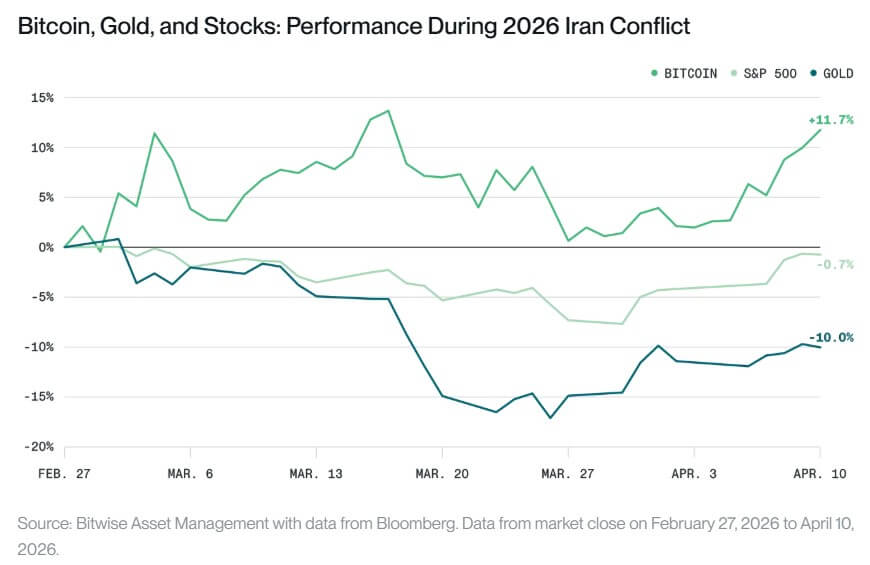
This performance challenges conventional wisdom that associates Bitcoin’s volatility with automatic declines during geopolitical shocks and suggests that market participants may be recognizing Bitcoin as fulfilling dual roles:
- A scarce digital asset competing with gold and other stores of value.
- A speculative asset linked to its potential utility for international transactions amidst increasingly fragmented global payment systems.
The latter perspective has gained traction particularly following Western sanctions aimed at major Russian financial institutions post-invasion of Ukraine—prompting countries globally to seek alternatives to traditional dollar-centric frameworks as they navigate geopolitical pressures.
This evolving discourse regarding Bitcoin’s utility amid fractious international relations raises pertinent questions about its capacity to serve as a politically neutral payment mechanism as conflicts escalate. Nevertheless, while this narrative gains visibility during periods of geopolitical tension, it does not negate Bitcoin’s inherent sensitivity to fluctuations in interest rates, liquidity conditions, and equity market dynamics.