Analysis of XRP’s Current Market Dynamics: A Comprehensive Overview
The recent performance of XRP has raised concerns among market analysts, as the digital asset’s ongoing price struggles appear to transcend typical underperformance, manifesting instead as a significant capitulation event. Long-term holders who acquired XRP at prices exceeding $2 are now confronted with substantial losses, prompting a reevaluation of their investment strategies.
Realized Losses and Market Sentiment
According to data sourced from Glassnode, the realized losses among this cohort have been quantified at an alarming rate, oscillating between $20 million to $110 million daily. This phenomenon coincides with a notable 55% decline in XRP’s value over the past six months, with current valuations settling around the $1.30 mark. Such figures underscore a worrying trend wherein selling pressure is increasingly emanating from investors aiming to mitigate risk amid an environment characterized by pronounced weakness.
This shift in investor behavior signals a critical juncture for XRP, where recent market entrants are succumbing to pressure while earlier investors retain sufficient profit margins to liquidate positions during rebounds. Consequently, XRP has entered its most prolonged losing streak since 2014, engendering a precarious top-heavy market structure that jeopardizes the sustainability of any price recoveries.
Nature of Selling Pressure
The current drawdown is distinguished not merely by its magnitude but by the underlying sources of selling pressure. Historically, XRP holders have typically sold into strength as prices ascended; however, the present situation reflects a stark divergence from this norm. Analysts characterize this dynamic as “distribution into weakness,” indicative of dwindling confidence in XRP’s short-term trajectory.
The implications of this phenomenon are profound: the ongoing decline has become increasingly resistant to reversal efforts. Recent buyers now find themselves in positions of loss while earlier investors remain incentivized to reduce exposure during any price rallies. This duality fosters a fragile environment where each price bounce presents opportunities for profit-taking and loss-cutting alike, thereby complicating recovery efforts.
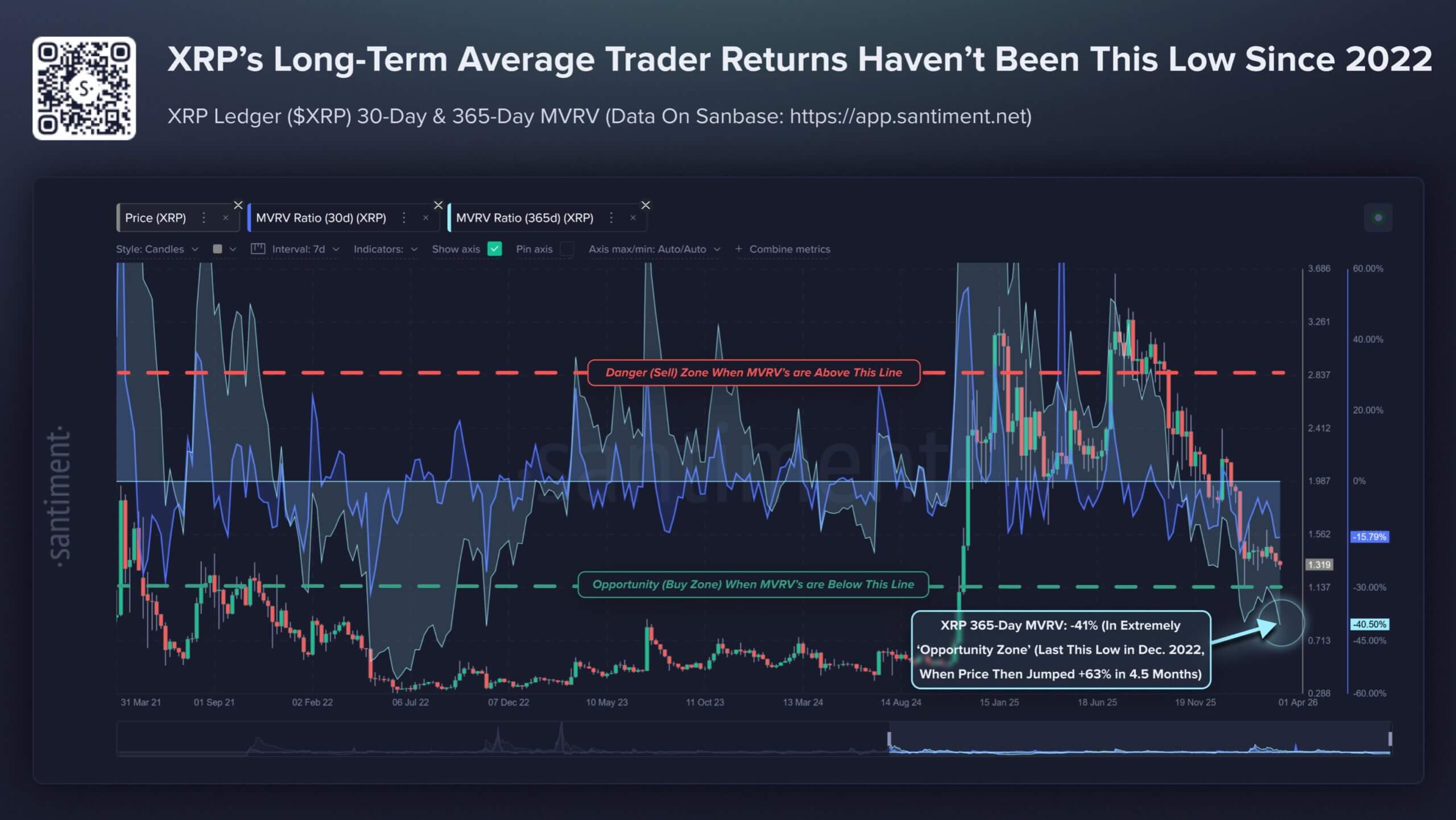
Supporting this narrative, data from Santiment reveals that wallets engaged on the XRP Ledger over the preceding year have experienced an average position decline of 41%, marking the weakest mean-to-realized value reading since the collapse of FTX in November 2022.
Market Conditions and Divergent Trading Strategies
The broader cryptocurrency market backdrop has exacerbated these challenges, as XRP’s downturn transpires amidst a general risk-off sentiment across digital assets. Bitcoin, for instance, has retraced from over $126,000 to approximately $66,000 during this period. In such an environment, traders exhibit reluctance to pursue assets lacking clear short-term catalysts, particularly when holder behavior is deteriorating.
Spot Demand vs. Futures Market Activity
Despite prevailing bearish sentiments, it is crucial to note that the XRP market is not devoid of positivity. Data from CryptoQuant indicates that spot cumulative volume delta on Binance has surged to approximately $520.2 million, suggesting ongoing interest from cash-market buyers.
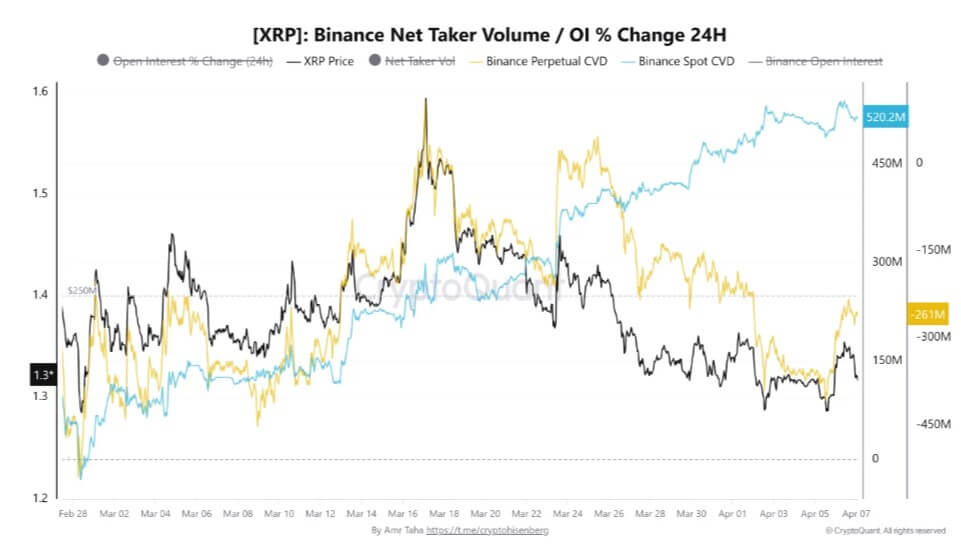
Conversely, the perpetual cumulative volume delta remains negative at around $261 million, indicating that leveraged traders have not adjusted their positions significantly. This divergence elucidates why XRP can exhibit signs of support while remaining fundamentally weak; spot demand may mitigate price declines but lacks the aggressive repositioning characteristic of strong upward movements.
Furthermore, whale activity signals a similar trend. Recent reports indicate that daily whale inflows into Binance have plummeted to approximately 12.6 million XRP, with a 30-day cumulative flow decreasing to around 1.44 billion XRP—down from roughly 2.6 billion XRP in March.
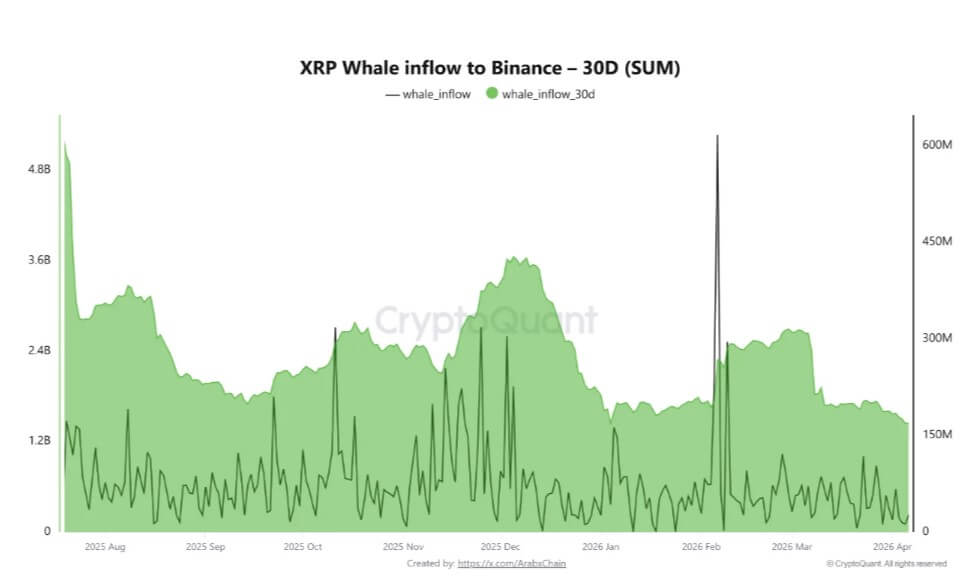
The reduction in supply sent to exchanges by large holders lessens one source of near-term selling pressure; however, diminished inflows alone do not equate to heightened demand. The market remains poised in a state of suspension where large holders exert less pressure while genuine buyers remain active in spot markets.
Ripple’s Operational Advancements Versus Market Perception
The hesitation present within the market is particularly striking given Ripple’s recent operational advancements. The company’s protracted legal confrontation with the U.S. Securities and Exchange Commission (SEC) culminated in a settlement following several favorable judicial rulings—an outcome which reinvigorated accumulation and propelled XRP into its most robust performance in years.
Moreover, Ripple has strategically pursued acquisitions and secured licenses aimed at broadening its product offerings and international presence. Proponents assert that these developments should ultimately bear significance for price valuations.
Asheesh Birla, CEO of Evernorth—a treasury firm focused on XRP—recently articulated that institutional momentum surrounding XRP is accelerating at an unprecedented pace compared to 18 months ago and emphasized that the financial infrastructure supporting the asset continues to evolve positively.
Despite these constructive developments, data from SoSoValue indicates that XRP exchange-traded funds recently experienced their first monthly net outflow exceeding $31 million in March—a stark contrast to an inflow streak totaling $1.2 billion that had previously positioned them among the most successful early crypto product launches outside Bitcoin.
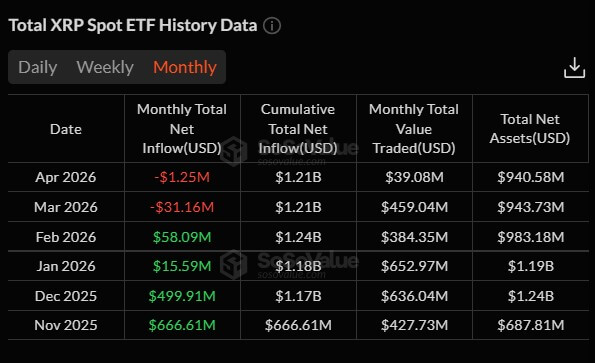
This outflow does not diminish Ripple’s long-term progress; rather it underscores investor caution regarding assigning an immediate premium to the token’s valuation.
In conclusion, XRP finds itself at a crossroads characterized by contrasting realities: while Ripple’s achievements in legal clarity and institutional engagement suggest a more optimistic long-term outlook, short-term dynamics reveal an asset beset by selling pressures from underwater investors and an uncertain derivatives landscape. The market must navigate these complexities before any decisive upward trajectory can be established.