

preferred on

Market Dynamics Under Health Crisis: An Analytical Overview
The recent resurgence of Bitcoin, surpassing the $80,000 threshold, has reignited a critical inquiry among traders and analysts alike: What is the behavioral response of the foremost digital asset in the context of a health crisis, particularly when such an event replaces traditional market concerns surrounding interest rates, regulatory frameworks, or crypto-specific leverage?
The proximate catalyst for this inquiry is a hantavirus outbreak aboard the MV Hondius, a luxury cruise ship en route to the Canary Islands. As reported by the World Health Organization (WHO) on May 6, there have been confirmed cases of severe respiratory illnesses on board, including two confirmed infections and three fatalities as of May 4.
As Bitcoin reached a peak valuation of $82,752 earlier this week—extending a notable rebound following a protracted period of macroeconomic turmoil—the timeliness of the hantavirus outbreak raises pertinent questions about Bitcoin’s resilience to sudden shocks that would typically incite a broader retreat to cash.
The Hantavirus Outbreak: Implications for Market Sentiment
According to the WHO’s guidelines, hantaviruses are primarily transmitted through contact with infected rodent excreta. While most strains exhibit limited human-to-human transmission, the Andes virus variant associated with the current outbreak poses a unique threat due to its potential for such transmission among close contacts.
The severity of hantavirus cardiopulmonary syndrome is underscored by its alarming fatality rates—up to 40% in certain regions of the Americas—rendering any suspected cases pivotal for public health officials and financial markets alike. Notably, WHO representatives have characterized the global risk as minimal and largely confined to the cruise environment. This distinction is critical; an isolated cluster aboard a cruise ship with rigorous contact tracing protocols significantly differs from a respiratory virus proliferating through densely populated urban centers.
The prevailing market apprehension stems from an uncertainty paradigm. Given that hantavirus infections may exhibit prolonged incubation periods, contact tracing becomes increasingly complicated, leading traders to respond reactively to official updates regarding passenger movements and case developments before a comprehensive understanding emerges.
The Legacy of March 2020: A Cautionary Tale
The specter of March 2020 looms large in traders’ collective memory; during this period, the WHO’s declaration of COVID-19 as a pandemic precipitated one of the most severe liquidity crises in contemporary financial history. At that juncture, Bitcoin had begun to establish itself as a hedge against monetary instability. However, this assertion was put to the test as the asset plummeted over 50% within approximately 48 hours, trading briefly below $4,000 as investors liquidated assets in search of cash liquidity.
This episode elucidated an essential truth: during initial stages of systemic shocks, liquidity can often outweigh investment theses. Assets like Bitcoin, which operate in continuous markets, can be rapidly liquidated and serve as immediate cash reserves for investors facing margin calls elsewhere.
It is imperative to note that the current hantavirus scare is significantly less grave than the COVID crisis faced in March 2020. Presently, there is no substantiated evidence indicating sustained community transmission, nor does there appear to be an imminent threat of economic shutdown or governmental imposition of pandemic-era restrictions. Nonetheless, traders remain predisposed to defensive postures in reaction to market headlines, particularly when they are informed by prior traumatic market collapses.
A More Resilient Market Structure
Bitcoin’s primary fortification today lies in its markedly evolved market structure compared to that which existed during the COVID-induced turmoil of early 2020. At that time, cryptocurrency liquidity was fragmented; leverage was predominantly concentrated offshore; and institutional access was severely limited. The market was chiefly driven by retail dynamics alongside derivatives positioning and exchange-level stress factors.
Contrarily, contemporary developments such as spot Bitcoin ETFs have introduced a regulated avenue for institutional investors seeking exposure. Furthermore, corporate treasuries have emerged as an additional layer of demand. The presence of market makers and custodians has fortified Bitcoin’s linkage to traditional investment flows.
This evolution equips BTC traders with enhanced analytical frameworks for discerning between transient profit-taking activities and genuine structural breakdowns.
 srcset=”https://cryptoslate.com/wp-content/uploads/2026/05/Screenshot-2026-05-07-124545.jpg 606w,
https://cryptoslate.com/wp-content/uploads/2026/05/Screenshot-2026-05-07-124545-300×113.jpg 300w”
sizes=”(max-width: 606px) 100vw, 606px”/>
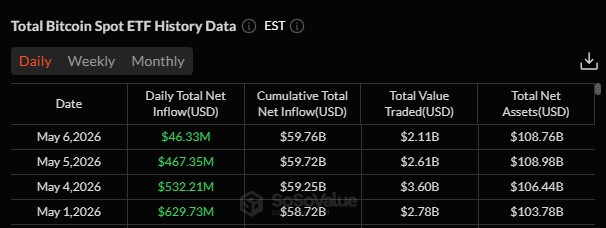
Recent data from SoSoValue indicates that U.S. spot Bitcoin ETFs have attracted over $1.6 billion in net inflows since early May—an indication that institutional demand remains robust despite prevailing health concerns.
Market Sentiment Analysis: Prediction Markets and Speculative Behavior
Current predictions from various markets suggest a measured caution among traders rather than outright panic regarding potential health implications stemming from the hantavirus outbreak. On platforms such as Polymarket, contracts querying whether there will be a “Hantavirus pandemic in 2026” reflect odds hovering around 9%. Conversely, Kalshi—a regulated U.S.-based prediction market—indicates higher probabilities (approximately 35.7%) that the WHO may categorize this outbreak as a pandemic.
The disparity in odds illustrates underlying differences in contract language and market structures while underscoring an uneven distribution of fear across trader demographics. Notably, speculative crypto participants appear less inclined towards anticipating a significant pandemic risk compared to broader event-risk traders who are factoring more heavily into official WHO communications.
The Speculative Response: Crypto’s Attention Economy
Interestingly, certain sectors within cryptocurrency have reacted more swiftly than warranted by actual health risks; several tokens themed around hantavirus have emerged on decentralized exchanges—one achieving a market capitalization of approximately $3.5 million within mere hours. This phenomenon speaks less to genuine health considerations and more profoundly reflects crypto’s propensity for exploiting fleeting global headlines for speculative gains.
The Determinants of Bitcoin’s Path Forward
The forthcoming challenge for Bitcoin resides in whether it can sustain its position above the $80,000 threshold or if it will succumb to another failed breakout scenario. Several key variables will play critical roles:
– **Public Health Communications**: The ongoing characterization by WHO officials regarding risk levels will substantially influence market sentiment.
– **ETF Demand**: Should demand remain positive or neutral amidst deteriorating headlines, it would indicate institutional buyers perceive this situation as mere noise rather than grounds for exit.
– **Traditional Market Indicators**: Any signs indicative of true pandemic risks would likely manifest through stronger dollar performance, declining Treasury yields, heightened volatility measures, and pressure across equity markets.
Absent these indicators, any pullback in Bitcoin’s value could be interpreted more as localized profit-taking following an impressive rally rather than onset of widespread liquidity constraints.
In conclusion, while the hantavirus outbreak presents real concerns, it does not equate to a repetition of the COVID experience from March 2020. Rather, it serves as an important litmus test for assessing Bitcoin’s institutional maturity when confronted with external catalysts beyond its native ecosystem.
The resilience demonstrated by Bitcoin following its recovery above $80,000 will be contingent upon its ability to navigate fears devoid of succumbing to panic-driven liquidity crises reminiscent of previous downturns.