
preferred on

Transformative Shift of Zcash: From Niche Anonymity to Institutional Hedging Tool
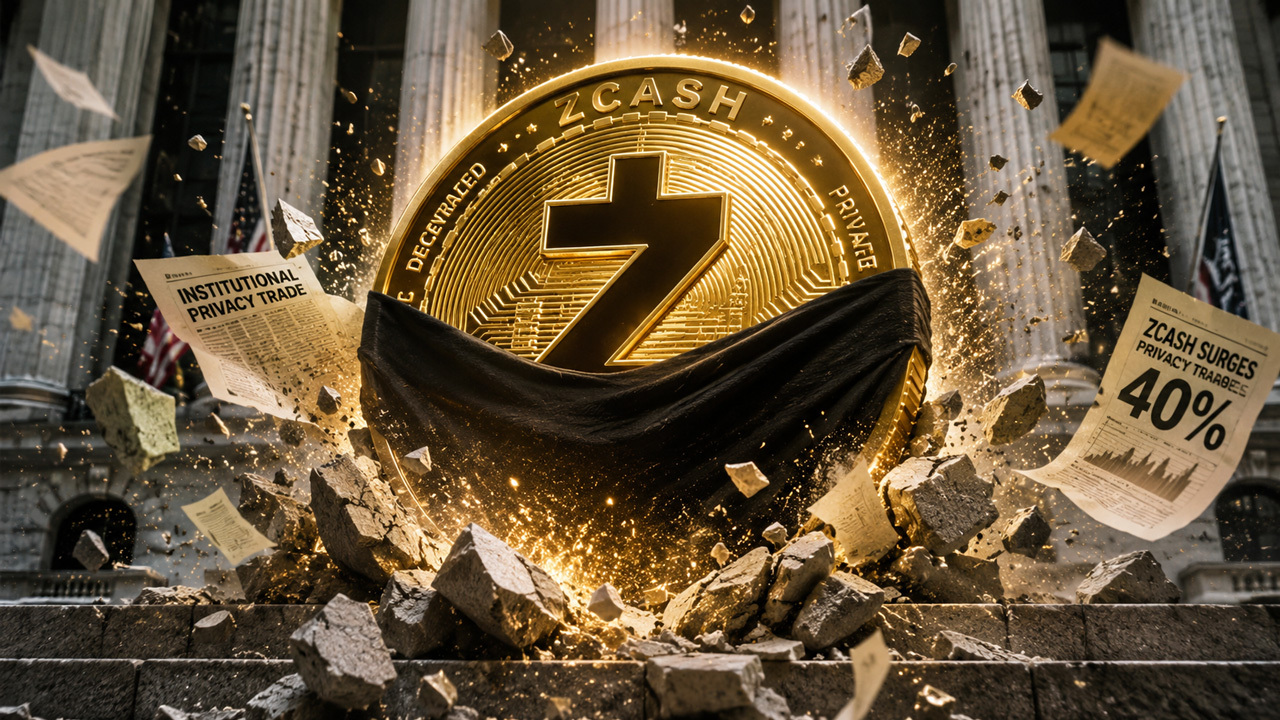
Zcash, a cryptocurrency traditionally associated with digital anonymity, is undergoing a profound metamorphosis, positioning itself as a robust institutional hedge against pervasive global financial surveillance. This transformation is underscored by a remarkable surge in its market performance, as evidenced by data from CryptoSlate. On a recent trading session, Zcash exhibited an extraordinary increase of approximately 40%, briefly surpassing the $600 threshold and reaching a local peak of $603 before stabilizing around $570. This remarkable price action has contributed to an impressive over 100% appreciation over the past month, indicating a potentially seismic shift in investor sentiment and demand.
Fundamental Drivers of Momentum
Arjun Chirumamilla, an investor at HashGraph Ventures, asserts that the current momentum surrounding Zcash is fundamentally driven rather than the result of transient market manipulation. He articulated:
> “You can coordinate pumps… but they never last. You can’t coordinate real tailwinds. When they converge, they become bigger than any one person and persist for years. That’s what’s happening with Zcash: a decade of quiet consolidation, and the convergence of privacy and quantum resistance.”
This perspective highlights the underlying structural shifts that are catalyzing Zcash’s ascent in the cryptocurrency landscape.
The Evolving Cypherpunk Paradigm on Wall Street
Zcash’s inception positioned it within a distinct niche of the cryptocurrency ecosystem; it was designed as a monetary network akin to Bitcoin but with enhanced privacy features that obscure transactional details—such as sender, receiver, and transaction amount. While this design garnered favor among privacy advocates, it also subjected Zcash to intense regulatory scrutiny, effectively precluding its integration into institutional capital flows that have buoyed assets like Bitcoin and Ethereum.
However, this dichotomy is beginning to dissipate. The transparency afforded by Bitcoin’s public ledger has enabled institutions to gain confidence in blockchain settlement and custodial practices while simultaneously revealing the limitations of open financial networks. The traceability of wallet balances, transaction histories, and counterparties is becoming increasingly sophisticated due to advancements in blockchain analytics and artificial intelligence technologies.
Proponents of Zcash contend that this very transparency has engendered a distinct market for private digital currencies. In this emergent narrative:
– Bitcoin is regarded as the preeminent store-of-value asset.
– Zcash is positioned as the vehicle for expressing demand for transactional confidentiality.
The recent announcement from Multicoin Capital—an influential crypto investment firm regarding its substantial accumulation of Zcash—has acted as a significant catalyst for this narrative shift. Tushar Jain, managing partner at Multicoin, elucidated that Zcash stands poised to capitalize on a marketplace increasingly devoid of censorship-resistant financial instruments, particularly in light of aggressive tax policies and wealth-seizure proposals emerging from jurisdictions such as California.
He noted:
> “As the political trend to seize private wealth continues to grow, people and institutions will increasingly seek private assets to protect themselves.”
Jain further contended that:
> “I used to think privacy only mattered for payments, not for SoV. Payments will be in stables so I thought private stables were the solution. I still think privacy matters for payments but now I think that privacy also matters for SoV due to wealth taxes.”
This sentiment resonates with Cypherpunk Technologies—a company supported by Tyler Winklevoss—that has actively pursued the accumulation of Zcash tokens over the past year. Their strategy includes acquiring nearly 295,000 ZEC tokens, representing 1.78% of the asset’s circulating supply with aspirations to ultimately secure 5% of the network.
Will McEvoy, Chief Investment Officer at Cypherpunk Technologies articulated a compelling distinction between Bitcoin and Zcash:
> “If Bitcoin represents an innovation in digital gold, Zcash is its equivalent for private digital cash.”
He underscored the impending challenges posed by artificial intelligence integration into commerce which could amplify corporate and governmental surveillance mechanisms rendering transparent ledgers hazardous for everyday transactions. In McEvoy’s view, an encrypted monetary layer may emerge as an essential safeguard against digital coercion.
Market Mechanics Driving ZEC Price Appreciation
The parabolic trajectory of Zcash is not merely attributable to ideological shifts but is also significantly influenced by market mechanics. A convergence of burgeoning demand alongside artificially constrained supply has created conditions ripe for market volatility—particularly for short sellers.
Data from CoinGlass indicates that Zcash’s open interest has eclipsed $1 billion with derivatives trading volumes surpassing $7 billion within a 24-hour span. Concurrently, this surge precipitated approximately $62 million in futures liquidations predominantly affecting short sellers.
As new buyers entered the market following Multicoin’s announcement coupled with renewed speculation regarding Exchange-Traded Funds (ETFs), a mechanical squeeze ensued. As ZEC ascended rapidly, short sellers were compelled to repurchase positions thereby exerting additional upward pressure on price dynamics. Momentum traders subsequently pursued this upward movement resulting in Zcash’s emergence among the most actively traded cryptocurrencies during this session.
The potency of this market setup is further accentuated by Zcash’s comparatively lower market capitalization and available float relative to Bitcoin or Ethereum. Additionally, a significant portion of its total supply remains secured within shielded addresses while an increasing share of network activity leverages Zcash’s privacy pool. Advocates argue that these factors collectively diminish the immediate availability of ZEC on exchanges thereby rendering it more susceptible to fluctuations in demand.
Prognosis for Zcash’s Pricing Trajectory
As analysts gaze toward future pricing forecasts for Zcash, aggressive long-term targets are emerging predicated on the assumption that Zcash will capture an expanding segment within the digital currency ecosystem—an expectation rooted in evolving perceptions regarding digital anonymity.
Barry Silbert, Chairman of Grayscale Investments, has highlighted historical misconceptions surrounding Bitcoin which led early adopters to erroneously believe it offered comprehensive privacy solutions for value transfer and storage. He posits that as awareness grows around the inherent transparency associated with public blockchains, there exists substantial opportunity for Zcash to gain traction among investors seeking confidentiality.
Grayscale’s internal projections suggest significant upside potential should there be an acceleration in capital rotation towards privacy-centric assets; they emphasize that ZEC’s current valuation constitutes merely 0.3% of the broader currency-focused cryptocurrency sector.
Should Zcash manage to secure even a modest 5% share within this market segment, it could translate into an astonishing eighteen-fold increase in total asset value—albeit with acknowledgment that lower-cap assets like Zcash carry inherently elevated volatility and risk profiles compared to established leaders.
Moreover, industry luminaries such as BitMEX co-founder Arthur Hayes have outlined even more ambitious trajectories suggesting that Zcash could ultimately command 10% of Bitcoin’s total market capitalization.
If these institutional projections materialize as anticipated, the recent price surge may not merely represent an ephemeral spike but rather the commencement of a historic repricing event within the realm of digital financial privacy.