
preferred on

Introduction: The CLARITY Act and Legislative Dynamics
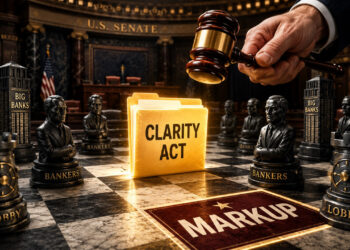
The financial landscape in the United States is currently experiencing a pivotal legislative confrontation as banks intensify their lobbying efforts to impede the progression of the CLARITY Act. This act, formally known as the Digital Asset Market Clarity Act, has garnered bipartisan support in the House of Representatives, successfully passing in July 2025. However, it now faces significant obstacles in the Senate, primarily due to contentious provisions concerning stablecoins and the regulatory framework for yield offerings by digital asset firms.
Current Legislative Landscape
Despite recent bipartisan negotiations aimed at resolving impasses within the Senate, banking institutions have voiced staunch opposition to the drafted provisions. Their argument posits that such language undermines traditional lending practices and precipitates potential capital flight from local economies.
Core Issues: Stablecoin Yield Provisions and Banking Sector Concerns
The principal area of contention resides in the CLARITY Act’s stipulations regarding yield-bearing payment stablecoins. A collective of influential trade organizations—comprising the American Bankers Association, the Bank Policy Institute, the Consumer Bankers Association, the Financial Services Forum, and the Independent Community Bankers of America—has publicly denounced the draft language proposed by Senators Thom Tillis and Angela Alsobrooks.
Perceived Loopholes and Economic Implications
While these banking associations acknowledge the senators’ intention to restrict direct yield payments on stablecoins, they contend that Section 404 of the current draft contains significant loopholes. Specifically, they argue that it allows digital asset exchanges and intermediaries to offer rewards linked to membership programs, provided these are not structured similarly to traditional bank interest payments. This distinction is seen as inconsequential by traditional financial institutions.
The coalition asserts that enabling crypto firms to calculate permissible rewards based on customer duration and account balances incentivizes consumers to retain stablecoins rather than depositing them within traditional banking systems. According to internal research conducted by these organizations, a surge in yield-generating stablecoin alternatives could potentially diminish liquidity for consumer, small-business, and agricultural loans by approximately 20%.
Divided Sentiments within Financial Institutions
Market intelligence indicates a discernible schism within the financial sector regarding opposition to the CLARITY Act. While major retail banks and community lenders remain staunchly against the proposed compromise, other institutions devoid of substantial consumer deposit bases have exhibited a more cautious acceptance of the Tillis-Alsobrooks framework.
Legislative Resilience: Senate Negotiators Stand Firm
In light of mounting pressure from banking lobbyists, legislators are resolutely defending their proposed compromises. Senator Tillis, who has been instrumental in shaping the stablecoin provisions, has characterized the draft as a carefully negotiated balance designed to mitigate risks associated with deposit flight while fostering innovation within the sector.
Concerns Over Regulatory Obstruction
Tillis emphasized that stakeholders from traditional banking had ample opportunity to engage in discussions regarding the language of the bill over preceding months. He underscored that the current text explicitly forbids stablecoin rewards from resembling bank deposit interest while permitting alternative reward structures for digital asset companies. His remarks reflect a growing frustration among lawmakers regarding what seems to be an evolving set of demands from banking representatives.
This frustration is echoed by crypto industry analysts such as Alex Thorn from Galaxy Digital. Thorn suggests that Tillis’s early engagement with banks may have been misguided, as their subsequent repudiation of negotiated compromises reveals a strategic intent focused on obstruction rather than constructive amendment.
The Urgency for Legislative Action
As lobbying intensifies off the Senate floor, there is a palpable sense of urgency among lawmakers to expedite legislative action. Senator Cynthia Lummis has recently articulated a clarion call for decisive action against protracted regulatory uncertainty that has left domestic digital asset firms navigating an ambiguous operating environment.
Legislative Timeline and Strategic Objectives
Lummis reiterated that both market structure language and contentious stablecoin provisions are ready for finalization. The necessity for clarity is underscored by her assertion that without definitive regulatory frameworks, American firms risk relocating their operations overseas—a scenario detrimental to America’s economic prospects.
Senate Banking Chairman Tim Scott has confirmed ongoing efforts toward a bipartisan markup in May aimed at advancing digital asset market structure legislation. Reinforcing this urgency, Senator Bernie Moreno recently projected that legislative momentum generated by previous successful bills could facilitate swift progression through committee.
The Broader Implications for Digital Asset Ecosystems
The ramifications surrounding the CLARITY Act extend far beyond immediate regulatory rights; they encompass fundamental changes in how governmental entities will engage with digital markets. The legislation aims to delineate jurisdictional boundaries between regulatory bodies such as the Securities and Exchange Commission (SEC) and the Commodity Futures Trading Commission (CFTC).
The Stakes for U.S. Economic Competitiveness
A failure to enact this legislation prior to congressional recess in August could precipitate irretrievable capital flight and jeopardize U.S. leadership in the global digital asset landscape. Despite resistance from banking lobbies, prevailing market sentiment appears increasingly optimistic regarding legislative outcomes.
Industry leaders such as Ripple CEO Brad Garlinghouse and Coinbase CEO Brian Armstrong have noted a significant shift toward legislative optimism within key sectors. This sentiment is further corroborated by predictive markets indicating over a 60% probability of the CLARITY Act being enacted into law by 2026.
Conclusion: A Critical Juncture Ahead
As lawmakers prepare for critical committee discussions on May 11, it remains to be seen whether bipartisan momentum can transcend entrenched opposition from legacy financial institutions. The upcoming weeks will be instrumental in determining whether regulatory clarity can be achieved amidst competing interests within this evolving financial ecosystem.