

preferred on

Market Dynamics: Equity Fund Inflows and Money Market Outflows
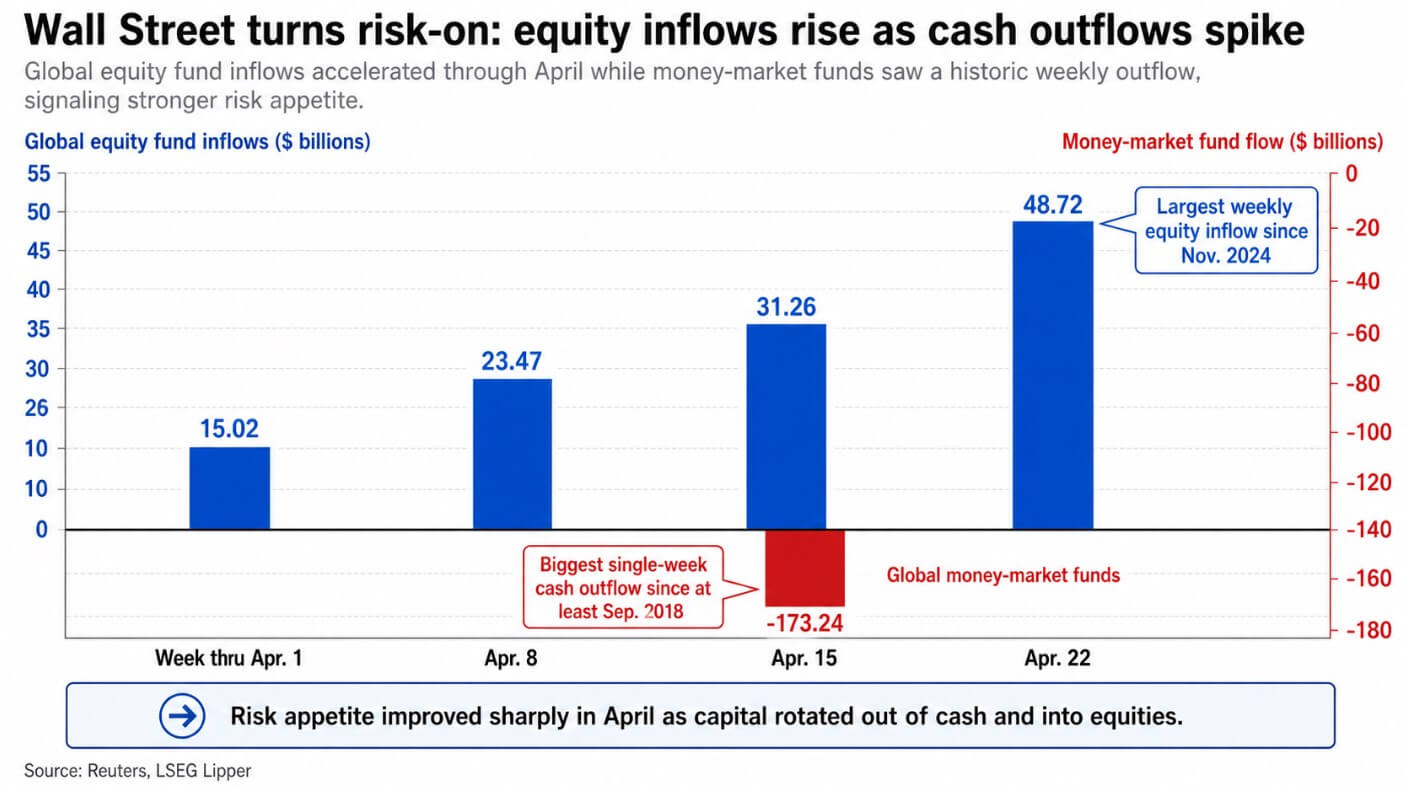
During the week concluding on April 1, global equity funds experienced a net inflow exceeding $15 billion. This trend escalated significantly, with subsequent weeks recording inflows of $23.47 billion, $31.26 billion, and culminating in a substantial $48.72 billion by April 22. Conversely, the global money market funds observed an unprecedented outflow of $173.24 billion in the week ending April 15, representing the most significant single-week exit from cash since at least September 2018.
The juxtaposition of these figures yields a compelling risk-on signal, aggregating approximately $292 billion. This figure emerges from the combined $118 billion in net inflows to global equity funds over the four-week period and the aforementioned $173 billion outflow from cash reserves.
Bitcoin’s Correlation with Traditional Assets
According to the Q2 Institutional Outlook report published by Coinbase and Glassnode, Bitcoin (BTC) demonstrates a daily return correlation of 0.58 with the S&P 500 for the fourth quarter of 2025, whereas its correlation with gold remains negligible. This data underscores a critical observation: as capital shifts toward riskier assets, Bitcoin is increasingly being perceived as an asset class that aligns with such behavior.
Investor Sentiment Analysis
Insights gleaned from a survey conducted by Coinbase among 91 global investors—comprising 29 institutional and 62 non-institutional respondents—between March 16 and April 7 reveal significant sentiment trends within the market. Notably:
– Among institutional participants, 75% perceive Bitcoin as undervalued.
– A similar sentiment is echoed among non-institutional investors, with 61% sharing this perspective.
– Only a minority—7% of institutions and 11% of non-institutions—classify Bitcoin as overvalued.
This data delineates a market landscape wherein substantial participants continue to identify potential for price appreciation, indicating that as capital diverts towards riskier assets, Bitcoin remains an attractive investment that has yet to undergo a euphoric price adjustment.
The On-Chain Landscape: Key Metrics
Recent on-chain analytics reveal pivotal trends regarding Bitcoin’s supply dynamics:
– The movement of BTC supply in the preceding three months witnessed a decline of 37% during Q1, concurrently with an increase of 1% in long-term holders’ supply (those holding for over one year).
– Speculative holders who had acquired Bitcoin at elevated prices have exited during the recent market drawdown, while long-term holders have accumulated additional assets.
– The Puell Multiple decreased to 0.7 during Q1, signifying that miner revenues were approximately 30% below their one-year baseline—a condition historically correlated with accumulation phases.
Statistical Summary of Survey Findings
| Metric | Reading | Implication for BTC Setup |
|---|---|---|
| Institutional respondents viewing BTC as undervalued | 75% | Large investors see potential upside |
| Non-institutional respondents viewing BTC as undervalued | 61% | Constructive sentiment extends beyond institutional realms |
| Institutional respondents viewing BTC as overvalued | 7% | No signs of institutional exuberance |
| Non-institutional respondents viewing BTC as overvalued | 11% | Lack of froth suggests stability in sentiment |
| Survey sample size | 91 global investors | Contextualizes sentiment breadth |
| Institutional sample share | 29 respondents | Defined subgroup analysis for institutional perspectives |
| Non-institutional sample share | 62 respondents | Diversifies sentiment analysis across investor types |
| Survey field dates | Mar. 16 to Apr. 7, 2026 | Ties sentiment to pre-Q2 market conditions |
| BTC correlation with S&P 500 (Q4 2025) | 0.58 | Acknowledges BTC’s behavior as a risk asset |
| BTC correlation with gold | Negligible | Indicates BTC’s deviation from traditional defensive hedges during this economic phase |
| Outlook for Q2 | Undervalued + risk-sensitive | Presents macro risk-on flows supporting BTC without necessitating euphoria. |
The Bullish Perspective: Opportunities Ahead for Bitcoin
If the momentum witnessed in April’s equity rotation persists into other high-yield sectors such as credit markets and emerging markets, Bitcoin stands to benefit significantly from this influx of capital.
The EPFR reported a pronounced resurgence in risk appetite, evidenced by high-yield bond funds recording their first inflow since mid-February and private credit witnessing an eight-week high in inflows.
This scenario creates a conducive environment for institutional investors’ conviction regarding Bitcoin’s undervaluation coupled with an improved on-chain positioning to catalyze significant price appreciation. The survey results indicate that many are currently underexposed; thus, any positive shift in macroeconomic conditions could prompt substantial buying activity.
Potential Price Trajectory and Economic Factors Influencing Bitcoin Valuation
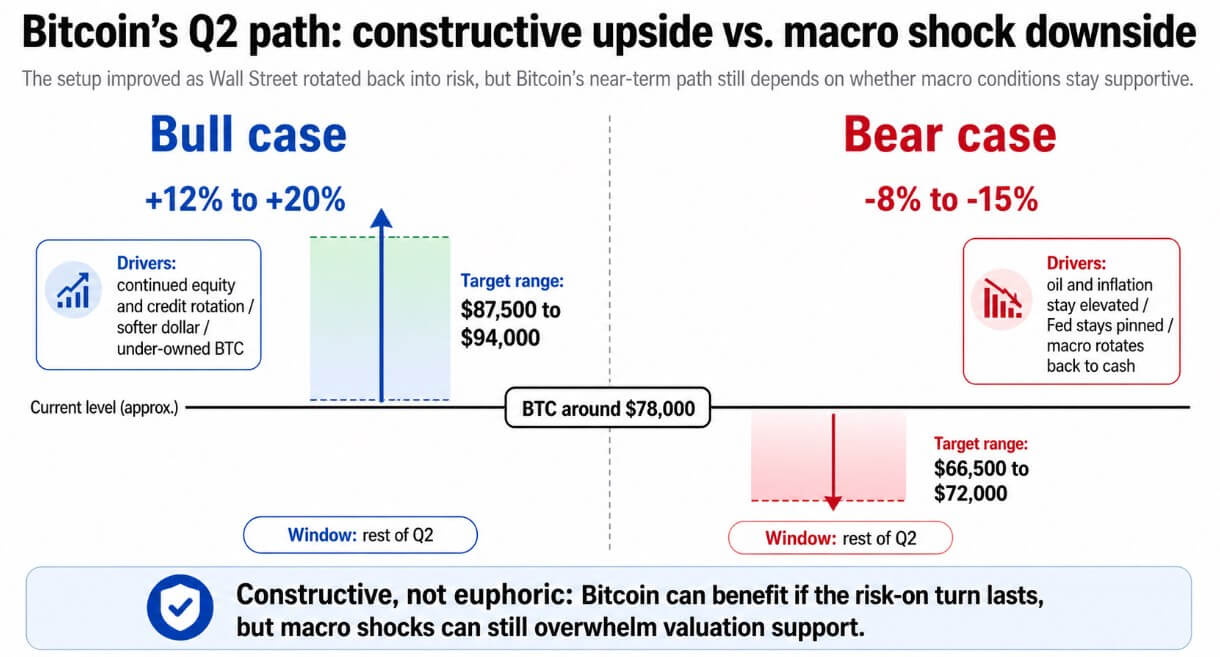
A projected gain ranging from 12% to 20% over the remainder of Q2 would position Bitcoin within the price range of approximately $87,500 to $94,000—potentially driven by sustained institutional capital rotation. Additionally, observed weakening in the U.S. dollar may provide an auxiliary support mechanism for Bitcoin’s ascent.
h2>The Bearish Perspective: Risks and Challenges Ahead
The official stance from Coinbase regarding Q2 remains neutral; critical conditions necessary for a more bullish outlook include resolution of geopolitical tensions such as those in the Middle East, stabilization or reduction in oil prices, and a decrease in inflationary pressures—all of which have yet to materialize.
Persistent high oil prices alongside Federal Reserve policies constrained by ongoing inflation could disrupt Bitcoin’s correlation with equities, transforming it from a supportive factor to one that hinders growth. Should macroeconomic desks revert to cash-oriented strategies akin to those observed in early March, Bitcoin’s role may be perceived as liquidity beta during downturns.
This macro-dominance could overshadow institutional beliefs regarding Bitcoin’s valuation. Despite survey participants’ assertions regarding undervaluation, geopolitical volatility may compel them to maintain cautious positions on the sidelines.
The accumulation data on-chain may still provide a constructive long-term narrative; however, any resurgence of macroeconomic shocks might override these indicators in the short term.
A potential correction ranging from 8% to 15%, translating into price levels between approximately $66,500 and $72,000, would align with historical precedents concerning macro-driven adjustments in Bitcoin pricing; such movements would merely necessitate a return to March-style defensive liquidity flows.
The Path Forward: Navigating Uncertainty and Opportunity in Q2
The trajectory for the remainder of Q2 hinges upon whether April’s equity and credit rotations can sustain momentum or falter upon exposure to subsequent geopolitical developments. Additionally, it remains critical to observe whether Bitcoin’s correlation with traditional equities remains robust or transitions towards a more independent trajectory driven by unique crypto market dynamics.
The bullish narrative largely relies on broader market acceptance of increased risk-taking while acknowledging that Bitcoin’s most informed holders are presently underexposed—a factor that may facilitate recovery once favorable conditions are met.