
preferred on

Analysis of Real-World Assets on the XRP Ledger (XRPL)
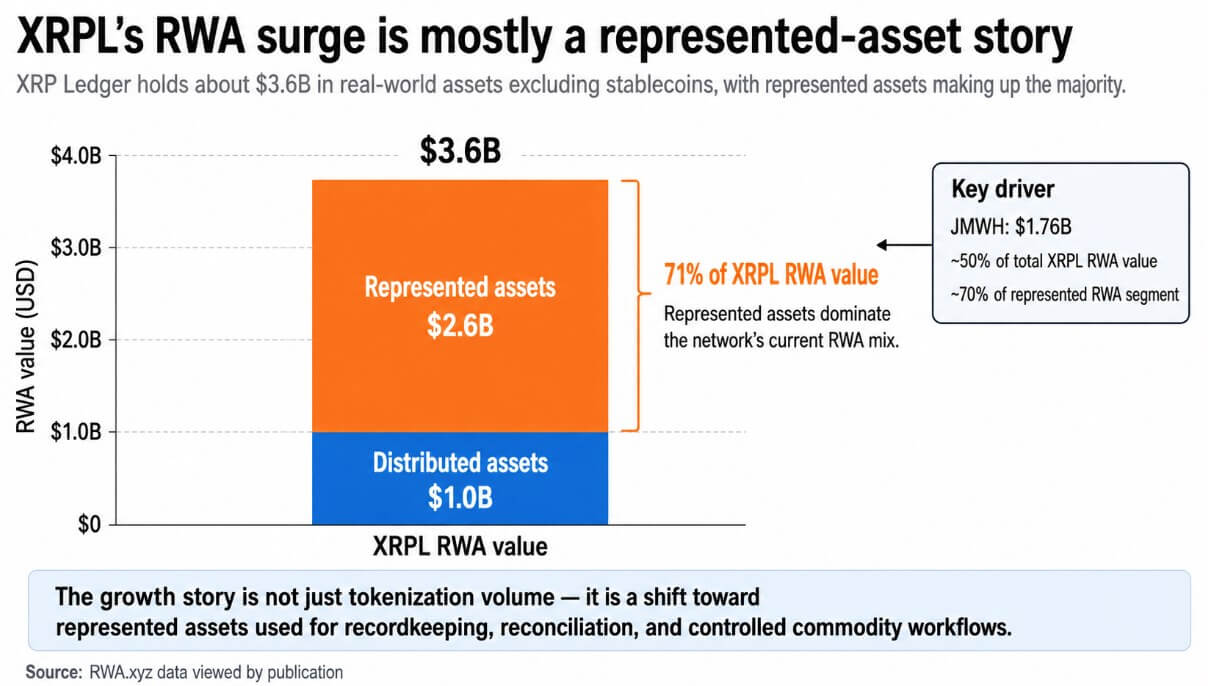
The XRP Ledger (XRPL) currently encompasses approximately $3.6 billion in real-world assets (RWAs), excluding stablecoins, with an allocation of roughly $1 billion in distributed assets and $2.6 billion in represented assets. This distribution reflects a pronounced emphasis, with 71% of XRPL’s RWA portfolio residing within the represented asset category.
Characterization of Distributed vs. Represented Assets
According to RWA.xyz, distributed assets are defined as tokenized assets that possess the capability to be transferred off the issuing platform and exchanged peer-to-peer. In contrast, represented assets remain confined to the issuing platform, where blockchain technology serves to document and reconcile claims associated with tangible assets.
It is noteworthy that the predominant focus within the RWA sector has been on distributed assets. The substantial $2.6 billion allocation of represented assets on XRPL predominantly occupies the infrastructure and recordkeeping segment of this market.
Market Insights and Performance Metrics
The asset page hosted on RWA.xyz indicates that JMWH, a significant player in this space, boasts a total value of $1.76 billion, reflecting a remarkable increase of 104.79% over the past thirty days since its inception date on January 13. Each JMWH token is representative of one real megawatt-hour of energy, underscoring its substantial contribution to XRPL’s overall RWA value, accounting for nearly half of the total and approximately 70% within the represented asset segment.
Rationale for Energy Sector Integration
The commodities sector, particularly in energy, presents multifaceted operational challenges that extend far beyond mere investor accessibility. Key workflows include:
– Production allocation
– Contract execution
– Delivery confirmation
– Consumption tracking
– Billing
– Environmental, social, and governance (ESG) reporting
– Audit trails
These workflows necessitate shared and reliable records among various stakeholders possessing disparate back-office systems.
Justoken, the issuer behind JMWH, specializes in commodities, energy, and natural resources. Their Enertoken initiative, developed in collaboration with Argentine energy producer YPF Luz, positions blockchain as an infrastructural backbone for energy production and trading operations.
A March 2026 announcement highlighted Enertoken’s capabilities in enabling enterprises and large consumers to digitally contract, manage, and monitor energy consumption by integrating cost simulation, contract execution, consumption tracking, billing, and real-time reporting functionalities while enhancing auditability and ESG compliance.
Luke Judges from RippleX articulated that JMWH’s design establishes a verifiable record of ownership and fulfillment where blockchain serves as the ledger for these commitments.
The Suitability of XRPL for Energy Workflows
The inherent feature set of XRPL aligns seamlessly with institutional commodity workflows characterized by stringent control requirements. Its Multi-Purpose Token documentation emphasizes compliance features such as:
– Embedded metadata
– Native authorization capabilities
– Asset freeze options
– Clawback functions
– Delegated administration functionalities
For energy operators, the ability to freeze or restrict token movement is particularly relevant within the represented asset paradigm. Furthermore, embedded metadata supports the traceability and certification data essential for energy sustainability workflows.
Market Dynamics of Tokenized Commodities
As it stands, tokenized commodities across various networks have reached an aggregate value of $8.1 billion in both distributed and represented classifications—a notable increase of 7.43% within a thirty-day period—whereas tokenized U.S. Treasuries are nearing $15 billion.
The commodities sector has attained sufficient scale such that a single energy-linked represented asset possesses the potential to materially alter a network’s RWA profile. Presently, XRPL encompasses a composition of approximately 301 RWA projects alongside a transfer volume reaching $150.8 million within thirty days—reflecting an ongoing network-building initiative centered on commodity and energy infrastructure.
| Element | Commodity / Energy Workflow Need | Why XRPL Fits |
|---|---|---|
| Contract Execution | Track commitments between issuers, producers, and buyers | Native controls and low-complexity asset issuance |
| Consumption Tracking | Monitor real-world energy use and allocation | On-chain metadata and recordkeeping |
| Billing and Reporting | Reconcile invoices and produce real-time reporting | Shared ledger reduces back-office friction |
| Audit Trails | Preserve verifiable records across multiple parties | Immutable records and traceability |
| Compliance Controls | Restrict movement where needed | Authorization, freeze, and clawback features |
| ESG / Certification Data | Attach sustainability and origin information | Rich metadata at the token layer |
| Delegated Administration | Allow institutions to manage assets without custom smart contracts | Native delegated token management capabilities |
Pursuit of Commodity Hub Status
If JMWH serves as a catalyst for broader adoption across commodity workflows utilizing the represented asset model on XRPL, it may precipitate further integration within the energy sector as well as other natural resources sectors.
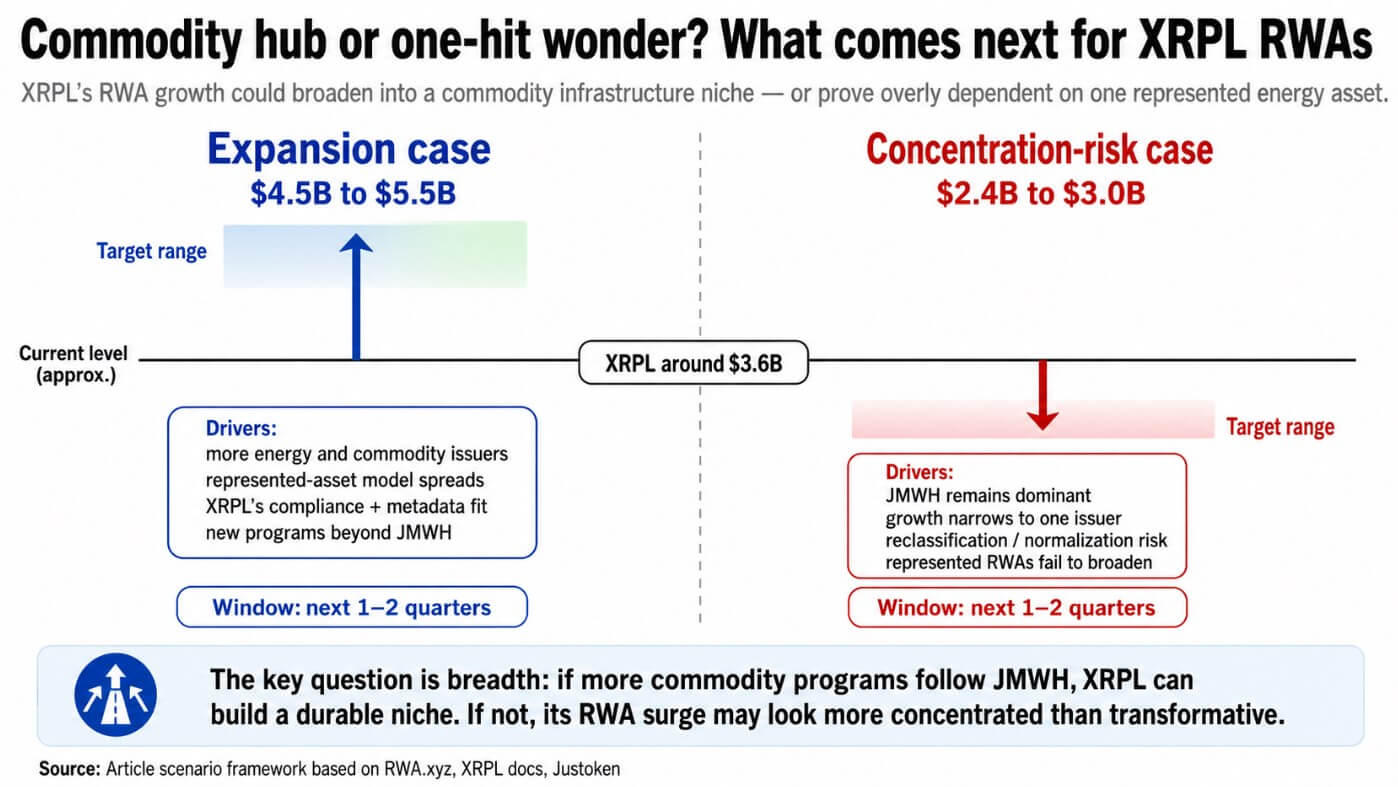
The involvement of YPF Luz as a prominent Argentine energy producer could serve as a pivotal case study; should the Enertoken model gain traction or foster similar partnerships across diverse markets, it is conceivable that XRPL’s RWA valuation could escalate towards an estimated range of $4.5 billion to $5.5 billion over forthcoming quarters.
The data from RWA.xyz indicates that commodities continue to expand across multiple networks; thus, the Enertoken model provides a compelling proof-of-concept demonstrating how blockchain technology can be implemented effectively within operational infrastructures in the energy sector.
Caution Regarding Concentration Risks
The current reliance on JMWH—accounting for approximately half of XRPL’s total RWA value—raises concerns about potential concentration risks inherent in this model. Should growth remain tethered solely to this singular large-scale tokenization initiative by Justoken, XRPL’s standing within the broader RWA landscape could stagnate or regress abruptly.
The uncertainty surrounding measurement metrics adds another layer of risk; should part of this recent valuation surge be attributed to data normalization or reclassification efforts rather than genuine growth in committed real-world energy value, the perceived expansion may be overstated.
The structural limitations associated with represented asset models further exacerbate these risks; tokens confined within controlled platforms prioritize attributes such as auditability and compliance at the expense of broader capital flows attracted toward open distribution models such as decentralized finance (DeFi) initiatives.
If market dynamics continue to favor open distribution models over controlled platforms for RWAs, XRPL’s niche focus on commodity infrastructure may remain constrained; consequently leading total RWA values to potentially retreat towards a range between $2.4 billion to $3 billion if expansion fails to proliferate beyond a limited number of controlled issuances.
Conclusion: Infrastructure Thesis Affirmation for XRPL
The available evidence substantiates an infrastructure-based thesis for XRPL; however, any demand for XRP tokens beyond operational fees remains indirect and challenging to quantify. The trajectory forward hinges upon whether Justoken and YPF Luz can scale Enertoken beyond its current scope or if other comparable issuers across energy or agricultural sectors will adopt XRPL’s represented asset framework effectively.
A burgeoning pipeline incorporating new initiatives spanning multiple commodity categories would affirm XRPL’s specialization in this realm; conversely, if market dynamics remain dominated by JMWH alone—confirming concentration risks—the network’s exposure will heavily rely on a single issuer’s strategic roadmap moving forward.