

preferred on

Concentration of Liquidity in the Crypto Market: An Analytical Perspective
The liquidity landscape within the cryptocurrency market is witnessing a pronounced hyper-concentration, predominantly coalescing around a select number of substantial trading venues. This evolving market structure has elicited cautionary advisories from global central bank researchers, who articulate the potential emergence of a heavily leveraged “shadow crypto financial system.”
Trading Volume Disparities Among Leading Exchanges
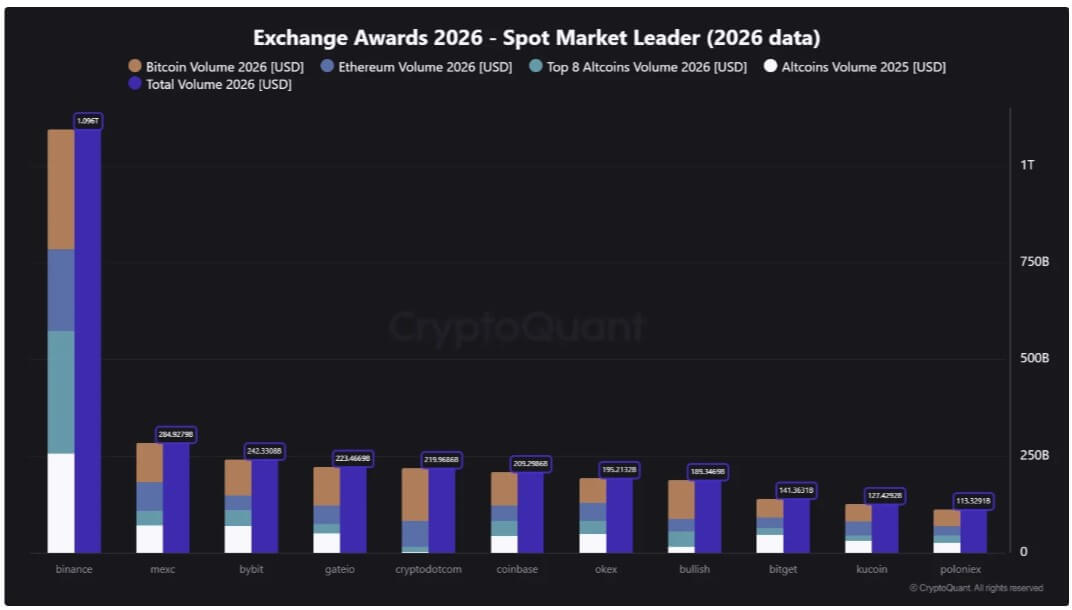
According to data sourced from CryptoQuant, Binance, the preeminent cryptocurrency exchange globally, reported a staggering trading volume exceeding $1 trillion within the initial 112 days of 2026. In stark contrast, rival platforms such as MEXC, Bybit, Crypto.com, Coinbase, and OKX collectively reported volumes significantly lower than Binance:
- MEXC: approximately $284.9 billion
- Bybit: approximately $242.3 billion
- Crypto.com: approximately $219.9 billion
- Coinbase: approximately $209.3 billion
- OKX: approximately $195.2 billion
The Implications of Multifunctional Cryptoasset Intermediaries
The stark volume disparity among exchanges substantiates findings presented in a recent paper by the Financial Stability Institute, published by the Bank for International Settlements (BIS). The research delineates how prominent crypto platforms have transcended their foundational roles in trading and custody to encompass yield products, lending mechanisms, derivatives offerings, staking services, and token-related functionalities.
The paper refers to these trading platforms as “multifunction cryptoasset intermediaries” (MCIs), asserting that they amalgamate roles traditionally delineated among banks, brokers, exchanges, and custodians within conventional finance. Consequently, the BIS has raised pertinent concerns regarding whether these crypto trading venues—attracting substantial liquidity—are evolving into financial intermediaries before regulatory frameworks governing customer assets, leverage dynamics, and liquidity risks have been adequately established.
The Concentration of Liquidity and Associated Risks
Despite enduring numerous exchange failures and regulatory enforcement actions over recent years, the distribution of trading activity across the crypto market remains uneven. According to the BIS report, there exist approximately 200 to 250 active centralized spot exchanges as of 2025; however, trading is predominantly monopolized by a limited cadre of large platforms.
Specifically, Binance is noted to account for roughly 39% of global centralized exchange spot volume while the top ten exchanges cumulatively manage about 90% of overall trading activity. Furthermore, it is estimated that the leading five MCIs collectively cater to an expansive user base of between 200 million and 230 million unique individuals, with a subset of approximately 20 million to 34 million engaging with staking or yield-generating products.
This burgeoning concentration signifies that these major crypto exchanges are evolving beyond mere transactional platforms; they are increasingly positioning themselves as pivotal balance-sheet hubs within a market still devoid of many legal protections characteristic of traditional financial systems. This structural evolution endows the largest venues with an influence that extends beyond typical market share metrics; their order books can significantly impact pricing strategies while their derivatives offerings dictate leverage configurations.
Moreover, their custody systems are becoming repositories for assets employed across various activities including spot trading, margin transactions, staking initiatives, and yield optimization strategies. Binance’s reported early-year trading volume of $1.09 trillion exemplifies the potency of this network effect; traders are consistently gravitating towards those platforms exhibiting the most profound liquidity depth and execution reliability.
The Emergence of Financial Supermarkets in Cryptocurrency Exchanges
The operational paradigm that has propelled large exchanges into positions of commercial dominance is now under scrutiny due to its inherent complexities. Modern crypto platforms are capable of providing an extensive array of services—ranging from spot trading and perpetual futures to custody solutions and yield generation—all consolidated within a singular operational framework. Some entities additionally manage affiliated token ecosystems or other infrastructural components linked to their overarching platforms.
In traditional financial contexts, these diverse services are typically compartmentalized among distinct institutions governed by disparate capital adequacy standards, liquidity mandates, disclosure requirements, and conduct regulations—encompassing banks, brokerages, exchanges, clearinghouses, and custodians which operate within defined regulatory confines. Conversely, the cryptocurrency sector appears to be gravitating towards an integrative operational model whereby users can deposit assets, engage in spot transactions, leverage collateral for borrowing activities, initiate derivative positions with increased leverage potential, and allocate unutilized balances into yield-generating products without necessitating navigation across multiple platforms.
This integrated model effectively retains capital within individual venues; however, it concomitantly complicates efforts by users and regulators alike to disentangle trading risks from credit exposures linked to custody and liquidity considerations. The BIS report posits that MCIs which accept customer assets through investment programs and subsequently utilize these for lending or market-making endeavors assume risks akin to those faced by traditional financial intermediaries—including credit risk, maturity risk, and liquidity risk.
Yield Products Transforming Balances into Credit Exposure
A salient illustration of this phenomenon is encapsulated in the proliferation of earn-and-yield products marketed as vehicles for users to accrue passive returns on dormant cryptocurrency assets. However, the underlying economic implications may prove far more nuanced than initially perceived. Depending on specific contractual terms and conditions, customers may inadvertently relinquish control over their assets to these platforms—permitting utilization for activities such as staking or lending without adequate safeguards.
The BIS paper highlights that certain arrangements may result in customers possessing merely an unsecured claim against the intermediary rather than a legally protected entitlement to specific assets. In practical terms, users might misconstrue these products as akin to conventional savings accounts while their legal ramifications resemble those associated with loans extended to the platform itself—a critical distinction that could carry severe consequences during periods of financial distress.
In stark contrast to banking clients who typically benefit from a robust framework characterized by capital requirements and deposit insurance protocols designed to mitigate risks during crises—such as access to central bank liquidity—customers engaged with yield products on crypto exchanges may find themselves devoid of comparable safeguards. In instances where a platform encounters withdrawal challenges or suffers significant trading losses, affected customers may emerge as unsecured creditors lacking recourse.
Case Studies: Lessons from Celsius Network and FTX
The BIS cites notable examples such as Celsius Network and FTX’s bankruptcy proceedings as illustrative cases where such vulnerabilities have manifested dramatically. Celsius’s yield offerings were predicated on leveraging lending dynamics coupled with liquidity transformation strategies; when adverse market conditions prompted consumer withdrawal demands en masse, the platform faltered under pressure.
Conversely, FTX’s structural issues exemplified another variant of this systemic challenge—where customer asset entanglement with proprietary trading activities exacerbated risk exposure at an organizational level. These case studies hold valuable insights today; contemporary exchanges are larger and more intricately interwoven into the cryptocurrency market infrastructure than many firms that collapsed in previous years.
The Dynamics of Leverage in Market Stress Scenarios
The BIS’s cautionary observations extend beyond customer protection considerations into broader market structural implications. Crypto derivatives markets exhibit continuous operational characteristics while frequently relying on automated liquidation mechanisms—often contingent upon collateral whose valuation can swiftly diminish within minutes. When leverage becomes concentrated across dominant venues that also govern spot liquidity dynamics, price shocks can precipitate liquidation events before human intervention can occur.
An illustrative instance is highlighted in relation to the October 2025 flash crash—a significant event that resulted in approximately $19 billion worth of forced liquidations across the crypto derivatives markets affecting over 1.6 million traders. This episode underscored how tightly interconnected leverage dynamics are with collateral valuations and automated risk management systems amidst concentrated venue operations.
Market observers attributed some responsibility for this incident to Binance’s operational methodologies; a pronounced macroeconomic shift adversely influenced spot prices leading to collateral devaluation—thereby triggering margin calls which initiated liquidations that further exacerbated downward price movements across affected assets.
The Potential Ripple Effects Across Financial Markets
This feedback loop—while not unique to cryptocurrency markets—can be considerably expedited by emerging structural frameworks characteristic of digital asset exchanges. Major trading venues occupy a central role within this ecosystem as they host essential liquidity pools alongside collateral accounts required for derivative positions through which deleveraging events transpire. A transient outage or liquidity shortfall at a dominant venue could potentially reverberate throughout broader market ecosystems beyond its immediate user base.
Regulatory Challenges Amidst Evolving Business Models
The confluence of these developments poses formidable challenges for regulators tasked with overseeing this rapidly evolving landscape wherein leading crypto platforms no longer conform neatly within pre-existing regulatory categories. A singular entity may concurrently assume multiple operational roles—including but not limited to exchange functions, custodianship responsibilities, brokerage services provision, lending facilitation processes as well as staking operations—all potentially falling under disparate oversight frameworks depending on jurisdictional parameters.
The BIS report advocates for establishing prudential requirements specifically tailored for MCIs engaged in financial intermediation activities; these could encompass mandates related to capital adequacy buffers alongside enhanced governance standards complemented by rigorous stress-testing protocols aimed at ensuring effective risk management practices while simultaneously safeguarding customer asset segregation principles.
Such an approach would represent a paradigm shift from primarily categorizing large-scale crypto firms as mere trading platforms towards recognizing their operational similarities with traditional financial conglomerates—a transition necessitating rigorous scrutiny surrounding balance-sheet risk management capabilities alongside customer protection measures during periods characterized by heightened liquidity stress or systemic failures.
This urgency intensifies further given increasing interlinkages between traditional finance sectors—including exchange-traded products integration along with institutional custodial arrangements vis-a-vis stablecoin reserves—and their crypto counterparts—a development underscored by warnings from BIS indicating that disruptions originating from significant platforms could impart ramifications extending well beyond confines delineated solely by cryptocurrency ecosystems.