

preferred on

Current Dynamics of Bitcoin Trading: A Critical Analysis of Market Behavior
The cryptocurrency market is presently embroiled in a high-stakes contest as Bitcoin grapples with the significant psychological threshold of $80,000. This pivotal juncture marks an intersection where long-term holders, motivated by recent price surges, are realizing substantial profits while institutional capital, increasingly directed towards exchange-traded funds (ETFs), mitigates the effects of sell-offs and sustains optimism for an impending rally toward $90,000.
Market Transition: From Volatility to Renewed Bullish Momentum
Bitcoin is navigating a critical transitional phase characterized by months of pronounced volatility and largely sideways trading. Recent market activity indicates a resurgence of bullish momentum, albeit contested by veteran investors who are strategically reallocating their holdings into newly generated liquidity. This reallocation reflects a broader trend wherein seasoned investors leverage favorable market conditions to lock in profits.
The Wealth Transfer Phenomenon at $80,000
As Bitcoin ascended from $78,000 to the psychologically significant $80,000 mark over the weekend, on-chain analytics underscored a pronounced increase in distribution patterns among seasoned investors. Data from Glassnode reveals that holders who accumulated their positions two to three years ago have accelerated profit-taking activities to an extraordinary rate of $209 million per hour, with gains ranging between 60% and 100% for these investors.
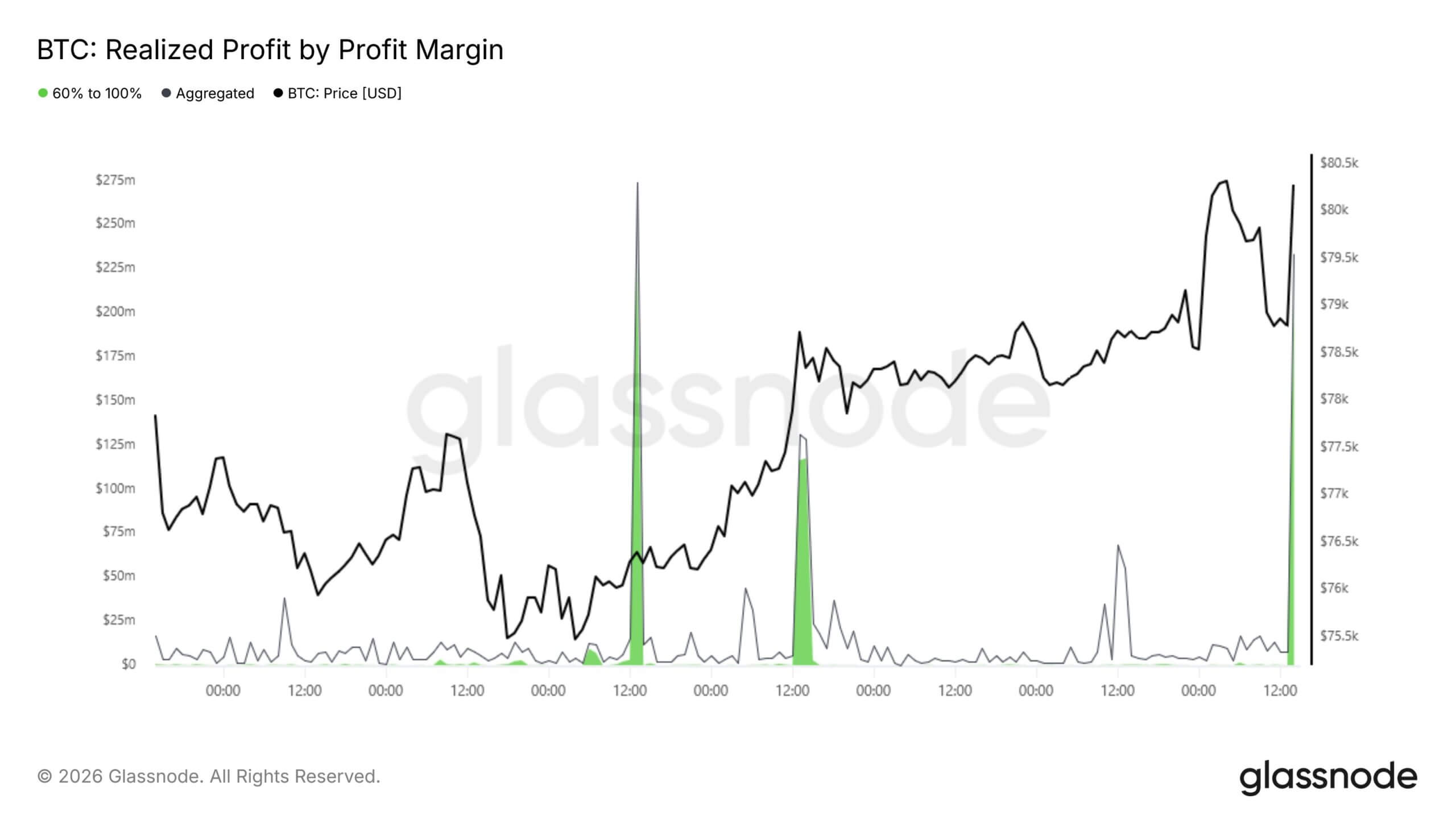
This behavioral shift is corroborated by metrics from CryptoQuant, which indicate that net realized profit and loss across the network has surged to approximately $1.12 billion—the highest level of realized gains since the previous December. Such a significant threshold suggests that traders who accumulated positions during previous bear market lows are now positioned to realize substantial returns, prompting them to rebalance their portfolios and convert digital assets into fiat currency.
In contrast to traditional equity markets, where massive sell-offs often induce panic, the cryptocurrency landscape interprets this magnitude of profit-taking amid rising prices as indicative of underlying market vitality. Analytics firm Santiment elucidates that this phenomenon serves as a real-time stress test for Bitcoin; the ability of the asset to maintain its value despite substantial liquidity being injected into the market reflects robust demand dynamics.
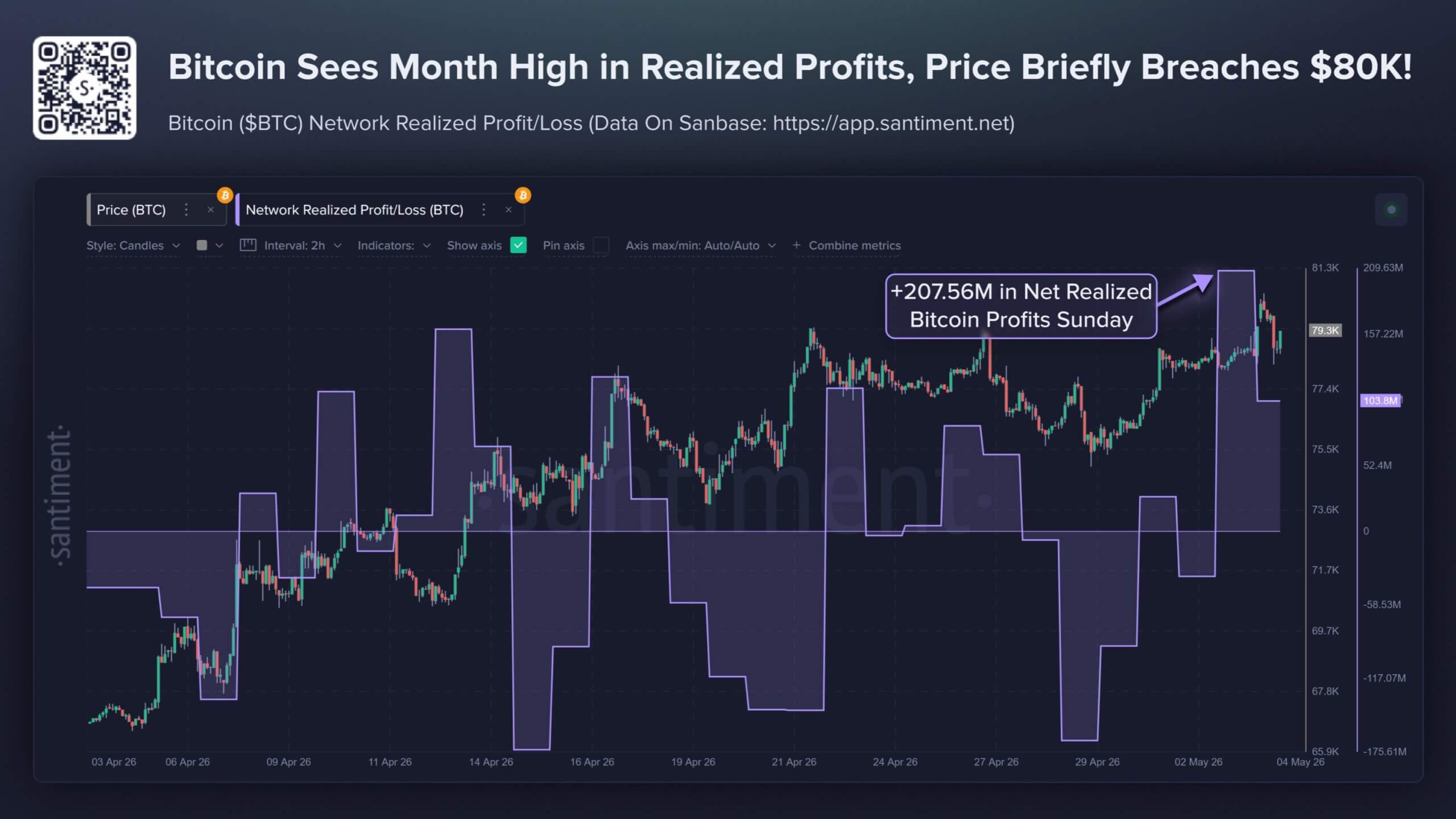
Moreover, this distribution cycle serves a structural purpose by resetting the market’s cost basis. As older, highly profitable positions are liquidated, they are absorbed by new entrants entering the market at around the $80,000 level. Statistically, these new buyers exhibit lower tendencies to panic sell during minor fluctuations, thus establishing a more robust price floor beneath current activities.
Institutional Demand and ETF Dynamics Altering Market Landscape
The primary catalyst behind this absorption phenomenon is the sustained success of spot Bitcoin exchange-traded funds (ETFs). Following a temporary lull in interest earlier this year, there has been a remarkable resurgence in appetite for these regulated investment vehicles, indicating resilience that is reshaping the fundamental architecture of the market.
Data compiled by SoSoValue reveals that within just the first two trading days of May, spot Bitcoin ETFs attracted over $1.1 billion in fresh capital. Notably, BlackRock’s iShares Bitcoin Trust (IBIT) accounted for more than $600 million of these inflows. Observers highlight that the nature of these flows is shifting towards a bullish trajectory; outflow streaks are becoming shorter and less severe while periods of sustained inflows are increasingly prolonged.
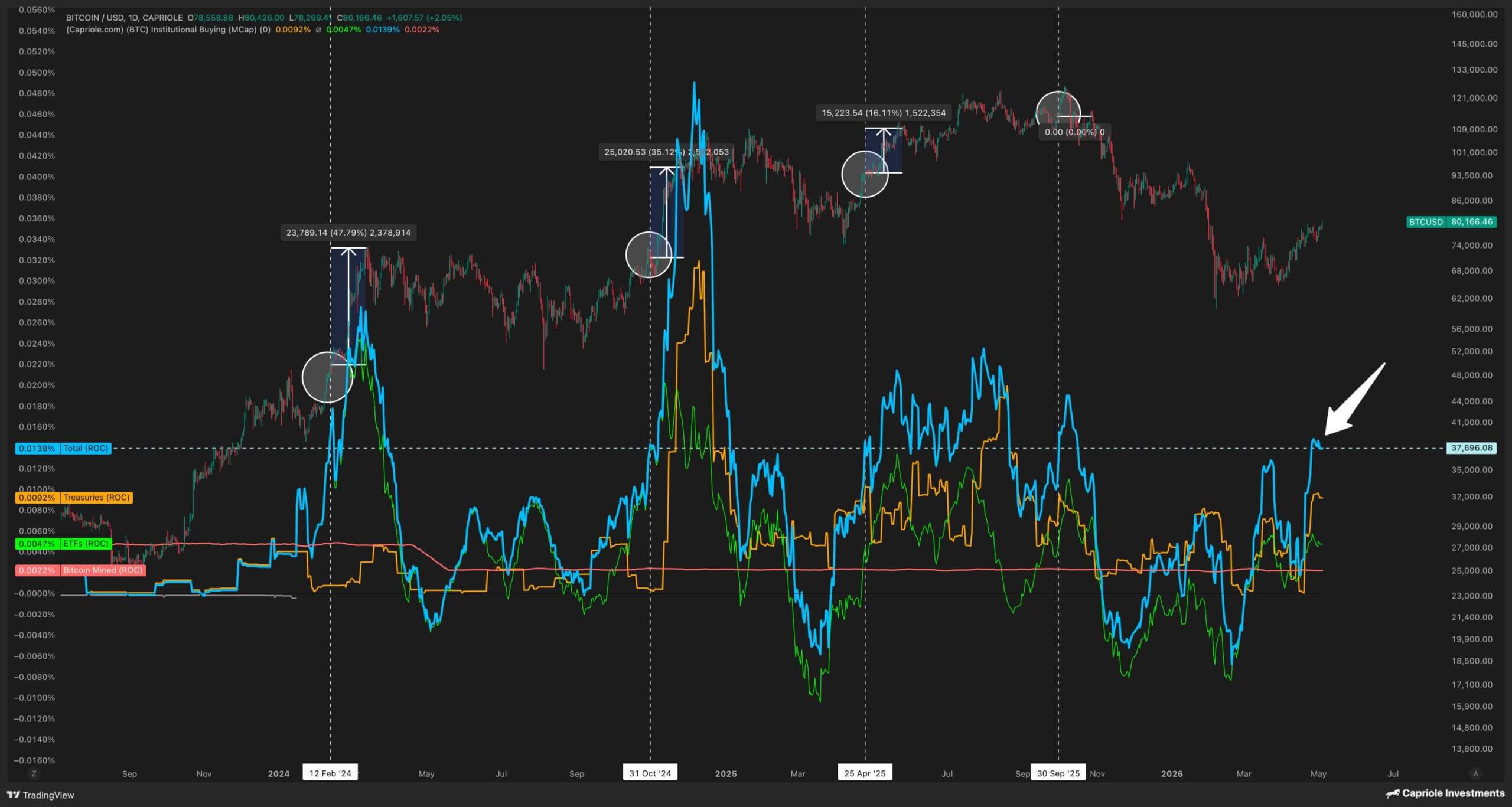
This persistence is critical; Bitcoin’s appreciation does not necessitate explosive multi-billion-dollar daily inflows but rather requires consistent daily demand facilitated by ongoing ETF purchases. Consequently, institutional participation is fundamentally altering supply-and-demand dynamics within the Bitcoin ecosystem. Charles Edwards, founder of Capriole Investments, notes that institutional buyers currently absorb over 500% of the daily Bitcoin supply produced by miners. Historical precedents suggest that such levels of supply absorption have historically resulted in average returns of approximately 24% within subsequent months—a trend that could propel Bitcoin towards $96,000 by June.
The Derivatives Market: Short Sellers Facing Liquidation Pressure
While spot accumulation provides a steady upward tailwind for Bitcoin’s price trajectory, dynamics within the derivatives market introduce significant potential for explosive price movements. Traders engaging in bearish positions have faced a relentless series of liquidations which have effectively transformed underwater positions into catalysts for upward price surges.
Independent analyst Axel Adler reports that bearish traders have endured approximately $7.88 billion in forced liquidations since early February. Despite undergoing multiple punitive squeezes, short sellers persist in establishing new positions near the $80,000 resistance level only to be forcibly closed out by market movements.
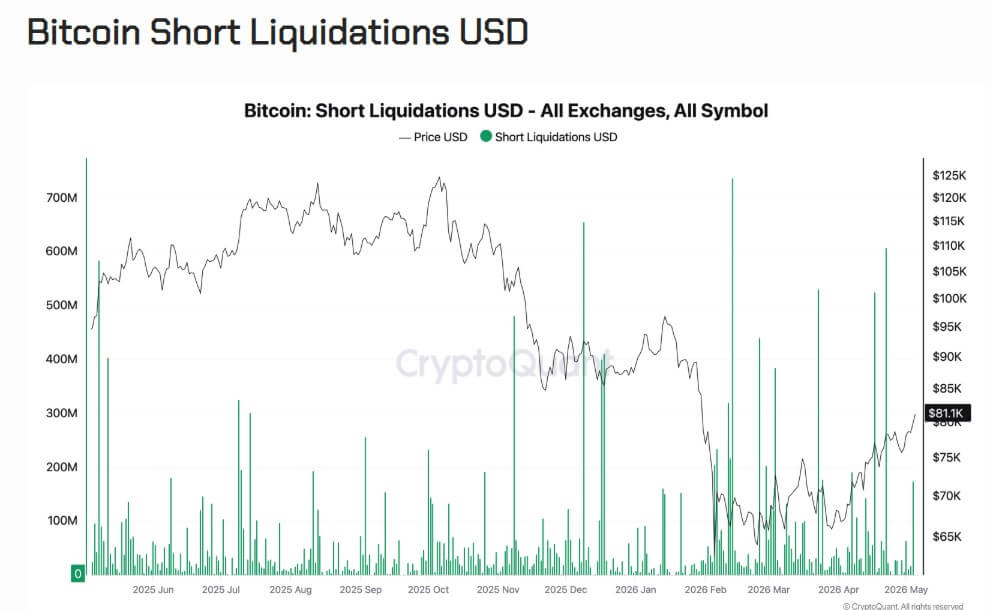
This pattern has unfolded in three distinct waves over recent months, with forced closures routinely surpassing half a billion dollars within a single day. After a relative calm period in late April, liquidation volumes surged again on May 4 to $175 million—underscoring vulnerability as short interest continues to accumulate just below the critical $80,000 threshold.
If Bitcoin can decisively breach and maintain its position above this level, prevailing market mechanics suggest that subsequent liquidation events could become self-reinforcing.
Macro Forces and Legislative Developments: A Broader Context
Despite inherent bullish tendencies within on-chain architecture and institutional appetites for Bitcoin exposure, macroeconomic forces and geopolitical developments remain pivotal factors influencing price dynamics. Recently, Bitcoin demonstrated resilience against various macroeconomic headwinds—including Federal Reserve policy adjustments and crude oil price fluctuations—by maintaining its overarching uptrend.
Notably, market maker Wintermute emphasized that Bitcoin’s ability to consistently close near its range’s upper limit for three consecutive weeks amidst external pressures signals formidable strength. However, significant technical hurdles remain; Bitcoin has repeatedly failed to secure closes above its pivotal 200-day moving average—currently hovering around $82,000—since late 2025. A definitive break above this threshold would constitute an unequivocal signal of trend reversal.
Trading firm QCP echoed this sentiment by indicating that the true litmus test for sustaining bullish momentum lies in achieving a clean weekly close above the CME futures gap situated between $82,000 and $83,000. Until such conditions materialize, erratic price action may persist as the most likely outcome.
Additionally, geopolitical developments and U.S. policy decisions are likely to play instrumental roles in determining whether such breakout conditions are met. Recent announcements from Washington regarding tensions in the Strait of Hormuz have temporarily bolstered confidence among risk assets while declining implied volatility suggests markets are adjusting expectations towards de-escalation in Middle Eastern tensions.
If macroeconomic stability is sustained and energy shocks avoided, there exists ample opportunity for digital assets—including Bitcoin—to ascend alongside broader equity markets.
The Legislative Landscape: Prospects for Regulatory Clarity
Contributing further to bullish sentiment is prospective legislative progress within the United States. The digital asset industry is closely monitoring developments surrounding the CLARITY Act—a landmark bill aimed at establishing comprehensive market structure—which is scheduled for bipartisan markup in May. The potential for regulatory clarity is already mitigating institutional hesitance toward engagement with digital assets.
Tom Lee from BitMine articulated this viewpoint succinctly:
“Crypto Spring has commenced; similar to previous cycles, investor sentiment remains muted and bearish even amidst strengthening crypto prices. We believe that either passage or failure of the CLARITY Act will affirm our perspective regarding ‘crypto spring’.”
In conclusion, the ongoing struggle at the $80,000 mark encapsulates Bitcoin’s broader maturation process as it transitions from a primarily retail-driven speculative instrument towards becoming an institutional mainstay. Should persistent ETF demand withstand macroeconomic uncertainties alongside veteran profit-taking activities, there lies potential for an unprecedented ascent towards the emblematic milestone of $90,000.