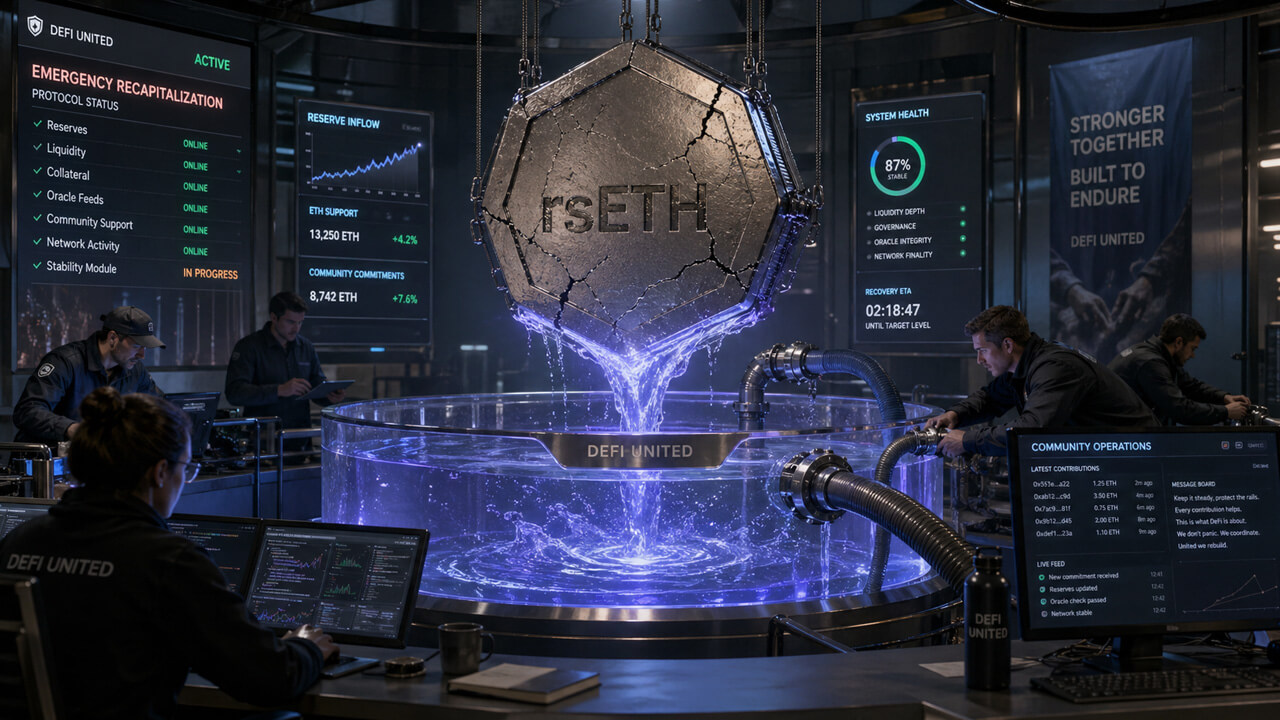
Analysis of DeFi United’s Emergency Recapitalization Efforts
The DeFi United initiative has emerged as a pivotal mechanism within decentralized finance, successfully amassing over 69,550 ETH through contributions from 222 distinct wallets across a total of 1,623 transactions. This substantial financial mobilization aims to restore the backing of rsETH, effectively positioning DeFi United as an analogous entity to a lender of last resort—a construct that operates devoid of regulatory oversight, central banking authority, or formalized mandates.
Current Funding Landscape and Shortfall Analysis
A governance proposal from Aave has identified the original shortfall of rsETH to be approximately 163,183 ETH. Through a combination of recoveries and freezes—including:
- 43,168 ETH from Kelp
- 30,766 ETH frozen by the Arbitrum Security Council
- Up to 12,323 WETH from Aave liquidations
- 1,845 WETH from Compound
—the effective funding gap has been mitigated to approximately 75,081 ETH. The current contributions from DeFi United cover roughly 92.5% of this residual gap, which translates to about 5,632 ETH remaining unaccounted for. A broader overview indicates commitments totaling 100,200 ETH against a target of 116,500 ETH when factoring in the recovery pathway initiated by Arbitrum—yielding an overall coverage rate of approximately 86%.
However, it is crucial to note that these figures are somewhat misleading; while they suggest imminent closure on the funding gap, numerous significant contributions await governance votes and several key participants have yet to disclose their financial input.
Graphical Representation of Funding Recovery
The Genesis of the Funding Shortfall
The vulnerabilities within KelpDAO’s architecture were laid bare when its rsETH bridge was configured in a one-of-one arrangement with LayerZero Labs as the sole verifier. An investigative report by Galaxy found that the assailant exploited this structural weakness to liberate 116,500 rsETH from Ethereum’s mainnet escrow. Subsequently, these illicitly obtained tokens were leveraged as collateral across multiple platforms including Aave, Compound, and Euler to procure an estimated $236 million in WETH and wstETH.
Within a mere span of 48 hours post-incident, the total value locked (TVL) across DeFi platforms plummeted by approximately $13 billion—Aave alone witnessing a staggering decline of about $8.45 billion in TVL. Concurrently, WETH utilization reached its zenith at 100%, indicative of user panic and swift withdrawals that led to USDT and USDC pools becoming fully utilized.
LayerZero’s official statement regarding the incident characterized it as RPC poisoning targeting infrastructure used by its decentralized validator network (DVN), although it refrained from attributing direct fault to flaws within the LayerZero protocol itself. The dependency on LayerZero Labs as the singular verifier concentrated risk within a solitary node of trust—a circumstance that DeFi United acknowledges with its designation of LayerZero as “Confirmed, TBD.” The absence of transparency regarding LayerZero’s contribution remains one of the most consequential gaps in ongoing recovery discussions.
Key Contributors and Their Implications
| Contributor | Status | Amount | Significance |
|---|---|---|---|
| Mantle | Pending vote | 30,000 ETH | Largest disclosed contribution; crucial for bridging the funding gap. |
| Aave DAO | Pending vote | 25,000 ETH | Core treasury backstop; serves as a test case for DAO’s willingness to absorb losses. |
| Stani Kulechov | Committed | 5,000 ETH | A personal commitment from the founder enhances credibility. |
| EtherFi | Pending vote | 5,000 ETH | Significant ecosystem support prior to governance finalization. |
| Lido | Pending vote | 2,500 ETH | Pivotal in setting precedents for loss coverage beyond its own protocol. |
| Golem Foundation | Committed | 1,000 ETH | An endorsement from a recognized ecosystem participant. |
| Emilio Frangella | Committed | 500 ETH | A visible individual contribution reinforcing public coordination. |
| BGD Labs + Ernesto | Committed | 350 ETH | Tied closely to Aave’s risk and governance frameworks. |
| LayerZero | Confirmed, TBD | TBD | A significant undisclosed contribution given the incident’s reliance on LayerZero infrastructure. |
| Ethena | Confirmed, TBD | TBD | A material participant with undisclosed amount yet. |
| Ink Foundation | Confirmed, TBD |
TBD | A material participant with undisclosed amount yet. |
| Frax Finance | Confirmed, TBD |
TBD | A material participant with undisclosed amount yet. |
The Case for Coordination without Central Authority
The formation of DeFi United transpired without any regulatory directive or central authority intervention. Before Aave’s treasury proposal was even slated for governance discussion, an initial assembly comprising EtherFi, Lido, Mantle, Ethena, Ink Foundation, BGD Labs, Emilio Frangella, Ernesto, and Aave founder Stani Kulechov had collectively pledged an impressive sum of 14,570 ETH.
The contributors currently identified include Mantle (30,000 ETH pending vote), Aave DAO (25,000 ETH pending vote), Kulechov (5,000 ETH committed), EtherFi (5,000 ETH pending vote), Lido (2,500 ETH pending vote), Golem Foundation (1,000 ETH committed), Frangella (500 ETH committed), and BGD Labs plus Ernesto (350 ETH committed). Notably absent are disclosed amounts from LayerZero and other entities such as Ethena and Frax Finance.
Aave’s ARFC frames its participation under a “No Ghost Left Behind” ethos—a reference to the DAO’s previous decision to directly address CRV-related bad debt and thereby shield suppliers from socialized losses. This framing presents a compelling argument for self-governance capacities within this emergent financial landscape.
Centrally Embedded Challenges in Decentralized Rescue Mechanisms
Aave’s proposal empowers Aave Labs to negotiate loans and settlements while also facilitating under-collateralized lending arrangements and future token sales. Mantle’s contribution is structured as a credit facility designed for eventual repayment through subsequent donations without altering Aave’s treasury requirements.
Aave’s calculations regard the Arbitrum Security Council’s frozen sum of 30,766 ETH as recoverable only through further governance action—an aspect outside DeFi United’s jurisdiction. This situation is similarly applicable to KelpDAO’s reopening withdrawals and LayerZero’s reactivation of bridge functionalities.
The intervention executed by Arbitrum raises critical questions about decentralization principles. An emergency powers council has exercised authority over tens of thousands of frozen ETH linked to the exploit while transferring assets into a controlled intermediary wallet. This action has both mitigated potential damage yet simultaneously introduced complexities into narratives surrounding decentralization versus centralized control during crises.
The Governance Discourse: Challenges Ahead
The discourse emerging within Aave’s governance forum reflects the tensions inherent in this scenario. One commentator acknowledges that while the recovery calculations are accurate, they argue against proceeding with Snapshot voting until a collateral-risk framework is adopted—one that would have precluded rsETH from being listed under such parameters. In this view:
- Paying immediate debts without addressing foundational issues: This approach merely postpones future crises rather than resolving existing vulnerabilities.
A contrasting voice asserts that those primarily responsible for creating these vulnerabilities contribute less than their proportional burden on Aave’s resources. Lido’s concurrent forum discussions sharpen these issues around precedent-setting contributions: while proposing up to 2,500 stETH only as part of a fully funded recovery package—citing potential exposure risks for its own EarnETH vault—delegates openly debate whether such contributions constitute mere donations or should necessitate preferential terms based on responsibility levels regarding collateral risk management.
Divergent Scenarios: Pathways Forward for DeFi Recovery Efforts
The potential outcomes hinge upon forthcoming governance decisions and external actions:
- Bull Case: If governance votes pass expeditiously and Kelp alongside bridge-side mechanics reopen smoothly while pending contributors finalize their commitments—this scenario could establish a model for cross-protocol crisis coordination within DeFi. It would affirm that decentralized finance can self-insure against significant exploits without external backstops while simultaneously functioning effectively during infrastructure failures.
- Bear Case: Should major votes falter or external recovery actions encounter delays—especially concerning politically charged issues like Arbitrum’s freeze—the disclosed contributions from LayerZero may fall short relative to expectations set by its pivotal role in system failures. In this case,Aave may endure prolonged exposure to residual impacts while governance backlash crystallizes around accountability for inadequate collateral configurations.
| Scenario Description | Description | User Impact | DeFi Implications | ||||||
|---|---|---|---|---|---|---|---|---|---|
| Bull Case | If all pending votes pass smoothly while external recovery steps unfold effectively< td > Normalization of rsETH backing; users avoid prolonged uncertainty< td > Demonstrates capacity for rapid self-insurance against large-scale failures< tr > | Bear Case | If major votes slip or external recovery steps stall< td > Extended delays create uncertainty; users remain dependent on governance dynamics< td > Illustrates fragility within decentralized structures when faced with critical failures< tr > | Key Dependencies | Outcomes hinge upon Arbitrum governance decisions or actions taken by KelpDAO< td > Users face both funding risk alongside coordination-related uncertainties< td > Centralized control emerges at key decision points despite decentralized branding< tr > | Governance Lessons | Rescue funds mobilized before resolution on collateral-risk frameworks can be established< td > Users may receive immediate restitution but future listing standards continue facing scrutiny< td > Highlights discrepancies between rapid recovery measures versus preventive consensus-building processes< tr > | Long-term Consequences | If rescue succeeds followed by reforms adoption< td > Confidence stabilizes; market skepticism towards bridge-backed collateral increases< td > Bailout politics become integral components within “decentralized” finance frameworks |
The potential efficacy of DeFi United in closing existing gaps provides hope for restoring rsETH backing while validating decentralized protocols’ ability to withstand substantial exploits without systemic collapse. Yet simultaneously exposes underlying vulnerabilities inherent within its operational architecture—characterized by dependencies on governance structures that remain contingent upon collaborative decision-making amidst crises driven predominantly by influential stakeholders within this emerging landscape.
This interplay between decentralized aspirations and centralized interventions encapsulates broader themes surrounding credible neutrality until significant losses necessitate reliance on those wielding authoritative keys during critical junctures in crisis management efforts within decentralized finance ecosystems.