preferred on

Bitcoin’s Recent Price Dynamics: An Analytical Overview
On April 22, Bitcoin (BTC) achieved an intraday peak of $79,485, propelled by a resurgence in broader risk assets that were buoyed by optimism stemming from a recent ceasefire. This development has significant implications for market sentiment and investor behavior.
Market Thresholds and Behavioral Economics
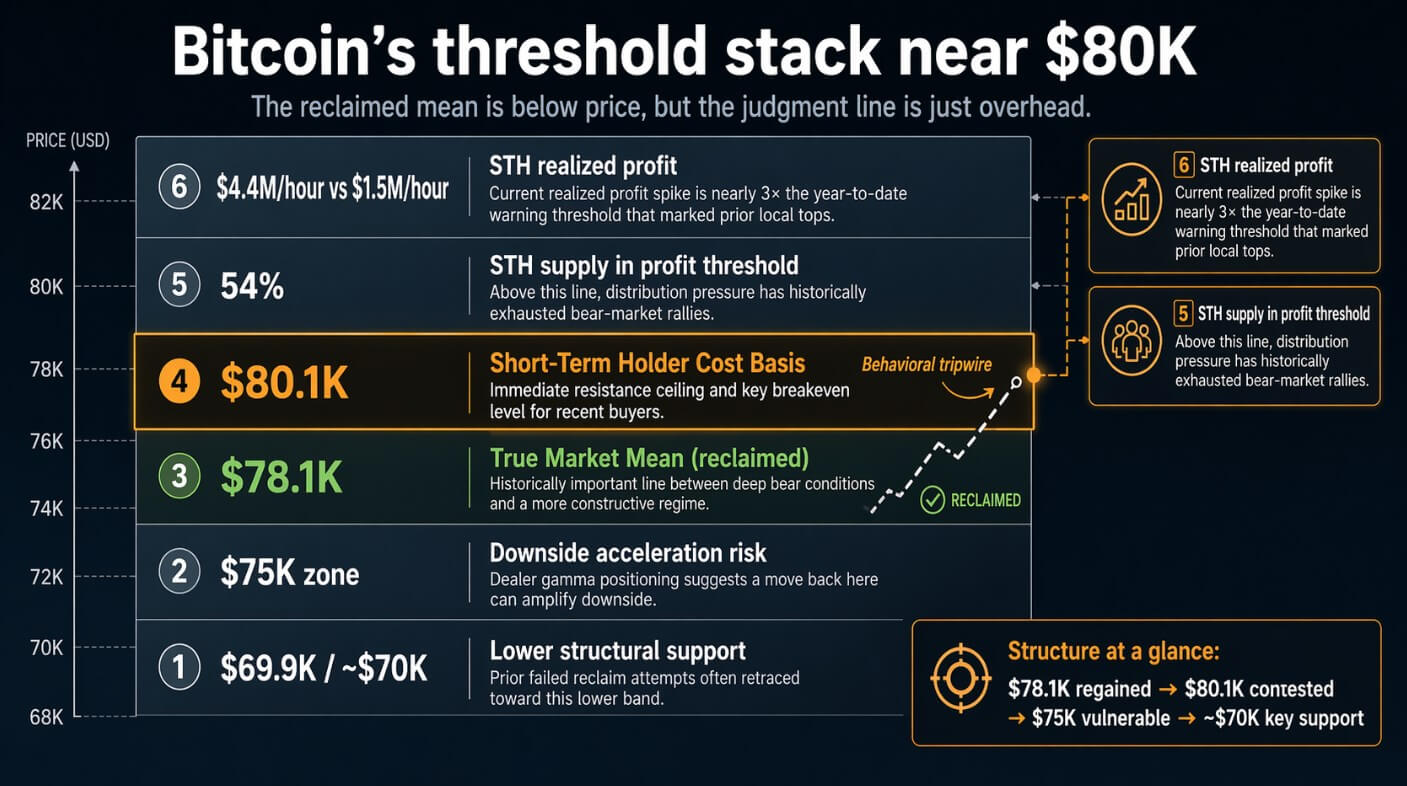
Current on-chain analytics delineate Bitcoin’s approach to the psychologically significant $80,000 mark as a pivotal behavioral tripwire—an upper boundary constructed from the breakeven psychology of recent market participants. According to insights provided by Glassnode, Bitcoin has successfully reclaimed the True Market Mean at $78,100. This threshold is critically positioned as the delineation between entrenched bear market conditions and a regime wherein mean reversion becomes a plausible narrative.
Glassnode’s recent report elucidates the complexities surrounding the $80,000 price point, indicating that three distinct seller mechanisms converge at this juncture, each amplifying the next:
– **Short-Term Holder Cost Basis**: The average acquisition price for coins purchased within the past 155 days stands at $80,100. This demographic represents the most price-sensitive segment of the market. The psychological transition from breakeven to profit typically induces selling behavior among these holders.
– **Profit Threshold**: A movement toward $80,100 would elevate the proportion of short-term holders operating in profit above the statistically significant 54% mark. This threshold is closely associated with peak distribution phases during bear-market rallies.
– **Surge in Realized Profits**: Short-term holders are currently realizing profits at a remarkable rate of $4.4 million per hour, nearly triple the year-to-date warning line of $1.5 million per hour identified by Glassnode. This surge raises critical questions regarding whether sufficient fresh demand exists to absorb the impending selling pressure.
The Macro-Economic Context
Bitcoin’s current price dynamics unfold against a restrictive macroeconomic backdrop. In March, U.S. Consumer Price Index (CPI) data indicated a month-over-month increase of 0.9% and a year-over-year rise of 3.3%, with gasoline prices contributing significantly to this uptick. The Core CPI recorded a more subdued increase of 0.2% month-over-month and a year-over-year figure of 2.6%. Despite this softer reading, the Federal Reserve cannot afford to overlook such a re-acceleration in headline inflation.
The labor market continues to demonstrate resilience as evidenced by March payrolls which increased by 178,000, while unemployment remained steady at 4.3%. The average workweek contracted slightly to 34.2 hours. These metrics contribute to a narrative of sustained economic strength that complicates any potential policy easing by the Federal Reserve.
A recent Reuters poll has indicated that economists anticipate at least six months before any interest rate cuts are implemented, driven primarily by elevated energy prices influenced by geopolitical tensions. This environment is reflected in forecasts predicting PCE inflation rates of 3.7% for Q2, tapering to 3.2% by Q4.
– **Brent Crude Oil Prices**: Registered at $100.58
– **U.S. Crude Oil Prices**: Recorded at $91.54
– **10-Year Treasury Yield**: Approximately at 4.286%
These factors collectively elucidate the macroeconomic constraints that continue to shape Bitcoin’s performance.
Demand Dynamics
Data from Farside Investors indicates that after experiencing an outflow of $291 million on April 13, Bitcoin saw an influx totaling approximately $1.54 billion across six trading sessions leading up to April 21. Noteworthy inflows included $663.9 million on April 17 and $238.4 million on April 20; however, the most recent session reflected a marked slowdown with only $11.8 million in net inflows.
Glassnode reports that cumulative volume delta has shifted upward with Binance emerging as a leader in buying activity while Coinbase remains relatively subdued. This divergence highlights offshore and crypto-native buyers as predominant forces in the ongoing rally, while U.S.-based institutional demand appears comparatively tepid.
The derivatives market presents a more cautious perspective; funding rates have consistently remained negative across major exchanges throughout March and April. Such positioning may indicate an environment primed for a potential short-squeeze if Bitcoin manages to break through current resistance levels while also suggesting lingering expectations of further downside movements.
Potential Resolutions for Market Dynamics
In assessing potential outcomes for Bitcoin’s trajectory in light of current conditions:
– **Bullish Scenario**: Should demand effectively absorb breakeven sellers and sustain momentum above the critical threshold of $80,100—augmented by continued positive ETF inflows—new buyers may ultimately prevail over short-term holder distribution dynamics. Given that funding remains negative, such an outcome could catalyze a squeeze effect that accelerates upward price movements beyond what can be achieved through spot buying alone.
– **Bearish Scenario**: Conversely, if market dynamics stagnate near the $80,000 level amid modest ETF inflows, realized profit behaviors could mirror historical patterns observed at prior local tops. A failure to break above $80,100 may manifest specific downside risks tied to dealer positioning; Glassnode’s options analysis indicates heavy negative gamma around $75,000—an area where dealer hedging could exacerbate declines.
A retreat into mid-$75,000 territory would signify an entry into an acceleration zone with potential support only available near historical lows around $69,900.
| Macro Input | Reading | Significance for BTC |
|---|---|---|
| CPI (March) | 0.9% m/m, 3.3% y/y | Elevated headline inflation limits Fed flexibility. |
| Core CPI | 0.2% m/m, 2.6% y/y | Softer metrics do not alter macroeconomic tone significantly. |
| Payrolls | 178,000 | A robust labor market complicates potential policy easing. |
| Unemployment Rate | 4.3% | No immediate signals for easing monetary policy. |
| Fed Outlook | Minimum six-month timeline before rate cuts | Delays in macro relief for risk-sensitive assets. |
| PCE Inflation Forecasts | 3.7% Q2 / 3.4% Q3 / 3.2% Q4 | Sustained inflationary pressures anticipated throughout the year. |
| Brent Crude Price | $100.58 | Continued energy pressures contribute to inflationary concerns. |
| U.S. Ten-Year Treasury Yield | 4.286% | Tight financial conditions persist due to elevated rates. |
The volatility envelope established by Glassnode underscores that while bullish scenarios remain plausible within normal volatility parameters, retesting levels around $75,000 also fall well within anticipated fluctuations over seven-day periods.
It is evident that Bitcoin has regained its footing above critical thresholds that previously characterized deep bear market conditions; however, it now faces formidable overhead resistance from those who have awaited long enough to recover their positions.