
Overview of Strategy’s Ascendancy in Bitcoin Holdings
In a significant development within the cryptocurrency investment landscape, Strategy, the entity formerly known as MicroStrategy and spearheaded by Michael Saylor, has outstripped BlackRock’s iShares Bitcoin Trust (IBIT) to emerge as the preeminent institutional holder of Bitcoin globally. This transition marks a pivotal moment in the ongoing competition between institutional investors in the realm of digital assets.
Recent Acquisition Details
Per a regulatory filing with the Securities and Exchange Commission (SEC) dated April 20, 2026, Strategy executed an acquisition of an additional 34,164 Bitcoin over the past week at an average price point of $74,395 per coin. This purchase represented an outlay of approximately $2.54 billion, constituting the third-largest single acquisition in the company’s history by coin count.
Following this strategic acquisition, Strategy’s total Bitcoin holdings have now reached 815,061 BTC, equivalent to approximately 3.88% of the total circulating supply of Bitcoin. Cumulatively, the firm has invested about $61.56 billion in its Bitcoin strategy, establishing an average cost basis of $75,527 per coin. With Bitcoin currently trading around $75,000, this positions the value of its holdings at approximately $61.2 billion, resulting in an unrealized loss exceeding $228 million.
Significance of Strategy’s Position Relative to BlackRock
The scale of Strategy’s latest acquisition is noteworthy in its own right; the additional 34,164 BTC would qualify any enterprise as the fifth-largest corporate holder of Bitcoin globally. This advancement has propelled Strategy past BlackRock’s IBIT, which currently holds 798,026 Bitcoin—having previously overtaken Strategy in early 2024 following the approval for spot Bitcoin ETFs in the United States.
This juxtaposition is particularly significant as these two entities exemplify divergent methodologies for gaining exposure to Bitcoin. While BlackRock’s fund operates under a regulated Wall Street structure that serves retail and institutional investors alike, Strategy has increasingly positioned itself as a leveraged treasury vehicle focused on Bitcoin accumulation through the utilization of debt and equity markets.
Notably, aside from Strategy and BlackRock, the only other entity widely believed to possess greater Bitcoin reserves is Satoshi Nakamoto—the pseudonymous creator of Bitcoin—whose dormant wallets are estimated to contain approximately 1.1 million coins.
Strategic Insights from Recent Acquisitions
In light of these developments, Strategy’s Chief Executive Officer Phong Le noted that the recent acquisition has augmented the company’s Bitcoin yield by an impressive 82%, elevating it to $4.97 billion for the year within a single week. He articulated that this outcome underscores the reflexive advantage derived from coupling an appreciating digital asset with accretive debt financing.
Market analysts monitoring Strategy’s accumulation trajectory have posited that the firm could approach the milestone of one million Bitcoins before year-end.
The Role of STRC in Funding Mechanisms
The latest transaction further emphasizes how significantly Strategy now depends on its preferred securities—designated as STRC—to finance its Bitcoin strategy while minimizing reliance on common-share dilution. According to regulatory filings, the company’s perpetual preferred security generated $2.18 billion last week, which constituted approximately 85.7% of the funds employed for this acquisition.
It is noteworthy that STRC also facilitated all of Strategy’s $1 billion Bitcoin purchase for the week ending April 12. Designed to trade near a par value of $100, STRC offers investors a variable dividend with an annualized rate of 11.5%, subject to monthly resets.
Company executives have previously indicated that this structure aims to maintain stock trading close to par value while mitigating sharper valuation fluctuations. In practice, STRC has evolved into a core component of Strategy’s funding apparatus; under Saylor’s leadership, almost 100,000 BTC have been acquired using these securities.
Implications for Market Dynamics
The evolution of Strategy from a conventional software firm to a dedicated Bitcoin acquisition vehicle underscores its transformation into an entity primarily focused on accumulating digital assets through diverse public-market instruments—including common equity and preferred stock.
Market Reactions to Strategic Acquisitions
Despite advancements in funding mechanisms supporting these acquisitions, market responses to such announcements have remained relatively consistent over time. Notably, large disclosures regarding Strategy’s purchases have frequently manifested as “buy-the-rumor, sell-the-news” phenomena for Bitcoin rather than serving as immediate bullish catalysts.
“Large strategy purchase announcements are historically sell-the-news events for Bitcoin,” stated Andre Dragosch, head of research at Bitwise Europe. “This behavior may be countercyclical because buying becomes old news by announcement time and traders often anticipate reduced purchasing activity in subsequent weeks.”
Research conducted by Bitwise Europe corroborates this perspective: large acquisition announcements from Strategy seldom result in immediate upside following their public disclosure. Instead, historical data indicates that Bitcoin prices typically weaken during the hours succeeding such filings.
Conclusions and Strategic Outlook
The market dynamics surrounding large-scale acquisitions by Strategy exhibit a familiar pattern whereby traders preemptively price in anticipated demand prior to formal announcements—thereby constraining potential upside following such disclosures.
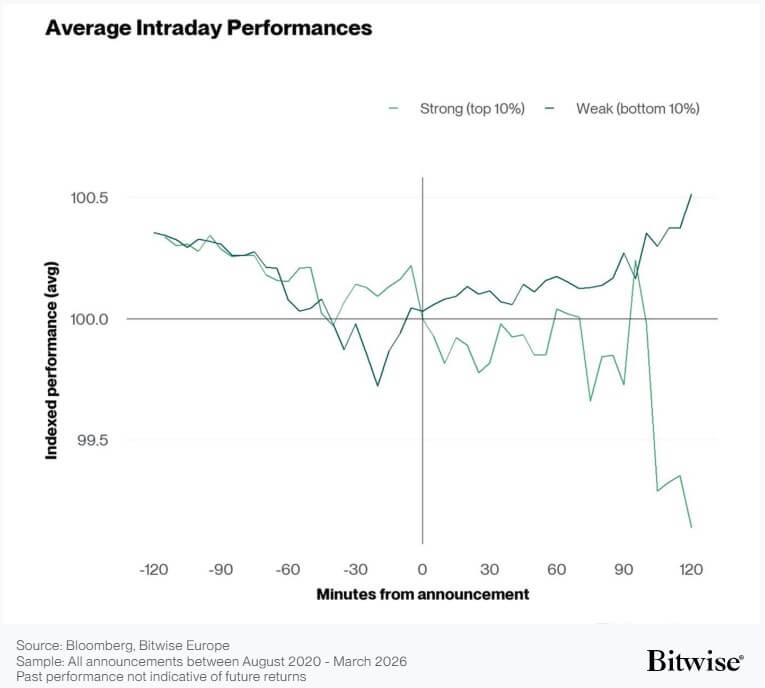
This phenomenon underscores a critical insight: quieter accumulation strategies may present less susceptibility to market front-running and could yield more reliable signals regarding sustained demand than larger acquisitions characterized by extensive media attention. Consequently, analysts advise caution against interpreting weekly filings from Strategy as dependable short-term trading indicators.