
Analysis of Recent Activity in Synthetic Oil Futures and Geopolitical Implications
This report delineates a significant surge in trading activity within the synthetic oil futures market, specifically on the decentralized exchange Hyperliquid, where traders engaged in transactions exceeding $500 million over the preceding weekend. This influx of trading activity is primarily attributable to escalating geopolitical tensions in the Middle East, particularly concerning military engagements involving Iran.
Market Response to Geopolitical Tensions
The abrupt declaration by Iran to close the Strait of Hormuz to commercial shipping—contradicting an earlier announcement regarding its reopening—has precipitated a marked increase in volatility within the oil markets. Concurrent reports detailing hostile actions against maritime vessels in proximity to this critical chokepoint have further exacerbated investor anxiety, prompting them to seek alternative hedging mechanisms amidst traditional financial markets’ closure for the weekend.
- Traders exploited blockchain-based trading platforms as a means to navigate around conventional market hours.
- The necessity for continuous trading options was underscored, given that crypto derivatives markets operate on a 24/7 basis, as opposed to standard financial exchanges.
Dynamics on Hyperliquid
On the Hyperliquid platform, perpetual futures linked to the international benchmark Brent crude experienced a formidable resurgence, surpassing $90 per barrel. This price movement effectively reversed a prior decline of approximately 10% that had been instigated by initial reports of the Strait’s reopening. Similarly, West Texas Intermediate (WTI) contracts surged to $86, recovering from a previous close of $79 on conventional commodity exchanges.
The observed weekend trading frenzy illustrates a notable shift among market participants who are increasingly leveraging blockchain infrastructure. Such platforms allow for novel trading paradigms that facilitate real-time responses to emerging geopolitical crises. Hyperliquid’s HIP-3 framework empowers developers to establish leveraged futures markets around traditional assets such as oil and gold, contingent upon the collateralization of 500,000 native HYPE tokens.
Record Open Interest and Market Sentiment
As geopolitical uncertainties mount, open interest within these synthetic markets has ascended to unprecedented levels, now exceeding $2 billion. This trend signifies a growing recognition among traders of the potential for significant price fluctuations stemming from geopolitical developments.
Escalation of US-Iran Hostilities and Its Market Impact
The recent escalation of hostilities between the United States and Iran can be traced back to the collapse of a temporary ceasefire agreement that was scheduled to conclude on April 22. President Donald Trump has reiterated that a naval blockade of Iranian ports will remain in effect until a comprehensive peace agreement is achieved. In retaliation, Iran’s Islamic Revolutionary Guard Corps has issued warnings regarding potential actions against any vessels approaching its territorial waters.
Market Sentiment and Predictive Indicators
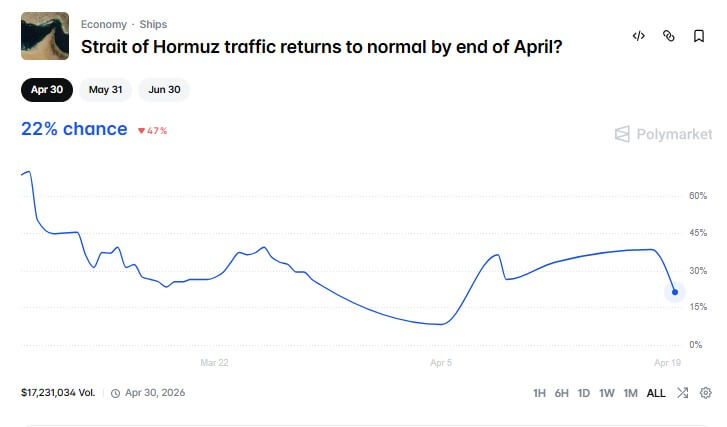
The abrupt closure of the Strait has reverberated through predictive markets. On Polymarket—a blockchain-based betting platform—the likelihood that shipping traffic would return to normal levels by the end of April has drastically decreased, plummeting to 22% as stakeholders swiftly reevaluated their positions in light of new developments.
This shift in sentiment has also tempered momentum across the broader cryptocurrency market; Bitcoin’s valuation hovered around $75,028 as market participants gravitated toward defensive strategies rather than speculative investments in digital assets. The prevailing geopolitical anxieties coupled with persistent global inflationary pressures have prompted analysts to brace for escalated manufacturing and transportation costs should crude oil prices breach the $100 per barrel threshold following Monday’s traditional market opening.