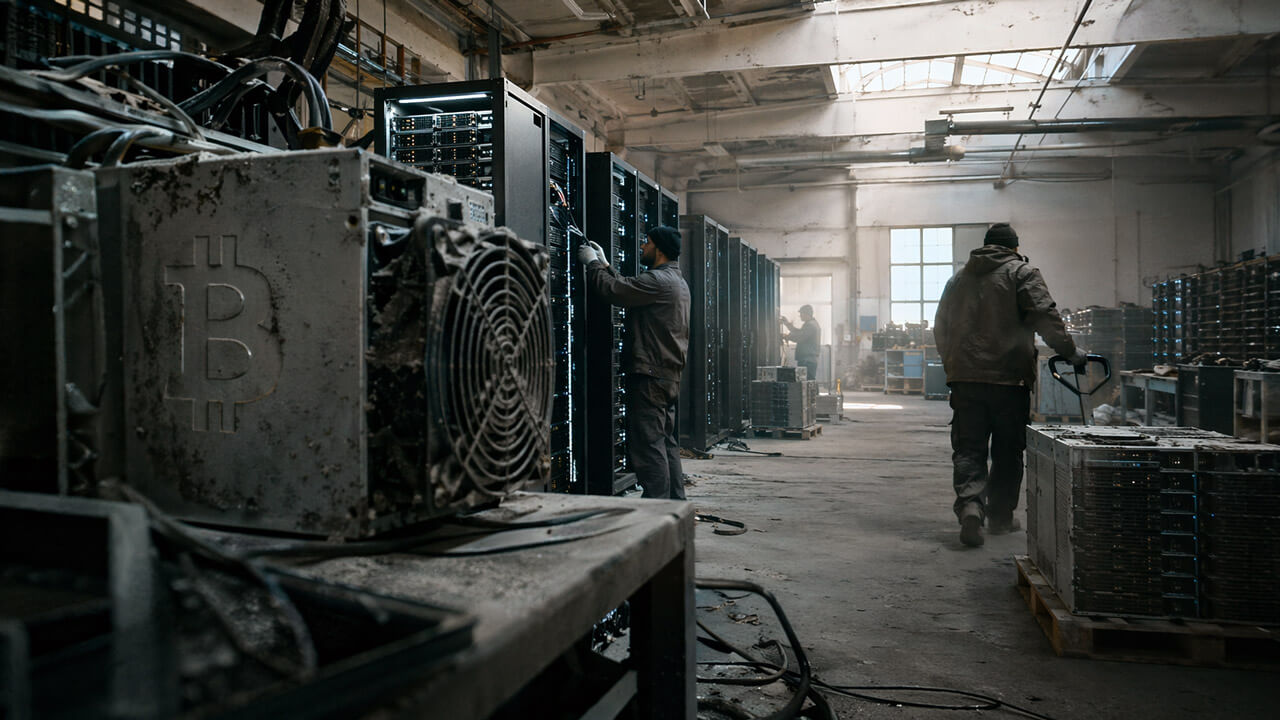
The Emergence of Artificial Intelligence as a Significant Threat to Bitcoin Mining
Quantum computing has often been characterized as an existential threat to Bitcoin, positioned as a singularly dramatic menace due to its potential to disrupt cryptographic systems and alter the foundational fabric of digital trust. However, the contemporary peril confronting Bitcoin is decidedly more mundane yet profoundly impactful: artificial intelligence (AI), with its inherent pressure on electrical resources.
Current Market Dynamics
As of the latest data, Bitcoin is trading at approximately $77,845, reflecting a 5% increase over the past 24 hours, a 6.7% rise over the week, and a commendable 9.2% appreciation over the past month. While these figures indicate a recovery in market sentiment, it is imperative to scrutinize the underlying economic realities impacting Bitcoin mining operations, which are currently ensnared in tighter economic constraints than the surface-level market dynamics suggest.
According to CoinShares’ Q1 2026 mining report, the average cost incurred by publicly listed miners to produce one Bitcoin has escalated to about $79,995 in Q4 2025. Concurrently, the prevailing hash price hovers around $30 per petahash per day, which implies that an estimated 15% to 20% of the global mining fleet operates at a loss when power costs rise significantly.
The Ascendance of AI in Resource Allocation
AI’s encroachment on Bitcoin mining operations is already manifesting through strategic realignments in resource allocation. Notably, Bitdeer has commenced decommissioning Bitcoin mining rigs at its Tydal, Norway facility to accommodate a new AI data center. This decision underscores a critical pivot: a miner historically entrenched in Bitcoin has opted to repurpose its resources towards AI infrastructure due to more favorable economic prospects.
Moreover, Bitdeer reported approximately $21 million in annual recurring revenue derived from external GPU cloud subscriptions as of February 28. This proactive transition emphasizes not merely a theoretical shift but a concrete strategy already underway. Similarly, Riot Platforms has initiated revenue-generating activities through its data center lease with AMD since January 2026 and envisions expanding its Rockdale site into a more substantial data center complex.
Core Scientific exemplifies this trend with substantial advancements in AI infrastructure deployment; it announced that around 350 MW had been energized under its CoreWeave contract and remains on track to deliver approximately 590 MW by early 2027. Other firms, such as MARA Holdings, are also exploring dual-capacity campuses for both Bitcoin mining and AI compute workloads, thereby enhancing operational flexibility in accordance with market demands.
Sectoral Realignment: A Two-Track Market
The current landscape delineates three distinct categories within the mining sector:
1. **Miners with Established AI and High-Performance Computing (HPC) Contracts**: These entities are actively reallocating capacity toward AI and HPC initiatives.
2. **Miners Engaged in Preliminary Framework Development**: These firms are piloting projects without significant revenue contributions yet.
3. **Miners Remaining Tied Primarily to Bitcoin**: A subset continues to focus predominantly on traditional Bitcoin mining activities.
According to CoinShares estimates, over $70 billion in cumulative AI and HPC contracts have been announced within the public mining sector. This indicates that listed miners could derive as much as 70% of their revenue from AI by year-end 2026, up from approximately 30% today.
Revenue Comparisons Between Bitcoin and AI
Despite the current dynamics favoring Bitcoin’s revenue generation at an average price of $80,000 per coin across public miners’ collective outputs, a closer examination reveals that several firms have already secured contracts that could render their AI revenue streams competitive with their Bitcoin yields.
| Company | Current Hashrate (EH/s) | Estimated BTC Mined/Year | BTC Revenue at $80K | BTC Revenue at $160K |
|——————|————————-|————————–|———————-|———————–|
| Bitdeer | 69.50 | 11,210.2 | $896.8M | $1.794B |
| MARA | 61.70 | 9,952.1 | $796.2M | $1.592B |
| CleanSpark | 47.30 | 7,629.4 | $610.3M | $1.221B |
| IREN | 43.00 | 6,935.8 | $554.9M | $1.110B |
| Riot | 36.40 | 5,871.2 | $469.7M | $939.4M |
| Cango | 27.98 | 4,513.1 | $361M | $722.1M |
| HIVE | 22.20 | 3,580.8 | $286.5M | $572.9M |
| American Bitcoin | 21.90 | 3,532.4 | $282.6M | $565.2M |
| Core Scientific | 15.70 | 2,532.4 | $202.6M | $405.2M |
| Keel Infrastructure| 14.80 | 2,387.2 | $191M | $382M |
The juxtaposition elucidates that while aggregate revenues still favor Bitcoin at present levels of pricing and network economics, certain entities equipped with robust AI infrastructures are poised to dramatically shift this balance.
Operational Implications for Miners
This bifurcation results in a two-track market wherein one segment predominantly relies on Bitcoin’s price fluctuations while another capitalizes on strategic placements of premium power sites adaptable for long-duration compute revenue streams.
– **Confirmed Annual AI Revenue**: Selected companies have already commenced generating substantial AI revenues that could eclipse their traditional Bitcoin earnings under favorable conditions.
| Company | Confirmed Annual AI Revenue (10-Year Sensitivity) |
|——————|————————————————–|
| Bitdeer | $21M |
| MARA | N/A |
| CleanSpark | N/A |
| IREN | N/A |
| Riot | $31M |
| Cango | N/A |
| HIVE | $15M |
| American Bitcoin | N/A |
| Core Scientific | N/A |
The operational landscape is shifting; miners may soon find themselves evaluating their investments primarily based on potential returns from data center leasing and AI ventures rather than solely on traditional cryptocurrency mining.
The Immediate Threat to Bitcoin’s Security Budget
In assessing the risks posed by these evolving dynamics, it becomes evident that the threat emanating from AI transcends mere competitive economics; it poses an immediate risk to Bitcoin’s industrial security infrastructure.
– **Economic Risk vs Engineering Risk**: Quantum computing represents an engineering risk concerning cryptographic integrity while AI signifies an economic risk by reallocating capital away from traditional mining activities.
As miners pivot towards more lucrative opportunities presented by AI infrastructure contracts—often accompanied by longer-term commitments—Bitcoin’s security framework may inadvertently suffer from diminished investment focus.
Mining operations might progressively gravitate towards utilizing less reliable power sources due to heightened competition for premium energy resources driven by burgeoning demand from AI initiatives.
Future Outlook: The Potential Restructuring of Mining Operations
The trajectory for public miner equities suggests they may increasingly diverge from direct correlations with Bitcoin prices as enterprise valuations shift towards service-oriented models predicated on data center leasing and compute capacity monetization rather than pure cryptocurrency extraction.
In conclusion:
– The imminent future will likely see a hybrid mining sector where some operators maintain a primary focus on Bitcoin while others evolve into power-and-compute businesses treating cryptocurrency mining as a secondary function.
– The overarching question will not merely revolve around whether miners abandon Bitcoin entirely but rather which segments of their operations will remain economically viable amidst escalating competition for premium resources.
While quantum computing continues to loom as a long-term strategic concern for cryptography within the blockchain space, artificial intelligence represents an immediate challenge affecting operational viability and financial sustainability for contemporary Bitcoin miners.