

preferred on

Market Dynamics and Psychological Implications of Bitcoin’s Current Valuation
Despite Bitcoin’s current price trading significantly above the nadirs experienced during previous bear markets, this relative strength engenders a sense of disorientation among market participants. Underneath this apparent resilience lies a substantial segment of the market grappling with unrealized losses.
Recent on-chain analytics indicate that by early April, approximately 46% of Bitcoin’s circulating supply was being held at a loss. This statistic implies that nearly half of the coins within the network were acquired at valuations exceeding the prevailing market price.
The psychological ramifications for market participants are profound; when a considerable number are ensnared in losing positions, emotional volatility tends to escalate. The divergence between price chart representations and the sentiments held by investors can manifest as a considerable chasm.
The Significance of the $60,000 Threshold
The $60,000 price point emerges as a critical juncture—not merely due to its round numerical value but because of its potential behavioral ramifications. A retracement to this level could exacerbate the plight of existing holders, transitioning a gradual decline into a precipitous drop. This scenario would serve as a litmus test for the psychological fortitude of holders: would they persist in their positions or capitulate and initiate selling?
Investors who entered the market during previous price ascensions have shifted their focus from aspirations of attaining new all-time highs to grappling with more sobering considerations: Did they misinterpret market signals? Should they mitigate their exposure? Does this drawdown possess further downward potential? Such contemplations are characteristic of market bottoms, wherein panic, once it gains traction, can proliferate rapidly.
Maintenance of Foundational Price Levels Amidst Market Distress
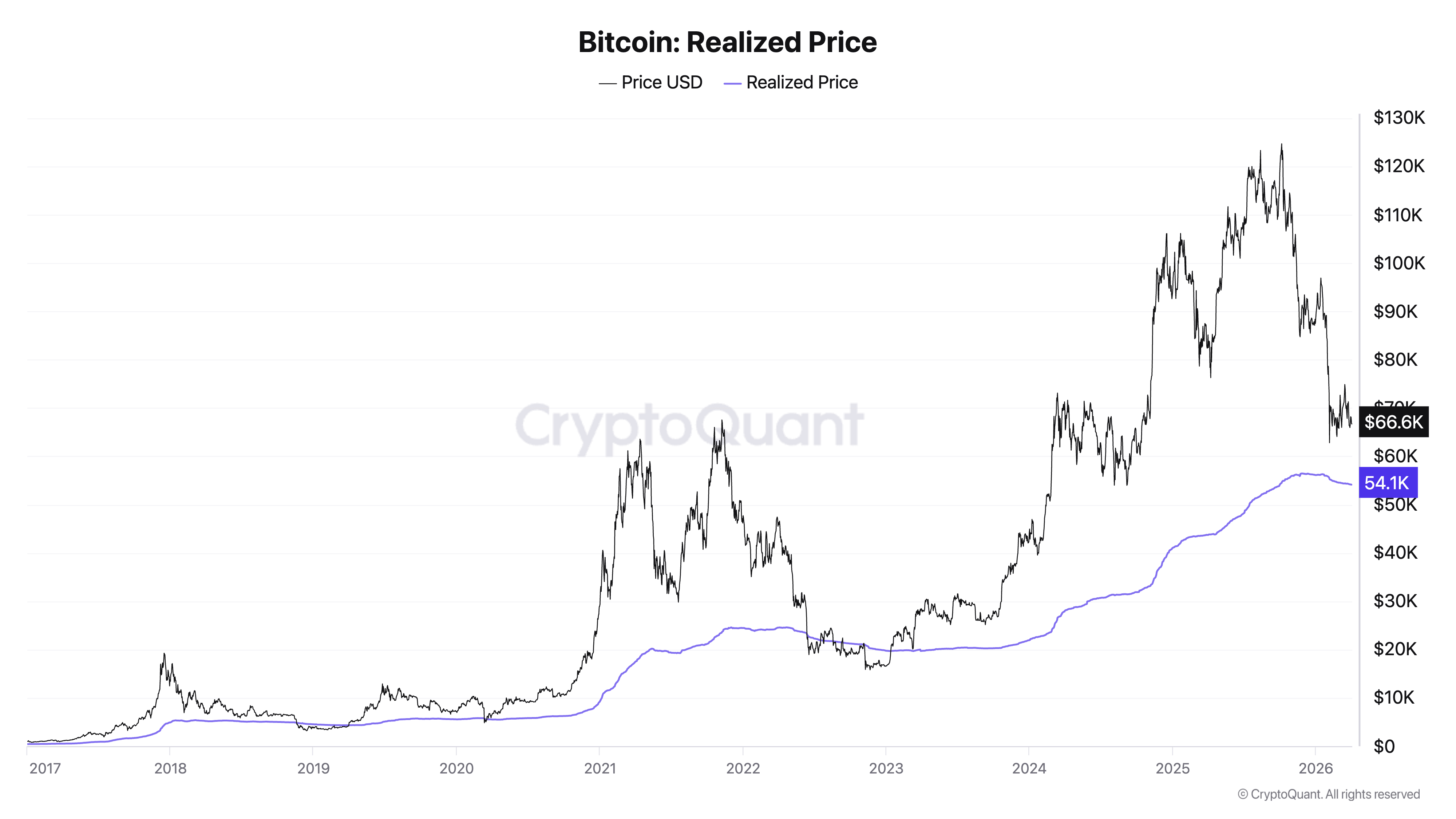
The prevailing market conditions exhibit signs of distress; however, critical support levels established during prior cycle washouts remain intact. A salient metric illustrating this phenomenon is the realized price—an essential long-term benchmark for Bitcoin. The realized price reflects the average value at which Bitcoin has exchanged hands and is presently situated at approximately $54,100. Notably, Bitcoin continues to trade above this threshold, signifying that the average holder across the network is not currently sustaining losses.
This sentiment is corroborated by weekly chart analyses which reveal that Bitcoin is also maintaining its position above its 200-week moving average, approximating values in the high $50,000s. This juxtaposition places the market in an anomalous state; it exhibits sufficient weakness to instigate fear and deteriorate sentiment while simultaneously leaving a substantial fraction of holders in negative territory. Yet, foundational support levels from previous bear markets persist.
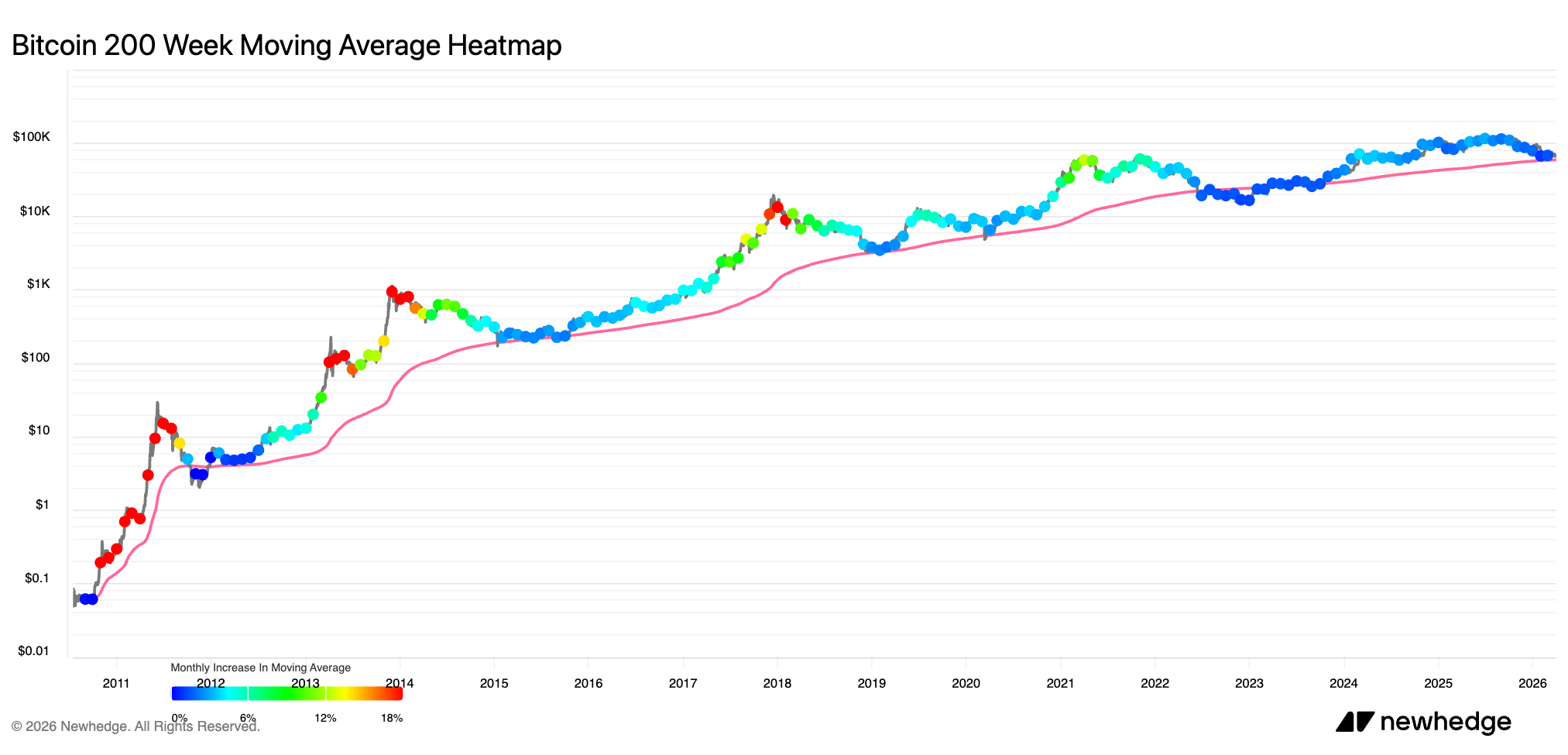
This phenomenon starkly delineates the current cycle from earlier iterations. While Bitcoin retains its characteristic volatility and enduring drawdowns inflict tangible stress on participants, the altitude at which these pressures manifest has significantly escalated. The distressing dynamics are occurring at higher price levels than previously observed.
Implications of Market Structure and Participants’ Sentiments
This elevation in price resilience may be attributable to an expanded and more robust demographic of long-term holders and increased institutional participation over recent years. Such structural enhancements afford the market greater stability compared to earlier cycles when fear-driven sell-offs could swiftly penetrate historical support levels with minimal resistance.
The pivotal inquiry remains: Can this market sustain additional discomfort before precipitating forced liquidation? Should Bitcoin descend toward $60,000 yet remain resilient, it would signify an important developmental phase within this cycle; nearly half of market participants are already operating under water while foundational supports continue to uphold value. Conversely, should this level be breached leading to widespread liquidation, we may witness a familiar bear-market trajectory unfold once again.
Presently, there exists a disconnect between visible market conditions and underlying structural realities. While Bitcoin may appear relatively stable on long-term charts, a significant portion of holders already experiences financial strain—a pivotal dynamic for external observers attempting to interpret the current state of affairs.
The market is currently navigating substantial pressure; thus, discerning how much additional strain it can endure before its structural integrity is compromised is a question that will likely find resolution in the forthcoming weeks.
As of press time at 3:27 PM UTC on April 3, 2026, Bitcoin retains its position as the foremost asset by market capitalization with a valuation reflecting an increase of 0.64% over the past twenty-four hours. The market capitalization stands at an impressive $1.34 trillion accompanied by a daily trading volume totaling $30.11 billion. For further information regarding Bitcoin’s performance, please refer here.
Crypto Market Summary
At press time at 3:27 PM UTC on April 3, 2026, the total cryptocurrency market capitalization is approximately $2.3 trillion with a corresponding twenty-four-hour trading volume reaching $74.01 billion. Presently, Bitcoin dominance is calculated at 58.05%. For comprehensive insights into the broader crypto landscape, please refer here.