
As the first quarter of 2026 concludes, Bitcoin’s lackluster performance increasingly appears less as a distinct anomaly within the cryptocurrency sphere and more as a manifestation of a broader market environment beset by escalating macroeconomic and geopolitical pressures.
On March 31, the closing price of Bitcoin was approximately $66,280, reflecting a year-to-date decline of approximately 24%. Concurrently, the S&P 500 index was poised to experience its most significant quarterly downturn since 2022, as investor sentiment shifted away from risk-laden assets.
The initial phase of the quarter had been characterized by optimism regarding an impending era of Bitcoin ETFs, corporate treasury investments, and a more favorable regulatory environment in the United States. However, this optimism dissipated as the quarter progressed, culminating in oil prices surpassing $100 per barrel and rising yields igniting questions about Bitcoin’s role as either a hedge or a leveraged macro asset.
Throughout this reporting period, Bitcoin’s depreciation was not attributable to any singular catalyst; rather, it stemmed from a confluence of factors including geopolitical conflicts resulting in energy shocks, waning confidence in potential easing by the Federal Reserve, diminishing institutional demand, routine sales by miners, selective de-risking among long-standing holders, and defensive positioning within derivatives markets. Collectively, these elements established a prevailing negative tone throughout the quarter.
By the end of March, although some of the most intense selling pressure had subsided, the market remained devoid of the robust purchasing activity typically indicative of a sustainable recovery.
Macroeconomic Dynamics: War, Oil Prices, and Interest Rates
The macroeconomic landscape exerted significant influence over Bitcoin during the initial three months of the year; however, it was February that marked a critical turning point. The onset of military tensions involving the United States, Israel, and Iran compelled investors to reconsider inflation rates, interest rate trajectories, and their overall risk exposure.
The conflict precipitated a sharp escalation in oil prices as market participants began pricing in potential disruptions across the Middle East. Brent crude oil prices consistently hovered above $100 per barrel amid concerns that extended disturbances in key shipping routes could exacerbate inflationary pressures further.
This situation compounded existing challenges faced by global markets, which were grappling with inconsistent economic growth and persistent inflationary anxieties. Analysts observed that rising energy costs directly influenced interest rate dynamics; investors who had commenced the year with expectations of a more accommodative monetary policy were instead confronted with prospects of sustained inflationary pressure necessitating tighter monetary conditions from the Federal Reserve.
The yield on 10-year Treasury bonds briefly approached 4.50% before retracting—a move indicative of a broader recalibration of rate expectations as market participants adjusted to an increasingly uncertain monetary policy landscape.
In parallel, equities succumbed to downward pressure as this repricing unfolded. According to reports from Reuters, the S&P 500 index was on course to decline approximately 7% for the quarter—its weakest quarterly performance in four years.
Within this overarching macro regime, Bitcoin exhibited dual characteristics. The geopolitical unrest and growing skepticism towards traditional asset classes seemed to bolster arguments for alternative stores of value such as Bitcoin. Conversely, heightened Treasury yields and an increased appetite for conventional safe-haven assets drained liquidity from speculative positions within digital assets.
This dynamic resulted in Bitcoin oscillating within a price range between $60,000 and $72,000—neither bullish nor bearish sentiments managing to establish a definitive trend. Ultimately, this quarter underscored how rapidly geopolitical tensions could alter trading conditions within cryptocurrency markets. What commenced as a year anticipated to witness easing financial conditions transitioned into one defined by risks associated with conflict, energy shocks, and intricate interest rate outlooks—all contributing to Bitcoin and the broader digital asset market’s exposure amid an extensive global risk recalibration.
Institutional Demand: A Disparate Response
While institutional demand persisted throughout Q1 2026, it proved insufficient to counteract the pervasive macroeconomic pressures that relentlessly drove prices downward. Data sourced from SoSoValue indicated that Bitcoin exchange-traded funds (ETFs) experienced net outflows totaling $1.8 billion during January and February before witnessing approximately $1 billion in inflows during March. This juxtaposition left nine ETF products with net outflows exceeding $800 million for the quarter—a clear indication that spot flows had weakened significantly and accumulation efforts were inadequate to provide sustained support amidst deteriorating risk sentiment.
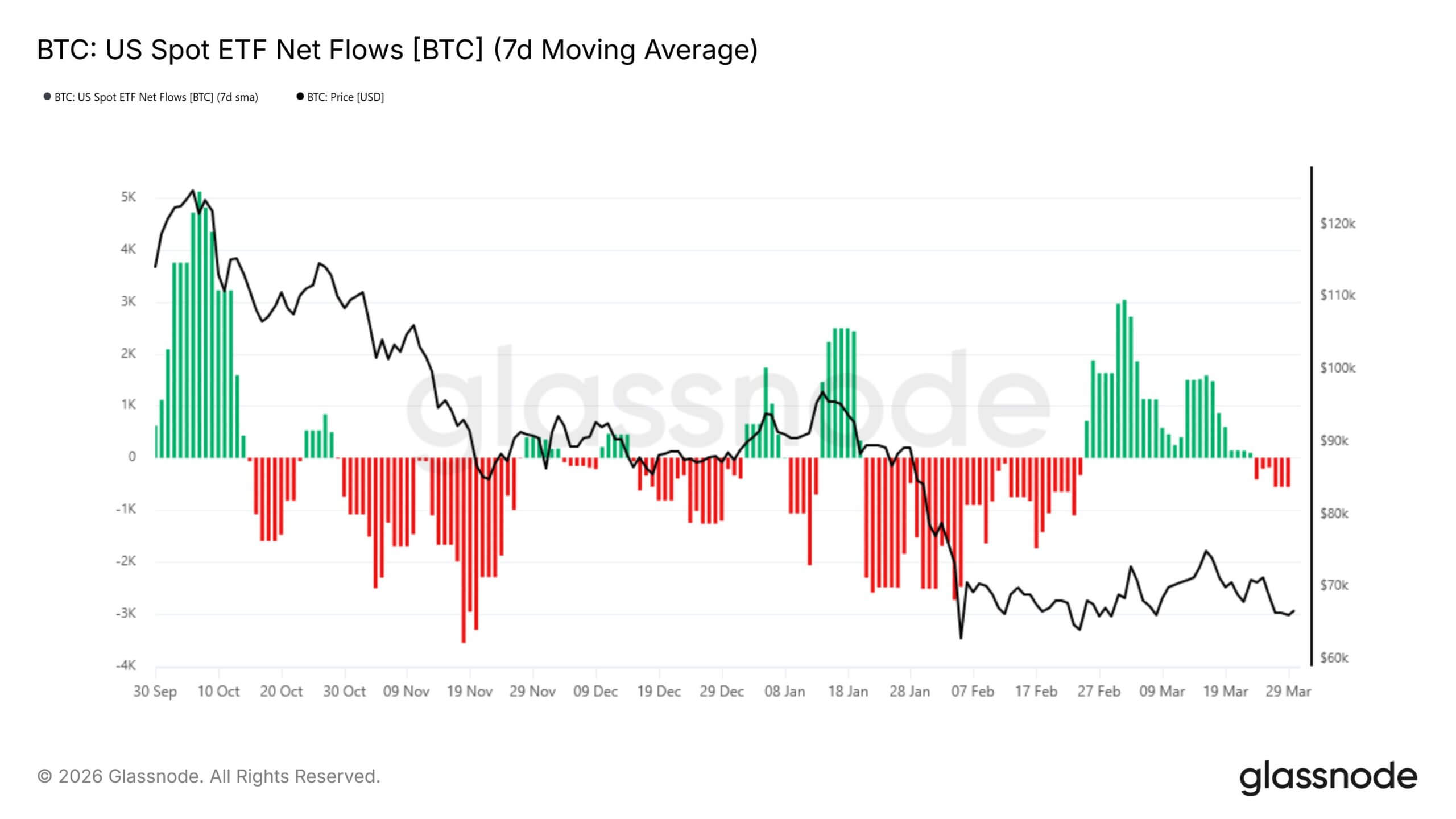
This pattern suggests that while demand remained present within institutional contexts, it lacked the requisite consistency to absorb ongoing selling pressure effectively. CoinShares linked this decline in demand to two overarching factors: apprehensions regarding the protraction of the Iran conflict and shifting expectations concerning upcoming Federal Open Market Committee meetings—where investor sentiment transitioned from anticipating interest rate cuts toward contemplating potential rate hikes.
The resultant environment left digital assets vulnerable to similar macroeconomic repricing pressures affecting other liquidity-sensitive trades. Furthermore, this loss of momentum was observable within corporate treasury transactions—previously heralded as one of last year’s defining narratives—where accumulation activities increasingly became concentrated among select entities. Strategy (formerly MicroStrategy), under Michael Saylor’s leadership, emerged as a dominant force within BTC acquisitions by amassing over 88,000 Bitcoins during this reporting period—representing one of its most substantial quarterly purchases since 2025.
Conversely, outside Strategy’s initiatives, overall purchasing activity among corporate treasuries appeared markedly subdued; during this timeframe, other companies combined acquired less than they had at the peak of treasury accumulation witnessed in 2025. Some firms that had previously advocated for treasury accumulation began divesting their holdings; Nakamoto sold approximately 284 Bitcoins in March for about $20 million at an average sale price of $70,422 per coin after having purchased net quantities totaling 5,342 BTC at weighted average prices around $118,171 during 2025.
This transaction illustrates how swiftly economic parameters surrounding these trades can shift. An enterprise once anchored on Bitcoin accumulation found itself liquidating assets at significantly lower valuations than those previously attained during its acquisition strategy.
This shift underscores broader strains impacting financing models that propelled last year’s treasury surge—wherein momentum was derived from rising Bitcoin prices coupled with public market investor enthusiasm rewarding listed companies that provided leveraged exposure through balance sheets. Companies capitalized on surging valuations through share issuance premiums relative to existing Bitcoin holdings while simultaneously utilizing debt financing to amplify exposure levels.
However, as Bitcoin prices plateaued or declined rather than ascend further—a structural framework that had previously supported aggressive accumulation strategies began to falter—culminating in tighter feedback loops across sector dynamics. Diminished Bitcoin valuations led to reduced net asset values per share; declining net asset values compressed equity premiums; constricted equity premiums diminished efficacy for new share issuance—all contributing factors undermining previously effective strategies for expanding Bitcoin holdings.
This phenomenon has become particularly pronounced among treasury company stocks. Shares that once represented high-beta proxies for Bitcoin upside have experienced steep declines from their peaks established in 2025—with many stocks underperforming against Bitcoin itself. Consequently, what appeared merely a year prior as a scalable public-market strategy has morphed into an increasingly challenging endeavor amid an evolving market landscape where underlying asset appreciation is insufficiently robust to uphold previous financing assumptions.
Miner Sales: Routine Pressure Amplified
A further critical variable impacting BTC price dynamics during this period has been routine selling activities conducted by Bitcoin miners. While miner activity was not exclusively responsible for Bitcoin’s lackluster Q1 performance—it became increasingly salient as overall demand weakened.
Asset management firm VanEck reported miners effectively liquidated nearly all newly issued Bitcoin supply over the preceding year—amounting to approximately 164,000 BTC sold into markets. For example, MARA Holdings illustrated these pressures by disclosing on March 26 its decision to sell 15,133 Bitcoins between March 4 and March 25 for around $1.1 billion; proceeds were primarily allocated toward repurchasing convertible notes and alleviating debt burdens.
Additional mining operations also reported significant drawdowns from their treasuries; Core Scientific sold approximately 1,900 BTC valued at roughly $175 million in January and indicated intentions to liquidate remaining holdings considerably throughout Q1 2026. Bitdeer reduced its treasury holdings down to zero by February; Riot similarly divested about 1,818 BTC worth around $162 million during this timeframe.
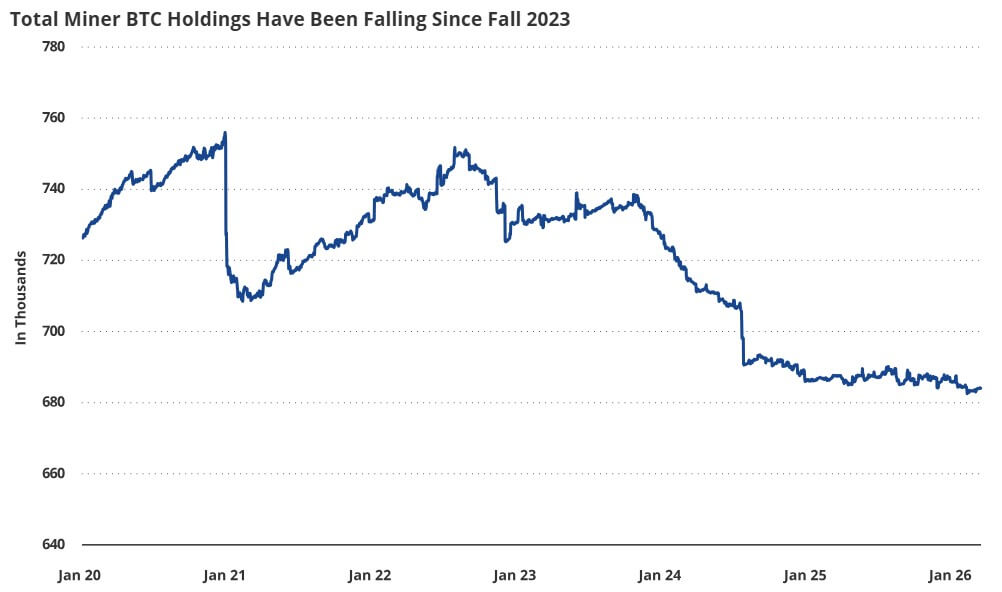
This trend indicates miners have transitioned away from being net accumulators; instead they have become net sellers within a marketplace characterized by inconsistent ETF inflows coupled with waning organic purchasing activity. Simultaneously reflecting pressures permeating through mining sectors rather than signaling outright panic regarding Bitcoin itself.
CoinShares articulated that prevailing price corrections alongside near-record hashrates have driven hash prices down to five-year lows while VanEck corroborated similar observations indicating average cash costs incurred by publicly listed miners rose to approximately $79,995 per mined Bitcoin during Q4 2025. These dynamics have left numerous operators grappling with constrained margins coupled with limited financing alternatives.
Concurrently with these economic strains facing miners—a discernible pivot toward artificial intelligence (AI) and high-performance computing infrastructure has emerged amongst several mining entities. CoinShares noted that cumulative contracts valued at over $70 billion have been announced across public mining sectors targeting AI applications—including firms such as TeraWulf and Hut 8 adopting operational models akin to data center operations alongside their mining activities.
This context elucidates why even routine sales conducted by miners have assumed greater significance despite not being precipitated by panic-induced capitulation events; rather these actions are emblematic of consistent distribution patterns occurring within markets lacking adequate absorption capacity.
Sustained Pressure from Long-Term Holders
The selling pressure exerted upon Bitcoin was further exacerbated by actions taken by long-term holders who continued their divestment strategies into early 2026.
Data compiled by CryptoQuant revealed that long-term holders’ Spent Output Profit Ratio (SOPR) dipped below unity—a clear indication that these holders were realizing losses upon selling their assets.
The firm’s analysis posited:
“The propensity for long-term holders—typically less susceptible to short-term volatility—to begin realizing losses can signal broader capitulation trends throughout the market.”
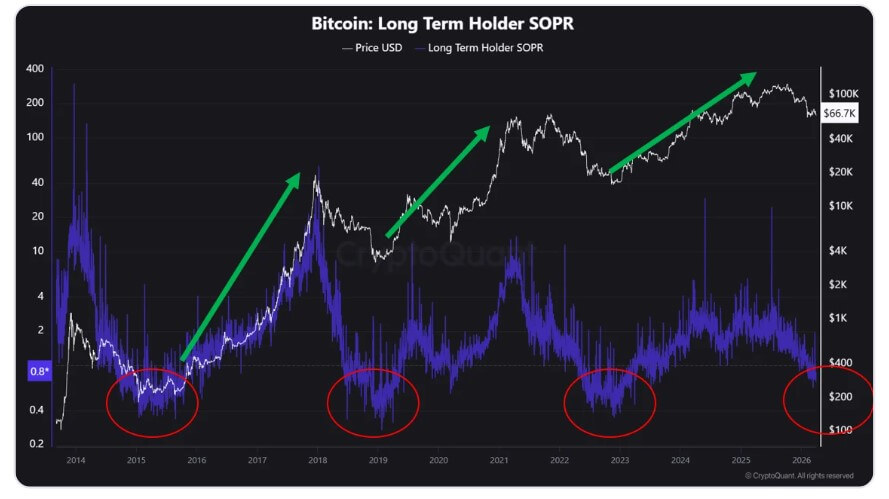
This assessment aligns with observations made by Glassnode indicating elevated realized losses persisting into late March without overt signs of panic—a suggestion that long-term holders engaged in controlled de-risking rather than indiscriminate liquidation events.
The increase in unrealized losses remained consistent with historical norms—implying stress levels were intensifying but had yet to precipitate wholesale market washouts.
An analysis conducted by VanEck indicated diminished transfer volumes month-over-month across all long-term holder age cohorts—evidence suggesting older coins were being transacted less frequently while distributions among long-term holders decelerated substantially.
This observation infers that while some experienced holders may have sought risk mitigation earlier during Q1—the overarching pattern was gradually evolving towards restraint rather than aggressive liquidation measures.
Taken holistically—the messaging conveyed through the quarter is far more nuanced than mere assertions depicting smart money exiting amid weakness; long-term holders are realizing losses but engaging in measured approaches devoid of panic-induced actions.
Bears Maintain Dominance Over Derivatives Markets
If spot trading volumes coupled with on-chain flows delineated one facet of market behavior—the derivatives landscape presented additional insights concerning prevailing sentiment.
According to Glassnode’s recent analysis—the perpetual funding rates remained firmly negative even amidst stabilization attempts from Bitcoin’s price—a clear indication that traders continue favoring downside exposure through derivative instruments.
The same report highlighted muted futures open interest levels suggesting that leverage has not been reinitiated effectively in anticipation of recovery movements.
A comparative assessment revealed spot market activity remained relatively subdued following selloff events into the $67K range—with exchange volumes reflecting only modest responses while any uptick appeared reactive rather than driven by conviction-based buying behavior.
This distinction bears importance since price stabilization does not inherently equate to buyer enthusiasm returning en masse; through late March—the perception surrounding Bitcoin’s trading environment appeared more balanced than during prior selloff phases yet lacked substantial bullish undertones.
Options markets mirrored this caution reflected through derivatives trading dynamics—with VanEck observing put-call open interest ratios averaging around 0.77 mid-March—the highest ratio recorded since June 2021—as well put premiums relative to spot volume achieving unprecedented highs around four basis points.
This suggests investors are incurring substantial costs associated with acquiring downside protection despite stable price actions—not indicative characteristics reflective of markets leaning towards upward movements; rather they illustrate lingering apprehensions about potential shocks ahead.