
Market Analysis: Bitcoin’s Recent Decline and Macro Influences
On Friday, Bitcoin (BTC) experienced a notable decline, retreating towards the $65,000 mark as investors exhibited a discernible reduction in exposure to risk assets. This market behavior was largely precipitated by escalating geopolitical tensions in the Middle East, which resulted in elevated oil prices, surging Treasury yields to levels not observed in months, and a strengthening dollar.
According to data from CryptoSlate, Bitcoin’s price trajectory saw a precipitous drop of nearly 5%, settling around $66,484—its lowest valuation since the commencement of March. This downturn continues a broader trend wherein the premier cryptocurrency consistently struggles to maintain its value amidst the re-emergence of macroeconomic pressures.
An analyst from Bitunix provided insight into the current market conditions, stating:
“BTC has fully transitioned into a reflector of liquidity structure. Price action remains confined within a broad $65,000–$72,000 range, with volume distribution showing clear supply overhead above $70,000, while the $65,000 region continues to accumulate passive demand.”
Further analysis from CoinGlass revealed that recent price movements resulted in approximately $200 million being wiped from the portfolios of crypto traders within a single hour, with long positions bearing the brunt of these losses.
Determinants of Bitcoin’s Price Decline
The current depreciation of Bitcoin cannot be attributed to an isolated shock within the cryptocurrency sector. Instead, it is intrinsically linked to geopolitical upheaval that has reverberated throughout global financial markets.
In a statement on Truth Social, former President Donald Trump disclosed a postponement of aggressive military action against Iranian energy infrastructure by an additional ten days, extending the deadline to April 6 amid ongoing negotiations. This announcement introduced renewed volatility into global markets; Brent crude oil surged toward $110 per barrel, while the yield on the US 10-year Treasury note ascended to 4.456%, marking its highest point since July. Concurrently, the Nasdaq index remained mired in correction territory following an 11% decline from peak levels.
The dollar has also strengthened considerably, positioning itself for its most robust monthly performance since July 2025 as investors gravitated towards safe-haven assets and markets recalibrated expectations for tighter financial conditions.
In this context, market analysts have posited that Bitcoin’s current decline underscores its characterization as a high-beta risk asset rather than a reliable hedge against geopolitical instability. As oil prices surge, investors are not only confronted with narratives of conflict but also heightened inflation expectations and potential increases in borrowing costs—factors that collectively contribute to an adverse environment for traditionally valued assets such as Bitcoin.
The Macroeconomic Reset: Oil Prices and Treasury Yields
A comprehensive understanding of recent market movements necessitates an examination of the dynamics surrounding oil prices and interest rates following Trump’s announcement. The deferment of military action may have altered immediate expectations regarding conflict timelines; however, it failed to assuage market concerns regarding inflationary pressures that continue to afflict risk assets.
Data sourced from Oilprices.org indicates that oil benchmarks have risen significantly since the onset of hostilities, with Brent crude increasing by 52% and US crude by 43%. Such substantial gains perpetuate inflationary fears even during periods where diplomatic efforts appear promising.
This inflationary narrative fundamentally influences Bitcoin’s pricing structure. Elevated oil prices not only signal geopolitical risks but also reflect concerns regarding persistent inflation that compel central banks to maintain tighter monetary policies for extended durations.
A Reuters poll dated March 26 highlighted that most economists anticipate the Federal Reserve will hold interest rates steady until at least September; however, financial markets have shifted their outlook dramatically—from expecting rate cuts to speculating on potential rate hikes later this year. On Friday, markets were pricing in a 70% probability that the Fed would raise rates in 2026. This confluence of factors presents a challenging environment for Bitcoin: rising energy costs paired with increased real-world borrowing expenses and an overarching focus on persistent inflation detract from the asset’s attractiveness.
The dollar’s impressive performance throughout March has compounded these challenges. According to data from TradingView, the dollar index is poised for a monthly increase of 2.4%, marking its best monthly performance since July as investors seek safety and reassess US interest rate projections. A robust dollar typically tightens global financial conditions autonomously while rendering speculative trades less appealing.
Given these dynamics, Bitcoin—having already lost momentum in preceding weeks—was particularly susceptible to shifts in investor sentiment as broader markets curtailed risk exposure.
Reliability of ETF Support Diminishes
Concurrently, Bitcoin’s descent towards $65,000 underscores that post-ETF market dynamics require consistent institutional inflows to effectively absorb selling pressure.
While demand for spot Bitcoin ETFs has not entirely evaporated this month, flow patterns have exhibited volatility concurrent with deteriorating macroeconomic conditions.
Data from SoSoValue indicates that after witnessing substantial inflows approximating $2 billion at the outset of March, there has been a marked deceleration in subsequent investment activity.

For context, US-listed investment vehicles recorded net outflows exceeding $70 million during this trading week compared to inflows totaling approximately $767 million during the week ending March 13. These figures illustrate a market landscape where institutional demand is no longer consistent or predictable.
The variability of ETF inflows can significantly buffer cryptocurrencies against adverse macro headlines; however, inconsistent inflows leave Bitcoin vulnerable to fluctuations in interest rates and equities akin to other risk assets within the broader financial ecosystem.
The Impact of Options Expiry on Market Movement
The selloff observed on Friday coincided with one of the largest derivatives expirations of the year.
Data from Greeks.live reveals that approximately $13 billion worth of Bitcoin options were set to expire on this date, characterized by a put-call ratio of 0.56 and a maximum strike price reaching $74,000.
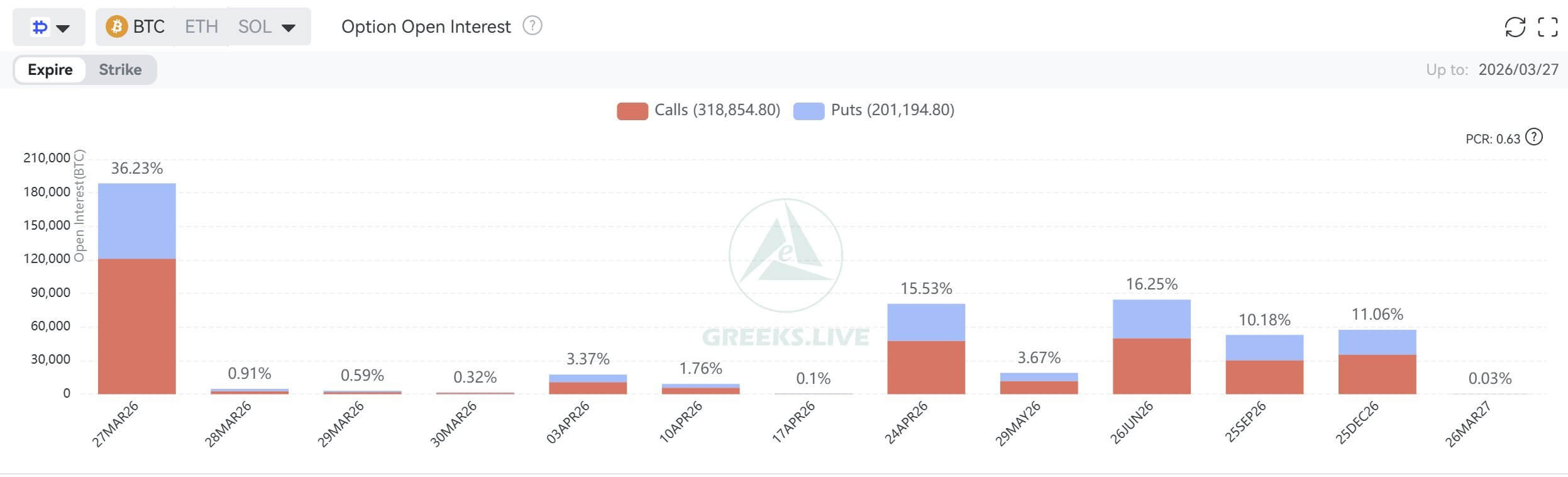
An assessment from Greeks.live indicated:
“Despite prevailing market volatility, trading activity for Bitcoin remains relatively subdued. Key options data suggest that Bitcoin’s main-term implied volatility (IV) stands at 51%, compared to Ethereum’s at 70%. As risk premiums continue their descent (RV), we observe an uptick in volatility risk premiums (VRP); during the initial half of this week alone, the 15-day VRP approached nearly 20%. Overall market confidence remains tepid following poor performance across both price dynamics and trading activity during Q1.”
A Bitcoin options contract provides its holder with the right—but not the obligation—to purchase BTC at a predetermined price before or on a designated future date. Consequently, traders often recalibrate their positions as expiration dates draw near—leading to pronounced price fluctuations as they either roll contracts forward or liquidate trades entirely.
As such significant options expirations frequently correlate with substantial market sell-offs; however, this outcome is not guaranteed nor automatic.
Current Market Dynamics and Future Implications
The recent movement toward $65,000 reflects more about prevailing market conditions than it does about any intrinsic loss of faith in Bitcoin itself. The cryptocurrency continues to be influenced by inflationary expectations, central bank policies, oil price volatility, and dollar strength. When multiple macroeconomic variables shift unfavorably for risk assets concurrently, BTC does not enjoy any preferential treatment; rather it experiences declines akin to other high-risk investments.
This prevailing environment positions Bitcoin within a constricted yet critical trading framework. Analysts at Bitunix articulated:
“In the near term, if geopolitical tensions remain ‘delayed but unresolved’ alongside tightening rate expectations, BTC is more likely to experience high-frequency range-bound volatility—oscillating between $65,000 and $72,000 as liquidity is redistributed among market participants. A genuine directional breakout necessitates alignment across key macroeconomic variables rather than being catalyzed by any singular event.”
As of press time 12:33 pm UTC on Mar. 27, 2026, Bitcoin holds its position as the leading cryptocurrency by market capitalization at approximately $1.33 trillion, reflecting a decline of 4.12%
Crypto Market Summary
The overall crypto market valuation stands at approximately $2.29 trillion, with a corresponding trading volume over 24 hours amounting to $100.46 billion. Current Bitcoin dominance is calculated at 57.99%.
“`