
Analysis of the Bitcoin Network’s Recent Two-Block Reorganization
On March 23, 2026, the Bitcoin network encountered an unusual two-block reorganization at block height 941,880. This incident was characterized by Foundry mining six consecutive blocks, while AntPool and ViaBTC briefly extended an alternative branch. Ultimately, the network resolved the fork as anticipated, adhering to its foundational principle: the chain with the most accumulated hash rate prevails. This event serves as a critical validation of Bitcoin’s design and its underlying assumptions regarding network security and transaction finality.
The Heuristic of Six Confirmations
The concept of requiring six confirmations for transaction finality in the Bitcoin ecosystem has evolved into a widely accepted heuristic, often repeated without an understanding of its foundational rationale. This standard can be traced back to Satoshi Nakamoto’s seminal 2008 whitepaper, which posited that finality is contingent upon the probability of an attacker catching up with the blockchain. As transaction blocks accumulate above a specific transaction, the computational burden required to amend historical records becomes prohibitively high for an adversary possessing limited hash power.
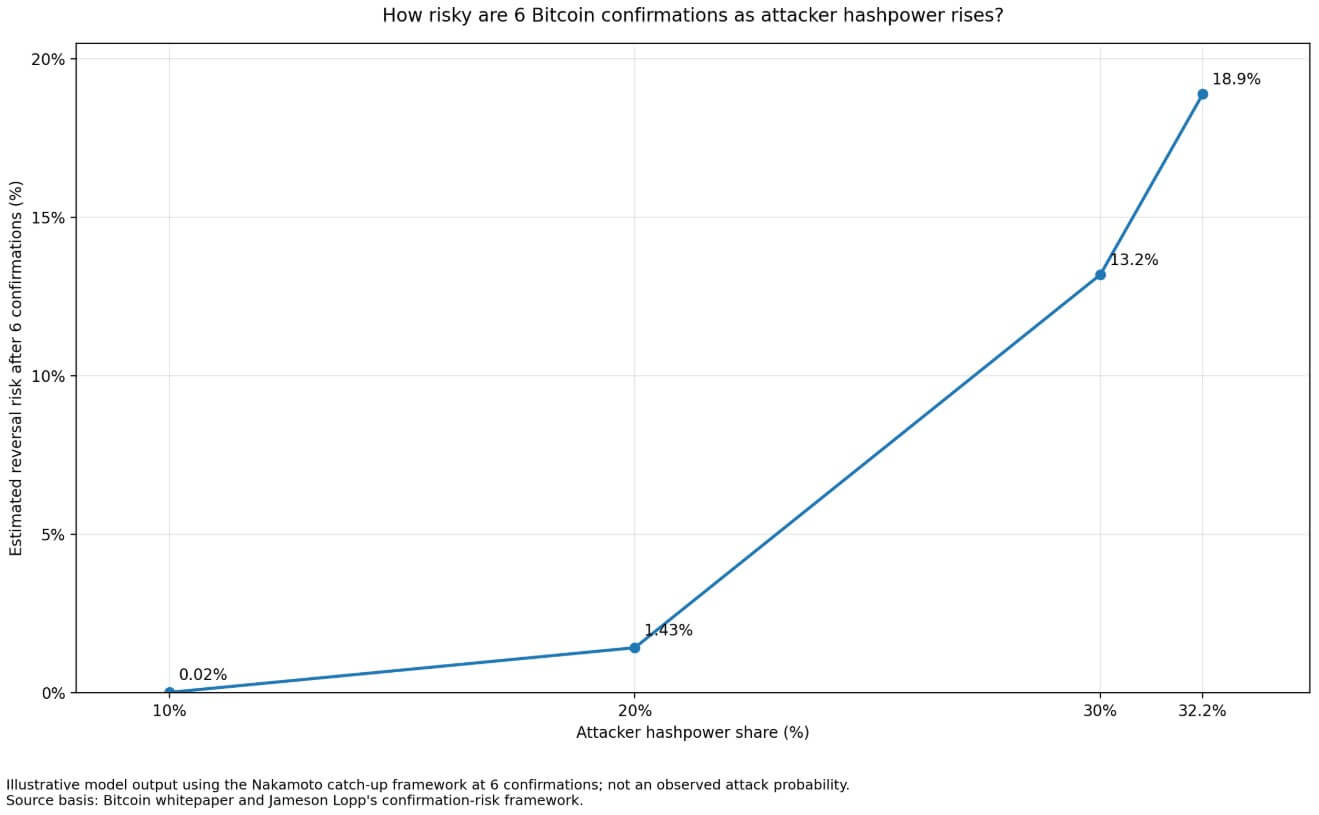
The designation of six confirmations as a threshold for safety is rooted in the assumption that an attacker controls approximately 10% of the network’s hash power. This assumption has significant implications when assessing transaction security:
– A six-confirmation model against an adversary with 10% hash power yields a reversal risk of approximately 0.02%.
– If that adversary controls 20%, the risk escalates to about 1.43%.
– A scenario involving a 30% adversarial control results in a reversal risk nearing 13.2%.
– Most notably, recent data indicates that Foundry’s share approximated 32.2%, thereby inflating the reversal risk associated with six confirmations to approximately 18.9%.
It is important to note that while mining pools are not inherently coordinated attackers, their aggregated hash power presents a different risk profile than individual miners operating independently. Foundry USA positions itself as an institutional-grade mining pool that coordinates numerous independent operators. Consequently, miners may shift between pools based on economic incentives, which complicates traditional models of transaction finality.
Furthermore, a latency security analysis conducted in 2022 highlighted that even under optimal conditions (i.e., for an adversary with only 10% control), six confirmations could still yield a safety violation probability ranging from 0.11% to 0.35%. Thus, it can be inferred that six confirmations were never intended as an absolute safeguard against all risks.
The Current Context and Its Implications
The circumstances surrounding the recent reorganization are noteworthy due to several concurrent factors impacting the Bitcoin ecosystem:
1. **Hashrate Concentration**: As of recent metrics, Foundry commanded roughly 31% of the global hashrate, while AntPool and ViaBTC held approximately 18.4% and 10.5%, respectively. Collectively, these three pools accounted for around 60% of total block production—an unprecedented level of concentration not seen in recent years.
2. **Economic Pressures within Mining**: The economic environment for miners has deteriorated sharply; notable indicators include a significant difficulty adjustment (a decrease of 7.76% on March 21) and plummeting hash prices—averaging $32.31 per petahash per day in February and even touching a record low of $27.89.
3. **Transaction Fee Dynamics**: Transaction fees contributed merely 0.57% to total block rewards in the most recent available data, indicating a reliance on declining block-subsidy economics.
In light of these dynamics, smaller and mid-sized miners are increasingly incentivized to consolidate under larger mining pools to stabilize their earnings—an outcome that amplifies existing concentration trends within the network.
| Condition | Latest Reading | Implications for Six Confirmation Rule |
|---|---|---|
| Pool Concentration | Foundry ~31%; AntPool ~18.4%; ViaBTC ~10.5% | A larger share of block production is concentrated within few coordinators, challenging fixed-confirmation assumptions for high-value transactions. |
| Top-Three Concentration | ~60% of block production combined | Transaction finality depends not solely on block count but also on how distributed hash power is among competing pools. |
| Difficulty Adjustment | -7.76% on March 21 | A substantial negative adjustment reflects stress within mining operations and contributes to declining network economics. |
| February Hashprice | $32.31 per PH/day | Reduced miner revenues enhance incentives for smaller miners to seek stability through larger pools. |
| Intramonth Hashprice Low | $27.89 | As profit margins tighten further, pooling for variance reduction becomes increasingly attractive. |
| Fee Contribution to Rewards | 0.57% in the last 24 hours | Poor fee support results in greater dependency on diminishing block-subsidy rewards. |
| Counterpoint: Redistribution Risk | Foundry reportedly fell ~60% during January winter storm | This illustrates that while current concentration levels are elevated, they remain susceptible to rapid redistribution under external shocks. |
In practice, major exchanges have already adjusted their operational protocols away from rigid adherence to six confirmations as an absolute standard for transaction finality—a decision informed by nuanced assessments of risk tolerance relative to use cases:
– **Coinbase** mandates two confirmations for BTC deposits classified as pending.
– **Kraken** and **Gemini** stipulate three confirmations.
This discrepancy underscores that while six confirmations may serve as a cultural benchmark within the community, it does not universally apply across varying contexts in transaction value or risk exposure.
Future Considerations and Risk Assessment Frameworks
The ongoing situation highlights divergent potential trajectories concerning hashrate concentration and its implications for user confidence:
– On one hand, if hashrate redistributes toward a broader array of coordinators due to recovering margins or new market entrants, then six confirmations may retain their viability as a standard for substantial BTC settlements.
– Conversely, should Foundry maintain its dominance above a critical threshold (e.g., over 30%) alongside persistently high concentration among leading pools without significant fluctuations in market conditions, stakeholders may reevaluate their internal thresholds for confirmation requirements—particularly those engaged in high-value transactions.
The Nakamoto model suggests that maintaining six confirmations against an adversary controlling over one-third of hash power yields an untenable catch-up risk close to 18.9%. Such figures challenge traditional narratives surrounding “effectively irreversible” transfers involving multi-million-dollar sums.
The recent two-block reorganization event starkly illuminated the widening gap between established folklore regarding Bitcoin’s finality standards and the mathematical realities underpinning them.
This juncture signifies a critical moment wherein practitioners must confront the limitations inherent in current practices surrounding confirmation policies as they consider future adaptations within this evolving landscape.