
The following is a guest post and analysis from Vincent Maliepaard, Marketing Director at Sentora.
The Ascendancy of Stablecoins and the Imperative for Enhanced Metrics in DeFi
In recent times, stablecoins have emerged as a significant settlement layer within the broader financial ecosystem, evidencing their growing prominence through substantial transactional volume. Notably, Visa reported an escalation in global stablecoin transaction volumes from over $3.5 trillion in 2023 to exceeding $5.5 trillion in 2024. This trend signifies not merely a fleeting experiment within the financial landscape, but rather the crystallization of an infrastructural element that is garnering tangible demand.
However, amidst this progress lies an intrinsic challenge: decentralized finance (DeFi) continues to evaluate its metrics predominantly through a framework of Total Value Locked (TVL), which may be misaligned with the current objectives of stability and resilience.
TVL: An Inadequate Metric for Assessing DeFi’s Durability
Throughout much of the preceding market cycle, TVL has served as the de facto metric for gauging success within DeFi ecosystems. Initially, TVL proved beneficial as it provided a straightforward indication of user willingness to migrate capital onto blockchain platforms. It facilitated market observers in tracking adoption during a formative period characterized by skepticism regarding decentralized infrastructure. However, as the imperative transitions from mere growth to sustainable durability, the utility of TVL diminishes significantly. This metric primarily reflects the volume of capital entering a protocol rather than how effectively that capital is safeguarded once deposited.
The distinction between exposure and strength is critical in this context.
A protocol may showcase hundreds of millions in deposits yet remain fundamentally vulnerable. Should these deposits rest upon precarious dependencies, flawed oracle mechanisms, concentrated governance structures, or insufficient safeguards, high TVL does not equate to systemic robustness; it merely indicates an increase in capital exposure. In this regard, TVL functions more as a gross measure of activity than as a legitimate indicator of intrinsic value. It elucidates where capital resides but fails to convey whether that capital enjoys adequate protection.
The ramifications of relying on TVL as a primary metric have been starkly illustrated by historical precedents.
In instances where significant protocols have experienced exploitation or failure, the associated TVL has plummeted dramatically. For example, Ronin’s TVL experienced a precipitous decline from approximately $1.2 billion prior to its 2022 bridge exploit to roughly $15 million today, as per data sourced from DeFiLlama.
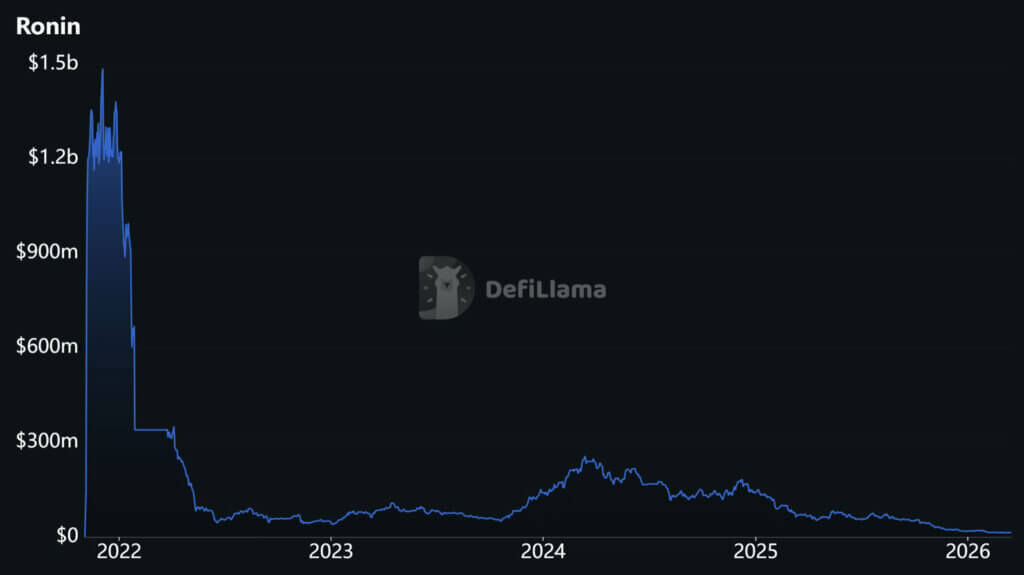
Such occurrences are not isolated incidents; they underscore the reality that mere deposit levels do not engender trust or value within decentralized frameworks. A substantial balance can evaporate swiftly once market participants recognize that the underlying protections are either tenuous or altogether absent.
This concern becomes increasingly salient as DeFi approaches broader mainstream financial distribution.
Facilitating DeFi’s Next Growth Phase
The forthcoming wave of adoption will not stem from necessitating that every user become an adept in on-chain risk management; rather, it will arise from traditional financial institutions—such as banks, fintech companies, exchanges, and consumer applications—leveraging DeFi technologies while simplifying user experiences. The objective will be to present users with streamlined interfaces: one deposit, one balance, and one yield figure. Nevertheless, this simplicity does not eradicate underlying risks; it merely obscures them. If the foundational capital remains susceptible to smart contract vulnerabilities, oracle discrepancies, and composability risks without clearly defined protective measures, then an ostensibly cleaner interface does not render the product suitable for institutional engagement; it only conceals risks from potential users.
This necessity underscores the call for an alternative metric: Total Value Covered (TVC).
TVC quantifies the capital explicitly shielded by well-defined risk-transfer mechanisms. While TVL provides insight into how much capital is present within a system, TVC offers a more relevant indicator of how much capital the system is equipped to protect effectively. This distinction serves as a more reliable gauge for institutional readiness since serious asset allocators seek not only to understand how much capital is accessible within a market but also how much can be deployed with clearly defined downside protection. They prioritize comprehension of capacity for safeguarded capital rather than solely appetite for risk.
Transforming Incentives through a TVC Framework
Under a paradigm dominated by TVL metrics, protocols tend to compete primarily on their ability to maximize deposits. Frequently, this leads to strategies such as increasing yield rates, enhancing incentives, or streamlining distribution channels. Conversely, within a framework that prioritizes TVC awareness, protocols are compelled to enhance their capacity for safely supporting capital inflows. Key considerations such as improved governance structures, cleaner technological dependencies, robust operational controls, enhanced monitoring capabilities, and resilient architectural frameworks become economically significant because they expand coverage capacity while concurrently reducing protection costs. Consequently, competition pivots from merely attracting capital towards safeguarding that capital effectively.
This paradigm shift would cultivate a healthier ecosystem within DeFi.
It would furnish users, strategic partners, and institutional allocators with greater clarity regarding which protocols are genuinely engineered for longevity and resilience. Moreover, this would establish a more meaningful benchmark for the next generation of on-chain products—especially those designed with institutional and mainstream users in mind. In an evolved marketplace, inquiries should transcend mere accumulation metrics; they must encompass how effectively protocols can sustain and protect capital under stress conditions.
This trajectory delineates the genuine path from crypto-native growth towards institutional scalability.