

preferred on

OpenServ, a company at the intersection of artificial intelligence and cryptocurrency, is navigating two distinct narratives: the development of an advanced AI infrastructure and the proliferation of a crypto token model. Their assertion that their innovative SERV Nano framework can either match or surpass OpenAI in specific tasks has rendered their proposition increasingly compelling, albeit with a heightened bar for substantiation.
The Dual Narrative of OpenServ: AI Infrastructure and Crypto Tokenization
OpenServ characterizes itself as a comprehensive platform designed for the development, deployment, and management of autonomous startups. Its offerings encompass a range of product functionalities including AI agents, workflow optimization tools, reasoning architecture, token launch frameworks, and monetization strategies executed on-chain. This positions OpenServ within an emergent category that remains largely underdeveloped.
Implications of EDX Markets’ Federal Trust Bank Charter Application
EDX Markets’ pursuit of a federal trust bank charter serves as a critical evaluation point for Wall Street-backed institutions attempting to integrate a larger segment of cryptocurrency’s custody and settlement processes within the regulatory confines of U.S. banking infrastructure. This endeavor holds broader implications beyond mere expansion narratives in the cryptocurrency domain.
Operational Layering in AI: The Underpinning Challenge
A significant portion of the artificial intelligence landscape continues to be dominated by models, user interfaces, and various wrappers. However, the more intricate operational layers—those requiring bounded reasoning, fiscal prudence, auditable outputs, and sufficient structural integrity to navigate tasks laden with budgetary constraints and real-world ramifications—remain relatively unaddressed.
Investigating OpenServ’s Positioning: AI or Blockchain?
The branding surrounding OpenServ’s launch on platforms such as Base and Solana poses an essential inquiry: does OpenServ primarily represent a blockchain initiative or an artificial intelligence project augmented by blockchain technology? The prevailing evidence suggests that it aligns more closely with the latter.
OpenServ’s documentation presents it as an agentic infrastructure layer aimed at supporting AI-driven products and autonomous business workflows. The cryptocurrency aspect is relegated to facilitating token creation, launch mechanics, incentive structures, fee flows, and overall capitalization.
The details surrounding the $SERV token highlight its function as a native ecosystem currency intrinsically tied to usage metrics, burn mechanisms, and reward systems across the platform. This framing indicates an operational model that is distinctly crypto-centric in its application to artificial intelligence.
Architectural Layers: Dissecting OpenServ’s Strategy
OpenServ’s architectural framework can be best understood through a layered approach. At the apex resides the narrative surrounding autonomous startups, AI agents, and self-service tools. The middle layer encompasses the orchestration component where OpenServ posits that its structured reasoning architecture can efficiently coordinate agent behaviors in contrast to generic prompt chains.
The foundational layer consists of crypto-economic mechanisms enabling project token launches, liquidity creation, and routing of platform value through ecosystem assets. The company’s public communications consistently intertwine these components into a cohesive narrative.
The strategic utilization of Base offers OpenServ an Ethereum Virtual Machine (EVM)-compatible environment conducive to token launches and liquidity operations. Concurrently, Solana provides access to a rapid and cost-effective ecosystem engaged in retail token experimentation and on-chain application development.
Market Flexibility versus Dependency
The dual-chain strategy broadens OpenServ’s potential market reach while also allowing it to portray itself as flexible rather than dependent on any single blockchain solution. For a firm aiming to penetrate the crypto-native audience with AI tools, this design proves commercially advantageous.
The Defense of Propositions: Evaluating Claims and Risks
However, this raises critical questions regarding the sustainability of their competitive edge. While the ability to attract attention through a token launch framework is significant—especially amidst the current market appetite for AI-linked assets—the long-term defensibility typically resides deeper within the operational stack.
If OpenServ’s lasting advantage is rooted in its orchestration capabilities, then Base and Solana serve merely as deployment venues while the true asset lies within its proprietary reasoning architecture that aims to enhance affordability, speed, and reliability for AI agents. Conversely, if its primary strength is in token design or chain-level packaging, it risks being perceived as little more than a crypto distribution mechanism cloaked in an AI narrative.
Benchmarking Against Industry Standards: The Role of SERV Nano
The crux of OpenServ’s current positioning revolves around its benchmark claims related to its reasoning framework and SERV Nano offering. Executives assert that this system can not only match but potentially outperform OpenAI models across standard evaluations while doing so at significantly reduced costs and elevated speeds.
This dual-layered assertion serves two pivotal purposes: it underscores OpenServ’s engagement with a genuine technical bottleneck within agent systems while simultaneously establishing a valuation link between infrastructural efficacy and potential token appreciation.
The Burden of Proof: Methodology and Task Selection
Once claims such as “matched GPT-5.4 at 20x lower cost and 3x greater speed” are articulated, the burden shifts toward validating methodology, task selection criteria, reproducibility of results, and evidence supporting real-world deployment scenarios.
OpenServ has disseminated documentation concerning its BRAID framework—an acronym for Bounded Reasoning for Autonomous Inference and Decisions—which purportedly enhances performance per dollar invested while improving reliability across bounded tasks by substituting loosely structured prompting with a more deterministic approach that is machine-readable.
A Comparative Analysis with OpenAI Models
The associated academic publication available on arXiv provides some technical depth beyond typical promotional materials; however, it necessitates rigorous scrutiny against established benchmarks set forth by industry competitors like OpenAI.
Differentiating Claims: Orchestration versus Model Capability
Understanding what exactly is being compared becomes imperative for OpenServ. If SERV Nano is perceived merely as another model offering, it represents one type of competitive claim. Alternatively, if it functions as an orchestration layer augmenting an existing model’s capabilities, then this represents a different competitive paradigm altogether.
An understanding of how bounded tasks with narrow decision trees can yield substantial advantages in enterprise settings—where reliability and cost efficiency often supersede broad conversational capabilities—is crucial for contextualizing these claims.
Evidentiary Thresholds: Establishing Credibility through Deployment
While none of these considerations invalidate the benchmark claims outright—since a structured reasoning layer delivering enhanced accuracy per dollar on bounded tasks addresses significant pain points within enterprise AI—it raises pertinent questions about evidence sufficiency around configuration choices, task selection methodologies, reproducibility protocols, and customer validation frameworks.
- Which specific models from OpenAI were utilized for comparison?
- Under what conditions were these comparisons conducted?
- What operational definitions accompany terms like “matched”?
- Were context windows aligned? Were tasks derived from public benchmarks or proprietary enterprise workflows?
- What proportion of any reported cost advantages stemmed from model selection versus orchestration logic?
The Importance of Rigorous Standards in Infrastructure Development
A serious commitment to infrastructure should embrace these rigorous standards since sustainable value accrues to platforms capable of substantiating their claims under independent scrutiny. As such, public messaging has evolved beyond mere model economics into assertions about production credibility bolstered by references to enterprise adoption alongside government utilization claims from entities such as the UAE government.
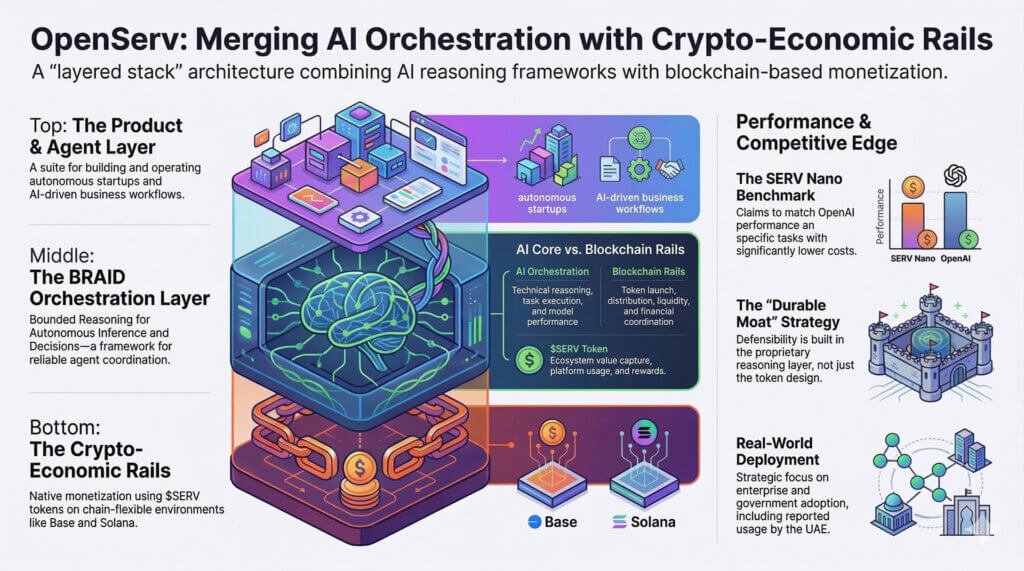
If substantiated appropriately through independent sources verifying deployment claims regarding enterprise relationships—whether categorized as pilot projects or fully-fledged production systems—the implications would significantly enhance OpenServ’s market position. This would signify a transition from merely having an appealing architectural framework toward establishing credibility as an operational player within AI-driven contexts constrained by real-world demands.
This transition carries considerable weight; thus far, public documentation offers partial visibility without providing comprehensive verification protocols. While details surrounding their framework architecture offer some insight into their operations—their tokenomics integrates fluidly with product architecture—the challenge remains in independently confirming deployment specifics while simultaneously distinguishing between paid contracts versus exploratory partnerships within enterprise environments.
Navigating Market Dynamics: The Role of Trust in Agent Infrastructure
The overarching market context elucidates this scenario further as demand intensifies for trustworthy execution layers amid agent infrastructures capable of managing budgetary constraints while adhering strictly to operational parameters.
Recent analyses spanning both artificial intelligence and cryptocurrency sectors have increasingly focused on verification methodologies alongside issues surrounding escrow services and machine payment systems—especially pertinent when agents engage beyond simple conversational roles into transactional actions governed by policy stipulations. This backdrop renders OpenServ’s pitch increasingly relevant compared to generic narratives linking AI frameworks with cryptocurrency tokens.
The necessity for reliable agent execution layers equipped with structure fostering accountability cannot be overstated; agents endowed with authority must operate within reliable frameworks characterized by bounded logic enabling auditability alongside accountability measures capable of sustaining trust relationships across their operational environments.
This emphasis additionally elevates expectations for transparency regarding each supporting claim associated with infrastructure integrity; deployment references should be unequivocally identifiable concerning their scope while ensuring clarity around contractual agreements existing between enterprises or governmental entities utilizing these systems. Furthermore:
- A token must exhibit clarity concerning its role in accruing value rather than functioning merely as ambient upside surrounding traditional SaaS platforms.
- Each assertion should be manageable yet collectively form coherent pathways leading towards established proof thresholds necessary for validation purposes.
In conclusion, while OpenServ warrants considerable attention due to its innovative pursuits at the intersection between artificial intelligence infrastructures supported by blockchain technology—the current framing still requires disciplined scrutiny. The company appears poised to establish itself firmly within the arena characterized by crypto-native infrastructures leveraging blockchain rails provided through Base alongside Solana—all while utilizing benchmark results against established models from competitors such as OpenAI to assert that its reasoning capabilities deliver superior economic advantages under specified task conditions.
This strategic packaging effectively addresses pressing market demands yet simultaneously creates promotional opportunities that may advance ahead prior substantive confirmations being achieved.
In essence:
OpenServ stands at a pivotal juncture—its success hinges upon accumulating verifiable evidence showcasing named deployments coupled with reproducible methodological frameworks alongside customer testimonials confirming tangible outcomes deriving from benchmark results translating seamlessly into operational realities prevalent within more complex environments.
Whether this ambition materializes remains contingent upon whether they successfully navigate these challenges whilst maintaining focus on delivering genuine advancements across layered structures integrating models alongside monetization schemes orchestrated effectively.
For now though—OpenServ embodies less about existing solely as another standalone blockchain protocol but rather emerges distinctly characterized within emerging domains driven predominantly towards developing crypto-native environments fostering robust infrastructures designed explicitly around leveraging synergies yielding tangible benefits derived directly from enhanced reasoning layers integrated seamlessly amidst broader operational contexts.
“`