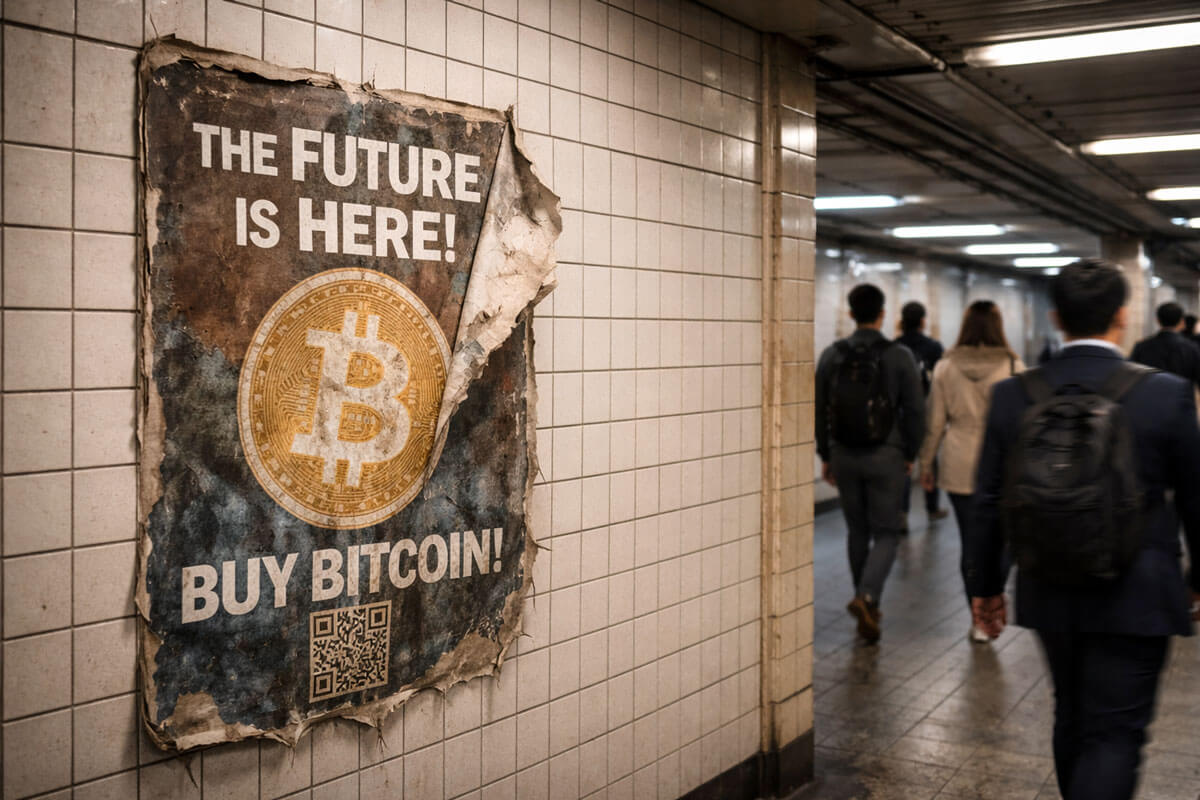
Bitcoin’s Current Public Engagement: A Comparative Analysis with 2017
Despite a marked increase in institutional access to Bitcoin—an unprecedented development in the cryptocurrency’s history—public interest has not experienced a corresponding resurgence. The advent of Spot Exchange-Traded Funds (ETFs) has facilitated a regulated channel for previously sidelined capital, while corporate treasury investments have further embedded Bitcoin into executive discussions. This evolution has catalyzed a significant rise in the asset’s price and visibility within financial circles; however, public search behavior suggests a divergent trajectory.
Institutional Growth vs. Public Interest
The pronounced increase in institutional engagement has not translated into a parallel escalation in public fascination. Analysis of Google Trends data reveals that global search interest in the term “Bitcoin” remains substantially below its late-2017 zenith, notwithstanding years of advancements in ETF offerings, treasury accumulation, and widespread adoption rhetoric.
This disparity underscores a central tension: while Bitcoin has penetrated institutional channels, mass curiosity remains muted compared to the fervor exhibited during prior retail-driven surges. The latest rally is predominantly fueled by institutional frameworks—ETFs, corporate treasuries, and professional market infrastructure—differentiating it significantly from previous cycles dominated by retail enthusiasm.
Shifts in Market Dynamics
The 2017 cycle was characterized by an expansive social pull, where search traffic surged as first-time buyers swarmed exchanges. The cryptocurrency transitioned from a niche financial subculture to mainstream dialogue. In contrast, the current cycle exhibits a more mature market structure, underpinned by deeper liquidity and formal ownership vehicles.
As evidenced by reports from CryptoSlate, even significant price milestones—such as Bitcoin surpassing $106,000—occurred without the typical retail frenzy observed in previous cycles. Retail participation appears to be subdued even amidst new all-time highs, as indicated by app-download trends and stagnant search behavior.
Analyzing Search Behavior: A Benchmark against 2017
Google Trends employs a methodology that measures relative search interest rather than absolute search volume, thus offering insights into comparative intensity rather than exact counts. The data, normalized and scaled from 0 to 100 within specified parameters, demonstrates that Bitcoin’s defining high occurred in late 2017. Subsequent surges in search interest during 2021 and thereafter have consistently fallen short of this benchmark.
This gap is particularly salient for analysts seeking to gauge public engagement vis-à-vis institutional growth. While retail demand has shown signs of recovery since early 2025, it has not rebounded with the vigor characteristic of prior peaks. Furthermore, by December 2025, it became increasingly apparent that the market was being shaped by institutional players such as banks and custodians rather than retail investors.
Institutionalization vs. Mass Public Re-engagement
The market’s gravitational center has undeniably shifted towards institutional participation. Spot ETFs have normalized Bitcoin exposure for investors accustomed to regulated environments. Treasury accumulation introduces a corporate dimension that was virtually nonexistent during the 2017 cycle. This transformation presents a conundrum: while institutionalization can sustain elevated prices, it does not inherently elicit heightened public curiosity or engagement.
The divergence between price movements and public attention can be attributed to the distinct behaviors exhibited by institutional investors compared to retail participants. Portfolio managers operating through ETFs do not generate the same level of search activity as novice retail buyers seeking information on wallets and exchanges.
The Future of Public Engagement with Bitcoin
The question now arises: can Bitcoin leverage its formal legitimacy to catalyze a new phase of widespread public demand? Or will this cycle continue to be defined primarily by institutional capital operating through sophisticated financial structures? The answer bears significant implications for the cryptocurrency’s trajectory.
Public attention serves as an important indicator of social reach; individuals tend to engage with topics they are curious about through online searches. Historical data illustrates that during times of heightened interest, such as the late 2017 peak, search activity surged dramatically. The current cycle has achieved considerable financial milestones without igniting comparable levels of public curiosity—a clear indication that the market’s character has evolved.
Conclusion: Bridging the Gap between Institutional Success and Public Curiosity
The juxtaposition of growing institutional acceptance against subdued public engagement creates a compelling narrative for analysts and investors alike. While capital can flow through ETFs and treasuries accumulate on balance sheets, ongoing low levels of global search interest indicate that mass public re-engagement remains incomplete.
The next significant threshold lies in fostering broader participation from retail investors—a phenomenon likely to be manifest across multiple indicators such as enhanced worldwide search interest, increased demand for exchange applications, and heightened social curiosity extending beyond finance-centric communities. Until such signals coalesce, it is prudent to infer that Bitcoin’s current strength is predominantly supported by structural advancements rather than comprehensive public re-engagement.