
Integration of Bitcoin into U.S. Household Finance: An Analytical Perspective
Bitcoin is increasingly permeating the realm of U.S. household finance, particularly as prospective homebuyers, constrained by elevated borrowing costs and a dearth of available inventory, seek innovative solutions to secure down payments without liquidating their digital asset holdings. The recent collaboration between Better Home & Finance and Coinbase represents a significant advancement in this domain.
Launch of Crypto-Backed Mortgages
On March 26, 2026, Better Home & Finance and Coinbase unveiled a pioneering structure that permits eligible borrowers to leverage Bitcoin or USD Coin (USDC) stablecoin as collateral to obtain a separate loan designated for a down payment, all while simultaneously securing a standard conforming mortgage for the property in question.
This arrangement engenders a notable intersection of cryptocurrency with one of the most scrutinized segments of the U.S. credit system, coinciding with affordability pressures that are substantially altering the demographics of prospective homebuyers and the timing of their purchases.
Market Dynamics and Context
The timing of this introduction is particularly salient. According to Realtor.com’s 2026 report, the United States is currently facing a housing supply deficit estimated at 4.03 million homes. Concurrently, the average rate for a 30-year fixed mortgage has escalated to approximately 7%, prompting a 10.5% decline in total mortgage applications and a 5.4% drop in purchase applications. Notably, first-time buyers now constitute merely 21% of the market as per the latest profile issued by the National Association of Realtors.
In this context, lenders and cryptocurrency firms are positing that an emergent class of prospective buyers possesses substantial wealth in digital assets but lacks the requisite cash liquidity to surmount one of the most formidable barriers to homeownership.
A Novel Approach to Mortgage Financing
The innovative product supported by Coinbase is strategically tailored for borrowers who prefer to maintain their exposure to cryptocurrency markets rather than liquidating their holdings for down payment funds. This decision transcends mere market timing; selling crypto assets can precipitate tax liabilities and compel investors to divest positions they regard as long-term investments.
Structure of the Financing Arrangement
The architecture of this financial solution encompasses two distinct loans at closing. The primary loan consists of a conventional mortgage for the property itself, while the secondary financing component is a privately financed loan secured by pledged cryptocurrency, specifically designated for funding the cash down payment.
Better Home & Finance offers both 15-year and 30-year fixed mortgage options, contingent upon credit approval, ensuring compliance with Fannie Mae guidelines so that the mortgage retains its status as a conforming loan.
This distinction is crucial; this product does not supplant traditional mortgages with crypto-based loans but rather integrates a crypto-secured financing layer around the down payment while preserving the main mortgage in its conventional format.
For borrowers utilizing Bitcoin, the initial collateral value must be no less than 250% of the loan amount denominated in fiat currency. In contrast, those opting for USDC must provide collateral valued at least 125% of the equivalent loan amount.
- For instance, a borrower could pledge $250,000 in Bitcoin to access a $100,000 cash-down-payment loan or $125,000 in USDC for an identical outcome.
The companies champion this arrangement as an avenue for preserving ownership of digital assets while simultaneously facilitating entry into the housing market. Furthermore, both loans can share analogous interest rates and amortization terms, culminating in a singular consolidated monthly payment obligation.
Market Pressures Creating Opportunities
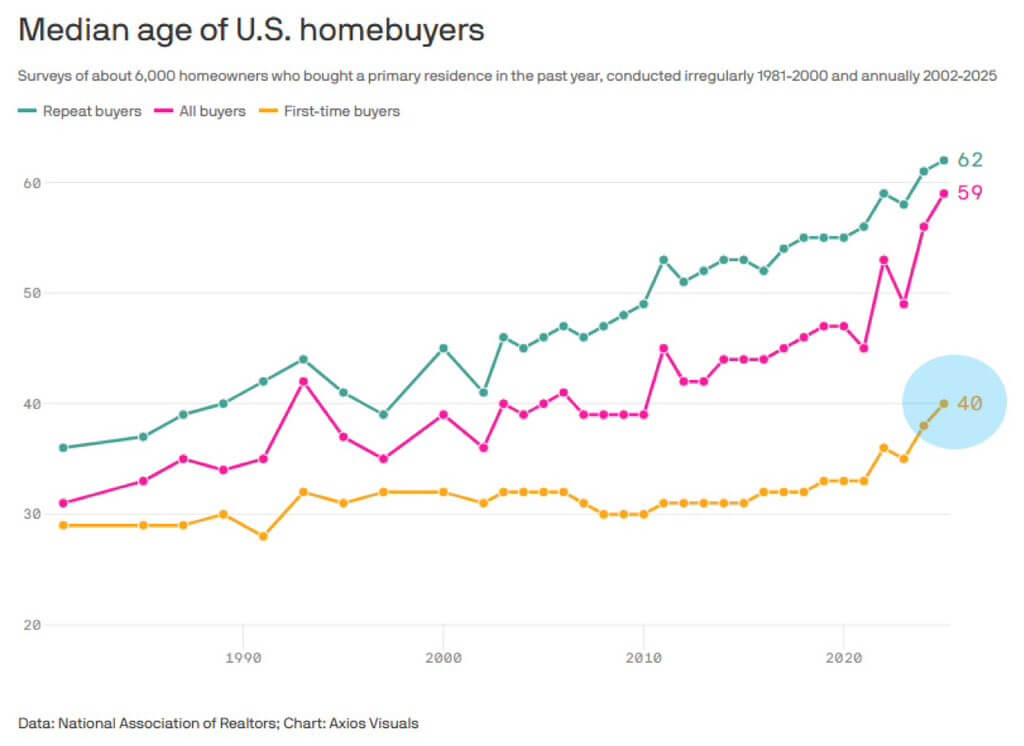
The appeal of this product is intrinsically linked to an increasingly challenging housing market landscape, particularly for younger buyers. Data from the National Association of Realtors indicates that the median age of first-time homebuyers reached an unprecedented 40 years in 2025—a reflection of compounded factors such as elevated mortgage rates, soaring home prices, and scant inventory availability.
The strain is particularly acute for households situated lower on the income spectrum. The NAHB/Wells Fargo Cost of Housing Index for Q2 2025 revealed that an average family requires approximately 36% of its income to cover mortgage payments on a median new home; however, this figure escalates beyond 71% for lower-income households.
Such data elucidates why enterprises perceive an opportunity in aligning digital assets with housing finance mechanisms. Traditional underwriting methodologies predominantly hinge on documented income streams, credit histories, and cash reserves—criteria that inherently favor families possessing pre-existing wealth amassed through home equity or other long-established financial instruments.
In stark contrast, millions of Americans have cultivated substantial positions in cryptocurrency; approximately 20% of U.S. adults—approximately 52 million individuals—own some form of crypto asset, with a significant majority being younger demographics. According to findings from the NCA 2025 State of Crypto Holders report, roughly 67% of token holders are aged 45 or younger, with an alarming 26% earning less than $75,000 annually.
This demographic analysis delineates a clear target market: younger buyers possessing significant crypto exposure yet exhibiting limited capacity or willingness to liquidate those assets at the point of transaction.
The Mechanics Behind Crypto Pledges
The developers have meticulously crafted this product to resemble not merely a volatile crypto loan but rather a compatible financing tool within traditional mortgage frameworks. Borrowers who choose to pledge Bitcoin or USDC are insulated from margin calls or additional funding requirements should market valuations fluctuate adversely.
According to Better Home & Finance’s stipulations, market volatility alone will not instigate liquidation; pledged assets will only be at risk if borrowers default on payments after a period exceeding 60 days—a threshold designed to reflect typical delinquency treatment standards associated with conforming mortgages.
The pledged cryptocurrency will be safeguarded throughout the duration of the down payment loan and returned upon full repayment. Importantly, borrowers are precluded from trading these locked assets during this period; thus preserving ownership but imposing restrictions on flexibility. However, for those using USDC as collateral, it remains possible to earn rewards on their stablecoin holdings—potentially mitigating servicing costs and diminishing their effective financing burden.
Notably, Better Home & Finance and Coinbase harbor aspirations that extend beyond this singular mortgage product; they envisage gradually broadening eligibility criteria to encompass tokenized equities, fixed-income securities, and other forms of tokenized real estate assets. This ambition signifies their recognition that this mortgage offering represents merely an initial stride toward integrating on-chain wealth into mainstream consumer finance paradigms.
Regulatory Landscape: Navigating Support and Resistance
This innovative launch occurs within a political milieu that exhibits increasing receptivity towards cryptocurrency; however, it does not transpire without notable opposition. The involvement of Fannie Mae alongside oversight from the Federal Housing Finance Agency (FHFA) could facilitate making such products more prevalent compared to earlier crypto-related mortgage initiatives.
In the preceding year, FHFA Director Bill Pulte mandated that Fannie Mae and Freddie Mac prepare frameworks for accounting cryptocurrency as an asset in mortgage applications—an initiative reflecting broader support for digital asset integration stemming from previous regulatory administrations. However, this policy opening has attracted criticism from legislators apprehensive about potential risks posed by integrating unconverted cryptocurrencies into housing finance frameworks.
- Democratic senators led by Elizabeth Warren have vehemently opposed such proposals arguing that current policies necessitate federally backed mortgage channels to account for cryptocurrency only post-conversion into U.S. dollars with appropriate documentation.
- They contend that broadening underwriting criteria to encapsulate unconverted cryptocurrencies could introduce novel risks into both housing markets and broader financial systems.
This critique strikes at the core debate surrounding products akin to those offered by Better Home & Finance and Coinbase; proponents advocate them as vital conduits translating digital wealth into tangible access without necessitating asset liquidation. Conversely, detractors caution against drawing volatile asset classes closer to foundational structures within U.S. home lending mechanisms.
The ultimate trajectory may hinge upon whether crypto-backed mortgages remain niche instruments accessible primarily to affluent digital asset holders or evolve into substantive financing channels for potential buyers presently excluded from traditional pathways due to prohibitive down payment requirements.