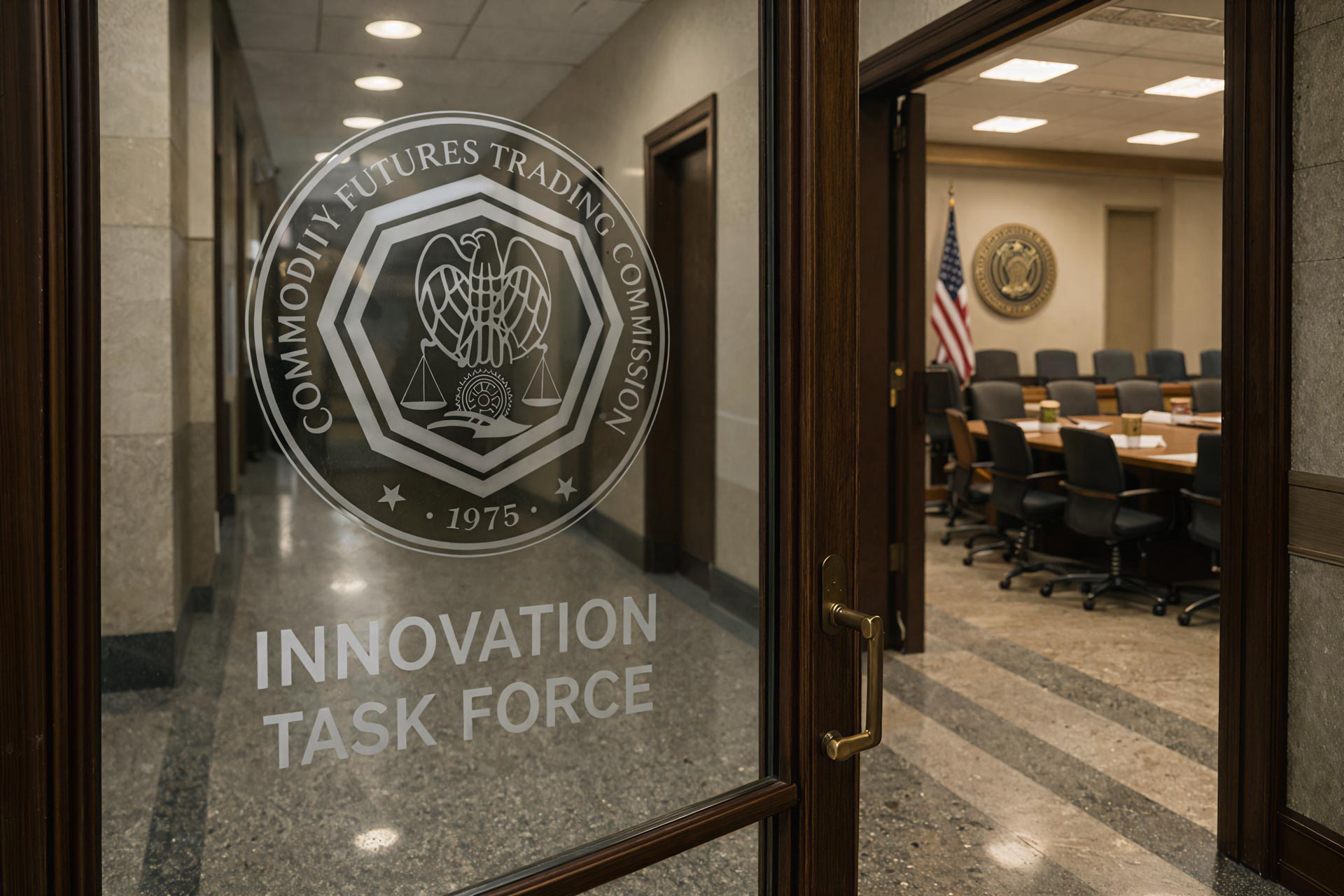

On March 24, 2026, the Commodity Futures Trading Commission (CFTC) initiated its Innovation Task Force, a significant strategic effort aimed at establishing comprehensive frameworks pertaining to cryptocurrencies, blockchain technologies, artificial intelligence systems, and prediction markets. This initiative marks a pivotal moment in regulatory history, as it signifies a transition from a provisional, enforcement-centric posture towards cryptocurrencies to an enduring regulatory framework.
The increasing interconnection of cryptocurrencies within financial systems, coupled with their political ramifications and complex jurisdictional challenges, has rendered a piecemeal regulatory approach untenable for federal authorities.
A Self-Explanatory Timeline
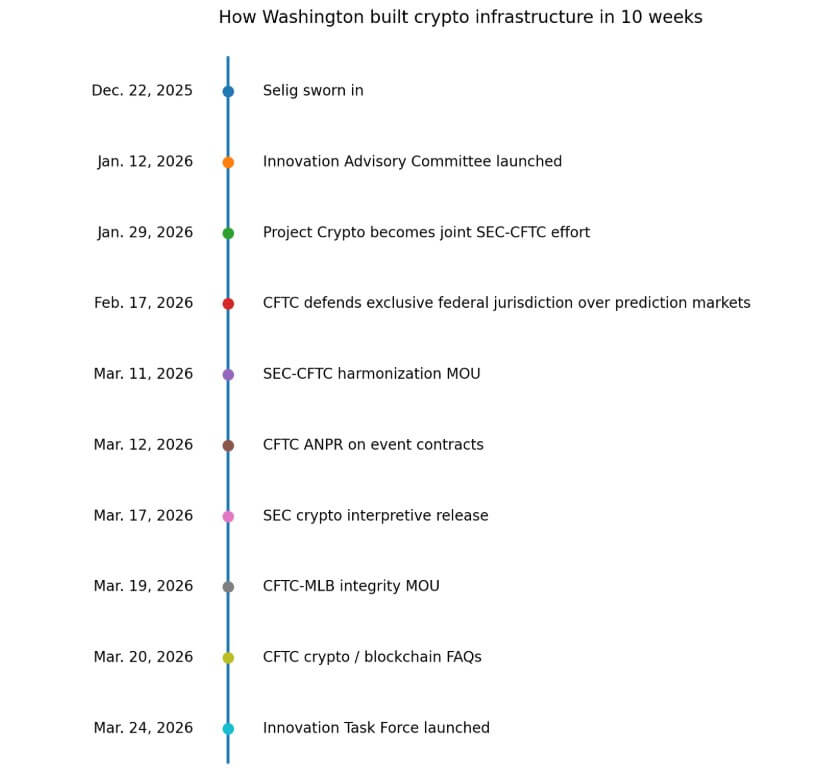
The developments subsequent to Chairman Michael Selig’s swearing-in in December 2025 provide compelling evidence of this regulatory evolution. Key milestones include:
– **January 12**: The launch of the CFTC’s Innovation Advisory Committee, comprising 35 members from prominent entities such as Coinbase, Uniswap, Ripple, Kraken, Gemini, Chainlink, Nasdaq, CME Group, Kalshi, and Polymarket. This diverse roster underscores the integration of cryptocurrency into mainstream financial infrastructures.
– **January 29**: Project Crypto emerged as a collaborative effort between the SEC and CFTC.
– **February 17**: The CFTC defended its exclusive federal jurisdiction over prediction markets in response to challenges posed by state authorities.
– **March 11**: A Memorandum of Understanding (MOU) was signed between the two agencies to facilitate coordination and eliminate regulatory redundancy.
– **March 12**: The CFTC issued an Advance Notice of Proposed Rulemaking (ANPR) concerning event contracts.
– **March 17**: The SEC published an interpretive release that delineated a taxonomy encompassing digital commodities, collectibles, tools, stablecoins, and securities—serving as an interim framework while legislative solutions are pursued.
– **March 19**: The CFTC entered into a groundbreaking MOU with Major League Baseball to ensure the integrity of prediction markets.
– **March 20**: The publication of Frequently Asked Questions (FAQs) on cryptocurrency and blockchain by CFTC staff aimed to clarify compliance guidelines.
– **March 24**: The formal launch of the Innovation Task Force dedicated to exploring emerging technologies in finance.
Institutional Regulation Framework
The establishment of advisory committees, formal MOUs, harmonization portals soliciting industry feedback, joint interpretive releases, rulemaking dockets, and dedicated task forces collectively construct a robust regulatory infrastructure. Both the CFTC and SEC are operating in parallel within this framework:
– The CFTC’s array of initiatives has established a comprehensive operational channel for industry engagement.
– The SEC’s March 17 interpretive guidance explicitly delineates product classifications under securities or commodities laws while recognizing a newly defined middle ground for certain digital assets.
– An important no-action position on Phantom—a self-custodial wallet provider—reflects regulators’ recognition of the interactions between on-chain software and registered derivatives markets.
Despite Congress’s failure to enact comprehensive market structure legislation—evidenced by stalled Senate discussions—the regulatory environment is evolving. Agencies are constructing a de facto operational system employing available tools such as interpretations and staff guidance.
| Tool | Recent Example | Significance |
|---|---|---|
| Advisory Committee | Innovation Advisory Committee launched on January 12 with representatives from major crypto firms. | Establishes a permanent channel for industry input and signifies that crypto is now viewed as an ongoing policy area. |
| Interagency Agreement | SEC-CFTC harmonization MOU signed on March 11. | Creates a formal process for reducing duplicative requirements and clarifying jurisdictional boundaries. |
| Harmonization Portal | A public initiative allowing firms to request joint meetings. | Facilitates practical coordination beyond mere commitments publicized in press releases. |
| Interpretive Guidance | SEC’s interpretive release on March 17 defining digital asset categories. | Shapes product classification under federal law by drawing clear taxonomic lines. |
| Staff Guidance | CFTC published FAQs on crypto and blockchain on March 20. | Aids firms in navigating compliance questions amid an evolving legal landscape. |
| No-Action Relief | CFTC’s no-action position regarding Phantom. | Indicates regulators are addressing the intersection of self-custodial wallets with registered markets. |
| Rulemaking Docket | CFTC’s ANPR on event contracts opened on March 12. | Migrates prediction markets from ad hoc treatment to formal rulemaking processes. |
| Jurisdictional Assertion | CFTC’s filing defending its exclusive jurisdiction over prediction markets on February 17. | Aims to clarify federal authority in a rapidly evolving market landscape. |
| Integrity Partnership | CFTC signed an MOU with Major League Baseball on March 19. | Delineates the growing importance of integrity monitoring in prediction markets within mainstream contexts. |
| Dedicated Task Force | The Innovation Task Force launched on March 24. | Allocates ongoing resources to address crypto-related issues, enhancing regulatory framework stability. |
The Concrete Manifestation of Cryptocurrency Regulation
The emergence of prediction markets elucidates how regulations surrounding cryptocurrencies can no longer be dismissed as niche technical discussions. Since the onset of the U.S. elections in 2024, this sector has proliferated rapidly, encompassing contracts linked to sports outcomes, political events, and economic indicators. The interplay between the CFTC’s jurisdictional assertions and its initiatives highlights an agency striving to maintain control over this burgeoning market segment.
The introduction of bipartisan legislation—the Prediction Markets are Gambling Act—by Senators Adam Schiff and John Curtis further accentuates the political scrutiny facing prediction markets. Such legislative efforts indicate that Washington is grappling with what level of federal oversight is warranted for these platforms. This scrutiny extends beyond prediction markets alone; it encapsulates broader concerns regarding derivatives infrastructure, tokenized collateralization processes, wallet accessibility to regulated venues, sports integrity monitoring practices, election forecasting methodologies, and federal-state jurisdiction conflicts. Given this complexity, ad hoc regulatory approaches are increasingly seen as inadequate for managing an asset class that has outstripped traditional policing mechanisms.
The Resilience of Regulatory Infrastructure Amidst Political Uncertainty
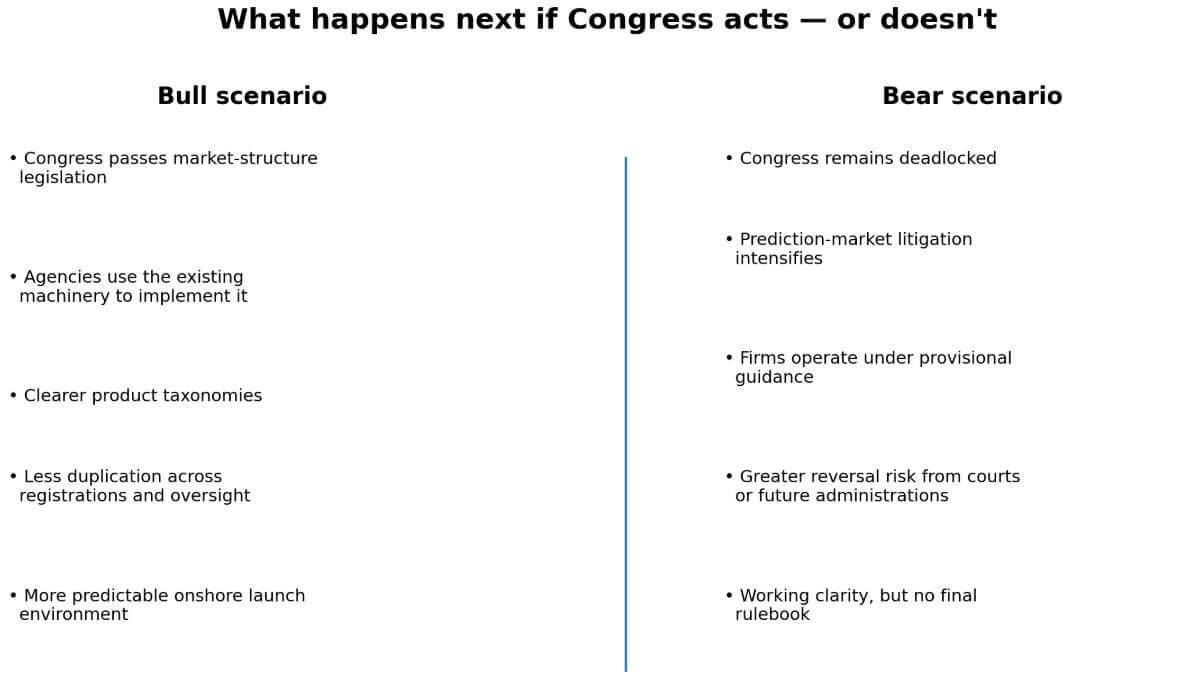
In an optimistic scenario where Congress successfully enacts market structure legislation, existing regulatory frameworks such as task forces and MOUs will serve as foundational elements for implementing a coherent U.S. cryptocurrency framework. This structure promises reduced duplication in registration processes and enhanced clarity in product taxonomies while fostering a more predictable environment for launching new financial instruments domestically.
Conversely, should Congress remain deadlocked—compounded by intensifying litigation surrounding prediction markets—the current guidance from both the SEC and CFTC may continue to be provisional at best.
In such circumstances:
– Firms may find themselves operating under a level of clarity that lacks finality.
– Regulatory systems constructed through interpretive authority become susceptible to reversal under future administrations or adverse judicial outcomes.
The persistence of federal agencies reorganizing around cryptocurrencies underscores that regardless of Congressional outcomes—be it legislative success or failure—the frameworks being established will not dissipate due to stalled rulemaking processes or failed legislative votes. The evolution toward more structured oversight is evidenced through committee formations, interagency agreements signing processes, rulemaking dockets opening up for public discourse, and dedicated personnel focusing exclusively on cryptocurrency-related matters.
This transformation embodies what it means for a financial market to transition from being merely a recurrent compliance challenge into becoming an indelible facet of the regulatory landscape in the United States.