
Analysis of Recent US Business Activity Trends and Implications for Bitcoin
In March 2026, the landscape of US business activity exhibited a notable deceleration, as evidenced by the latest PMI data. This data serves as a cautionary signal for market participants, indicating that economic growth momentum is waning concurrently with an uptick in inflationary pressures.
This confluence of factors presents a challenging environment for Bitcoin trading. The juxtaposition of a cooling economy against a backdrop of persistent inflation typically leads traders to anticipate that the Federal Reserve will maintain elevated interest rates for an extended period. Such monetary policy dynamics are generally detrimental to risk assets, including cryptocurrencies.
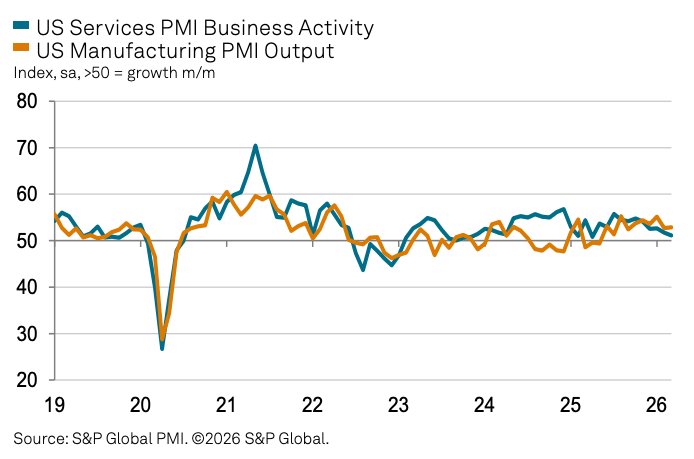
According to S&P Global, the flash composite PMI experienced a decline to 51.4 in March, down from 51.9 in February, signaling a contraction in expansionary momentum.
Sectoral Analysis of PMI Components
The sectoral breakdown reveals that services—representing a substantial portion of the US economy—contracted to 51.1 from 51.7, while manufacturing experienced a slight improvement, rising to 52.4 from 51.6. Notably, companies reported the most significant increase in input costs within the last ten months and marked the first decline in employment levels in over a year.
Interpretation of Economic Indicators
While the headline PMI figure indicates a deceleration in growth, the underlying implications are far more concerning. Specifically, segments of the economy closely tied to consumer demand are demonstrating signs of weakness, whereas manufacturing appears to be moving forward as firms endeavor to secure supplies and mitigate exposure to surging costs and elevated energy prices exacerbated by geopolitical tensions.
This dichotomy elucidates the unease among investors; the report reflects an economy bracing for potential disruptions.
In reaction to these developments, Bitcoin experienced a slight dip, retreating from its position above $70,000 as traders processed this information.
Furthermore, broader market responses mirrored this sentiment: oil prices remained elevated, Treasury yields increased, and the DXY index showed minimal fluctuation as investors recalibrated expectations regarding persistent inflation even amid slowing growth trajectories. The absence of a pronounced market reaction does not imply that Bitcoin’s trading environment has become favorable.
A Cautionary Note from the PMI Report
Central to the PMI report is the widening disparity between manufacturing and services sectors. While heightened factory activity could ostensibly be perceived as positive, it instead signals underlying strains within the economy; firms have escalated purchases and stockpiled inventories in anticipation of supply chain disruptions and escalating costs.
Simultaneously, service sector indicators paint a more pessimistic picture: new business growth has decelerated, export levels have diminished, and confidence among service providers has waned. Contributing factors include rising living expenses, increased borrowing costs, and uncertainties stemming from geopolitical conflicts.
S&P Global posits that survey results align with an estimated annualized growth rate of approximately 1% for the US economy in March; concurrently, price trends suggest inflation may gravitate back toward 4%. Such conditions revive concerns over stagflation—a scenario characterized by stagnating growth coupled with persistent inflationary pressures.
This evolving macroeconomic landscape is poised to exert significant influence over cryptocurrency markets.
The Implications for Bitcoin
Historically, Bitcoin has thrived under conditions where financial markets anticipated looser monetary policies and enhanced liquidity provisions. However, recent findings suggest an opposing trajectory; expectations regarding Federal Reserve rate cuts may be overly optimistic due to insufficient alleviation of inflationary pressures amidst an economic slowdown.
The report emerges at a particularly sensitive juncture for global markets: energy prices have surged due to geopolitical instability—specifically related to conflicts in Iran—amplifying inflation concerns. When oil prices escalate and corporations begin issuing warnings regarding increased operational costs and supply chain delays, market sensitivity intensifies towards any indications that the Federal Reserve may adopt a more restrictive stance.
This macroeconomic scenario presents formidable challenges for Bitcoin trading dynamics. Despite ongoing bullish narratives surrounding cryptocurrency adoption and resilience, prevailing perceptions categorize Bitcoin as a high-risk asset susceptible to adverse movements when yields rise and the dollar strengthens.
While some advocates posit that Bitcoin could ultimately benefit if confidence in broader economic policies deteriorates, Tuesday’s PMI data offered scant support for such assertions. The prevailing message indicates that market participants are increasingly focused on an environment characterized by prolonged higher interest rates.
The forthcoming inflation and labor data releases will serve as critical indicators moving forward; should these reports corroborate trends highlighted by the PMI—namely an economic cooling concurrent with sustained price pressures—Bitcoin may continue to navigate turbulent trading conditions influenced by macroeconomic realities that cannot be overlooked.