
Analysis of the Pentagon’s Funding Request for Military Engagement in Iran
The Pentagon has formally submitted a request to the White House for an additional $200 billion in funding designated for military operations relating to Iran. This substantial figure equates to approximately 2,915,451 Bitcoin, calculated at the current market valuation of $68,600 per Bitcoin. However, it is crucial to clarify that this juxtaposition does not imply that the U.S. government is contemplating financing military expenditures through cryptocurrency or utilizing Bitcoin as a transactional medium. Instead, this comparison serves as a heuristic device, translating an extensive federal expenditure into a unit of value that investors and stakeholders can more readily comprehend against existing financial benchmarks.
This framing transcends typical bureaucratic fiscal language, facilitating a clearer understanding of the enormity of the proposed funding within a context that resonates with market participants. It is pertinent to note that this request precedes any formal legislative submission to Congress, where it is anticipated to encounter significant resistance from legislators across both major political parties.
Quantifying Nearly 3 Million Bitcoin
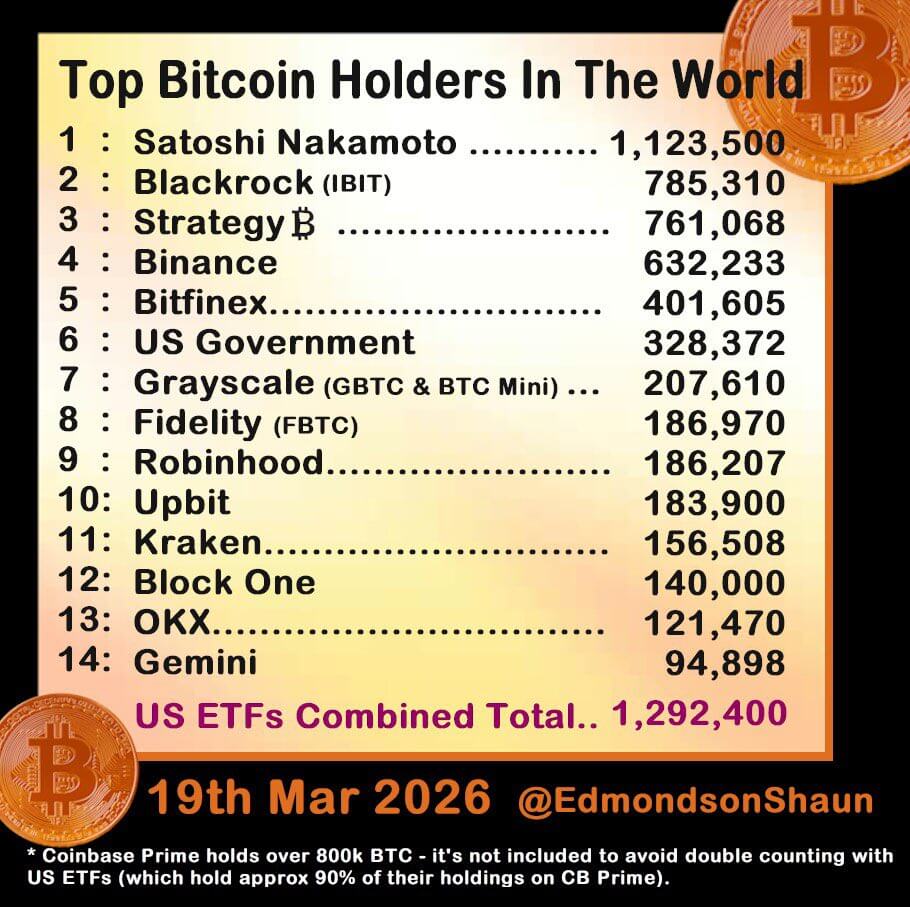
To fully appreciate the magnitude of the funding request, it is instructive to juxtapose it with existing Bitcoin holdings across various entities. The United States government itself holds approximately 328,372 BTC according to data compiled by BitcoinTreasuries. Thus, the proposed $200 billion allocation translates to an amount nearly 8.6 times greater than the current holdings of U.S. government-related entities.
Moreover, when extending this analysis to encompass the largest corporate and institutional holders of Bitcoin, the disparity remains pronounced. For instance:
- Strategy, recognized as the largest public corporate holder of Bitcoin, holds approximately 761,068 BTC.
- BlackRock’s iShares Bitcoin Trust (IBIT), the preeminent Bitcoin fund, manages around 785,629 BTC based on its latest share counts.
- Satoshi Nakamoto, the pseudonymous creator of Bitcoin, is estimated to control approximately 1.096 million BTC.
In this context, the Pentagon’s funding request represents about:
- 3.7 times Strategy’s holdings
- 3.6 times IBIT’s assets
- 2.6 times Satoshi’s presumed reserves
This astonishing scale remains evident even when measured against broader institutional ownership metrics. Collectively, the ten U.S. spot Bitcoin ETFs—including IBIT—hold approximately 1.52 million BTC; thus, the proposed funding request would still surpass this total by a factor of 1.86. Furthermore, data from BitcoinTreasuries indicates that the top 100 public companies holding Bitcoin collectively possess around 1,176,615 BTC; hence, this request would be roughly 2.4 times greater than their entire holdings.
Contextualizing Against Global Holdings
The magnitude of the $200 billion request becomes even more pronounced when compared with holdings in major cryptocurrency exchanges. For example, Binance—currently the world’s largest cryptocurrency exchange by trading volume—reported holding over 639,000 BTC as part of its user balance reserves per its March proof-of-reserves update. Consequently, the Pentagon’s funding request exceeds Binance’s holdings by almost a factor of 4.4.
Remaining Issuance and Its Implications
A more profound perspective emerges when considering Bitcoin’s total supply dynamics. According to Blockchain.com, there are currently 20,003,043 BTC in circulation out of a capped total issuance of 21 million BTC; this implies that only 996,957 BTC remain available for mining. Thus, the proposed war budget would equal approximately 2.83 times all remaining Bitcoin yet to be mined.
The Divergent Nature of Monetary Systems
This analytical exercise reveals an essential distinction between traditional fiat currency systems and scarce digital assets such as Bitcoin. The U.S. government can propose such expansive military funding because it operates within a monetary framework characterized by debt expansion and currency supply growth without prior accumulation of tangible assets.
The total federal debt has exceeded $39 trillion as per Treasury data; thus illustrating how such monumental expenditures can be accommodated through deficit financing and bond issuance mechanisms rather than through prior accumulation of finite resources.
Conversely, Bitcoin operates under a system where its maximum supply is irrevocably fixed at 21 million units; new coins are generated solely through a mining process that necessitates substantial energy investment and time commitment for each block mined. This inherent scarcity renders Bitcoin significantly more challenging to amass at scale compared to fiat currencies produced via sovereign borrowing practices.
The Philosophical Underpinning and Policy Implications
This fundamental difference underscores arguments posited by advocates for Bitcoin who assert that it functions not merely as a store of value but also as a critical monetary benchmark that elucidates governmental fiscal behaviors often obscured within fiat frameworks.
Brian Armstrong, CEO of Coinbase encapsulated this sentiment succinctly on social media: “Bitcoin is a check and balance on inflation. When spending gets too far out of hand, capital moves to Bitcoin.”
This perspective appears increasingly influential within policy discussions in Washington D.C., evidenced by actions taken during March 2025 when the Trump administration established an order for a Strategic Bitcoin Reserve—characterizing Bitcoin as a reserve asset intended for retention rather than liquidation while directing officials to explore budget-neutral acquisition strategies.
Conclusion: The Significance of Scarcity in Fiscal Discourse
The overarching narrative is clear: in an economic landscape characterized by escalating military expenditures and burgeoning fiscal deficits expressed in fiat terms, a finite asset with predetermined supply parameters gains relevance as a meaningful reference point for evaluating governmental financial decisions.
Thus, while a $200 billion military budget request may merely represent another entry on Washington’s ledger books, in terms of its implications for Bitcoin valuation and scarcity dynamics—it manifests as a claim on an amount far exceeding not only governmental and institutional holdings but also surpassing all unmined bitcoin remaining within protocol constraints.