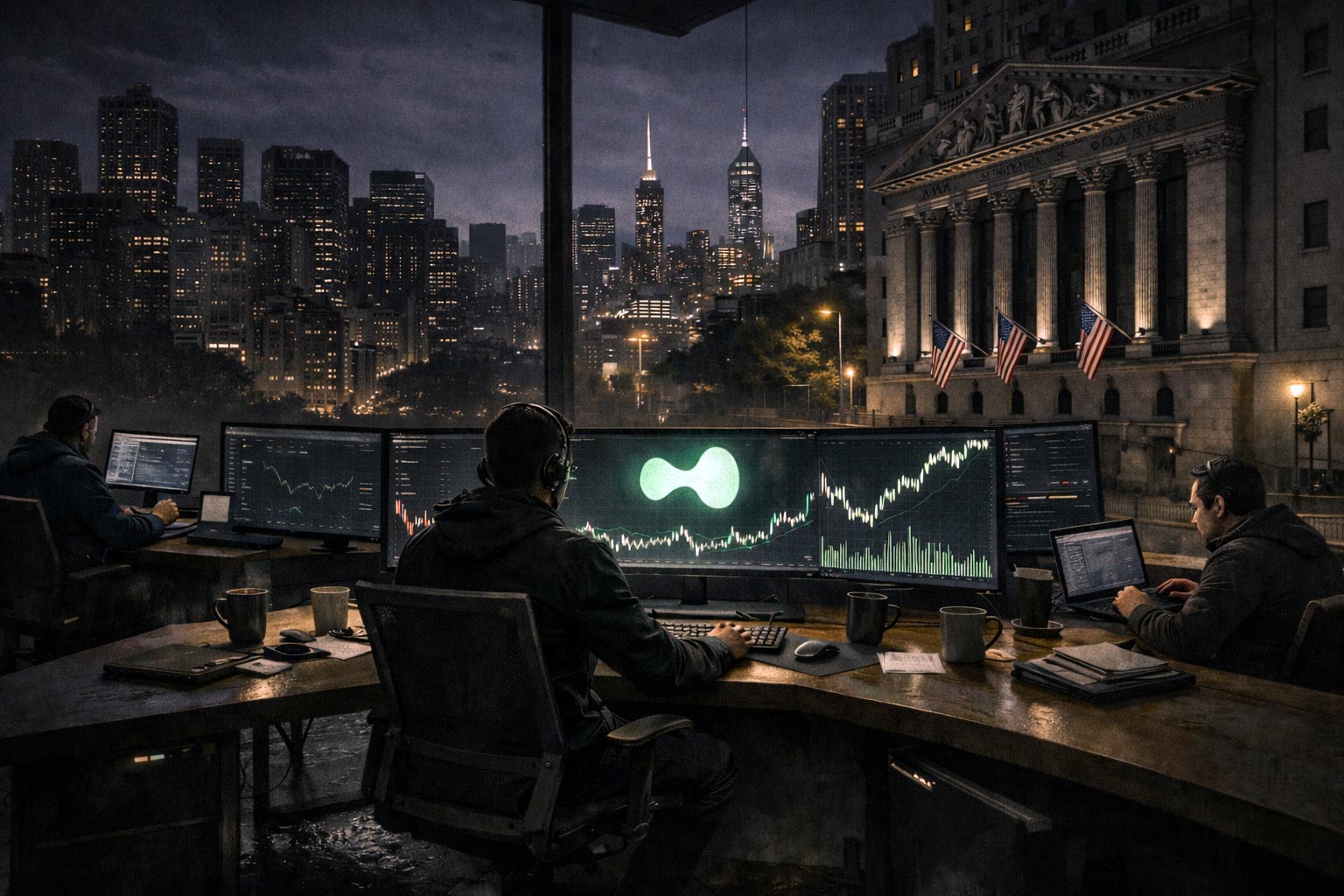
The Evolution of the S&P 500 Trading Paradigm
For an extended period, the operational framework governing U.S. risk assessment was tethered to traditional trading hours. The S&P 500 index commenced trading at 9:30 a.m. Eastern Standard Time (EST) and ceased operations at 4:00 p.m. EST, with premarket speculation and after-hours activity serving as supplementary mechanisms to fill the temporal gaps in market engagement.
However, a significant inflection point emerged on March 18, when S&P Dow Jones Indices licensed the S&P 500 to Trade[XYZ]. This strategic licensing facilitated the launch of the inaugural officially sanctioned perpetual derivative linked to the benchmark, accessible on Hyperliquid. This innovative platform permits eligible non-U.S. investors to utilize institutional-grade index data in a manner that transcends conventional trading limitations.
The trading ecosystem surrounding the S&P 500 is already robust, processing over $1 trillion in daily trading volume across interconnected exposures. The introduction of a perpetual derivative allows for continuous trading—24 hours a day, seven days a week, and 365 days a year—including a critical 49-hour window from Friday’s 5:00 p.m. close to Sunday’s 6:00 p.m. reopening of CME futures when traditional U.S. market infrastructure is inactive.
This strategic maneuver signifies a structural bet on the potential for initial market reactions to global events to materialize within continuously operational frameworks prior to the reactivation of conventional venues.
Market Dynamics and Initial Performance Metrics
Trade[XYZ] has instituted a perpetual derivative tethered to licensed S&P benchmark data, eschewing direct ownership of the underlying 500 equities. By midday following its launch, the contract exhibited approximately $3.4 million in open positions—an amount that pales in comparison to the trillions represented by the benchmark itself.
Trade[XYZ] has reported that its markets have cumulatively processed in excess of $100 billion in volume since October 2025, currently operating at an annualized pace exceeding $600 billion. Furthermore, Hyperliquid’s broader HIP-3 macro markets expanded from roughly $260 million in open interest one month prior to January 27, escalating to approximately $1.43 billion recently.
The introduction of the S&P contract into this evolving venue aligns with a trend where non-cryptocurrency macro instruments have begun to gain significant traction.
The Weekend Gap: An Opportunity for Innovation
The Chicago Mercantile Exchange (CME) already provides near-continuous weekday access to S&P exposure via E-mini S&P 500 futures, which trade from Sunday at 6:00 p.m. EST until Friday at 5:00 p.m EST with one daily maintenance hour intermission. Additionally, NYSE Arca and various brokers facilitate premarket and after-hours trading windows.
Nevertheless, traditional market infrastructure remains dormant from Friday evening until Sunday evening, resulting in a substantial two-day hiatus during which pivotal announcements—ranging from tariff decisions to military escalations or central bank disclosures—can occur without any immediate official market reaction.
Data from Kaiko has revealed that during the escalation between the U.S. and Iran on February 27-28, Bitcoin spot volumes surged dramatically from an average of $1.5 billion per day to $2 billion, ultimately reaching $8 billion while traditional markets remained inactive. This phenomenon indicates that while cryptocurrency markets can capture initial reactions effectively, deeper institutional liquidity tends to materialize later when conventional market hours resume.
The pattern underscores that cryptocurrencies are capable of reflecting immediate market sentiments without yet asserting definitive pricing authority. The S&P perpetual contract on Hyperliquid aims to fulfill this initial-response role more precisely than Bitcoin has historically done as a proxy for global risk.
Institutional Momentum Towards Continuous Trading
The infrastructure supporting this transition is evolving expeditiously; Nasdaq is actively pursuing a model for 24/5 trading and has filed proposals aimed at extending equity trading hours to encompass 23 hours per day over five days each week. Concurrently, the Depository Trust & Clearing Corporation’s National Securities Clearing Corporation is targeting a shift towards 24×5 trade processing commencing Sunday at 8:00 p.m. EST through Friday at 8:00 p.m. EST, pending regulatory approval slated for June 28, 2026.

While incumbents are progressing towards continuous availability, they have not yet attained this goal; cryptocurrency markets have effectively established their primacy in this arena.
| Venue | Typical Trading Window | Weekend Access | Public Price Visibility | Depth Today | Main Limitation |
|---|---|---|---|---|---|
| U.S. Cash Equities | Regular Session: 9:30 a.m.–4:00 p.m. ET | No | High During Regular Session | Deepest Liquidity Available | Inactive Outside Official Session |
| Premarket / After-Hours Equities | Tends Around 4:00–9:30 a.m. ET and 4:00–8:00 p.m. ET (Variable by Venue) | No | Fragmented Across Venues; No Unified Tape | Moderate Liquidity; Typically Thinner than Regular Hours | Thin Liquidity and Fragmented Price Discovery Effectiveness |
| CME E-mini S&P Futures | Sunday 6:00 p.m. ET to Friday 5:00 p.m. ET (with Daily One-Hour Break) | No Access Through Full Weekend Gap | High Visibility During Weekdays | Deep Liquidity Available on Weekdays | Closed From Friday 5:00 p.m. ET Till Sunday Resumption At 6:00 p.m. ET |
| Hyperliquid S&P Perpetual | 24/7/365 Availability | Yes | Public On-chain Tape Transparency | Initial Depth but Growing Momentum | A nascent Market; Depth Still Developing; Credibility Dependent on Stress Performance Metrics |
The Imperative of Transparency as a Competitive Differentiator
A recent analysis conducted by NYSE indicates that overnight U.S. equity trading remains marginally small—accounting for roughly 0.11% of total volume and approximately 0.15% of year-to-date notional activity in 2025.
This small-scale activity is markedly fragmented; prior-day trades often elude public feeds, while matches occurring on Sunday evenings are not readily available through Securities Information Processors.
The HIP-3 framework employed by Hyperliquid operates on-chain, allowing for independent analysis of deployer actions—a critical factor in an increasingly competitive landscape where clarity and transparency are paramount during periods when official infrastructures lack operational visibility.
A study conducted by New York Fed underscores that U.S. equity returns tend to exhibit notable positivity during European market opening hours, suggesting that price discovery continues even amidst closures of U.S.-based venues.
If a licensed S&P perpetual contract consistently reflects macroeconomic shocks encountered during weekends prior to CME futures reopening, it could evolve into an influential signal market within this new paradigm.
A Dual Perspective on Future Market Dynamics
The bullish narrative posits that as the S&P perpetual contract evolves from its current modest scale into one representing tens or even hundreds of millions of dollars in open interest, weekend liquidity will deepen correspondingly. Repeated on-chain movements may closely align with CME reopening levels on Sundays, leading macro desks to treat these readings as serious price references while establishing crypto’s precedence over traditional venues in price discovery sequences.
A threshold model can frame market credibility effectively:
| S&P Perpetual Open Interest (OI) | Interpretation | Implications for Price Discovery Mechanics |
|---|---|---|
| Under $25M | Symbolic Presence Only | Diminished Utility as Sentiment Indicator; Lacks Trusted First Print Mechanism |
| $25M–$100M | Credible Signal Generation Potential | Adequate for Comparison Against Sunday CME Reopening Levels; |
| $100M–$250M | ||
| Competitively Positioned Against Incumbents | Significant Contest Over Trusted Initial Price Publication Mechanisms |
The overarching concern remains trust under conditions of stress; geopolitical or economic disruptions during weekends could expose vulnerabilities related to liquidity or incite oracle disputes—factors which could swiftly undermine credibility more rapidly than consistent weekend prints might establish it.
The HIP-3 model assigns operational accountability to deployers who define both market parameters and oracle mechanisms. In contrast, traditional U.S market frameworks are constructed around established hour frameworks characterized by circuit breakers, coordinated halts, and regulatory oversight calibrated specifically for recognized venues.
The Future Trajectory of Market Pricing Mechanisms
While traditional markets continue to maintain dominion over official opening and closing transactions, it remains uncertain whether meaningful reactions prompted by events such as Friday-night geopolitical strikes or Saturday tariff disclosures will begin manifesting on-chain prior to the reopening of U.S futures markets.
The inherent advantage resides in both temporal visibility and transactional transparency afforded by cryptocurrency platforms which facilitate weekend trading of the S&P with publicly accessible records preceding full operational capacity restoration within U.S market infrastructures.
The sustainability of this model depends critically on maintaining adequate depth within the S&P perpetual contract on Hyperliquid while ensuring tight spreads endure through initial weekend stress tests without precipitating crises related to credibility.