


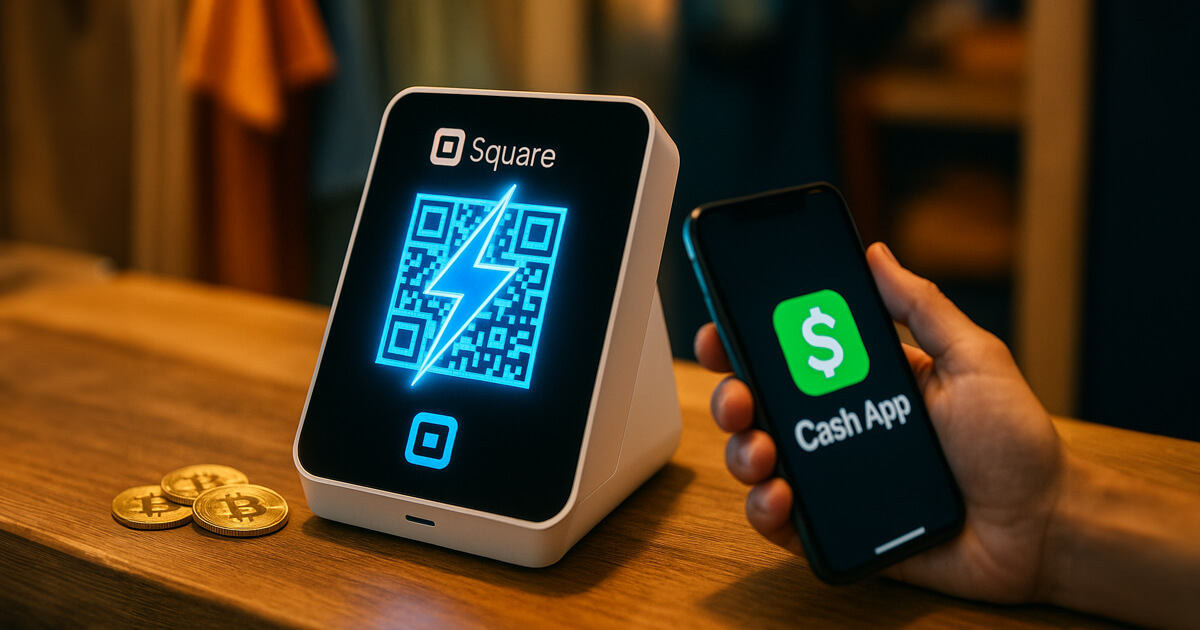

Introduction to Bitcoin Payment Integration in Square’s Merchant Ecosystem
Block has officially activated Bitcoin payment capabilities across its Square merchant network, thereby enabling approximately four million sellers to facilitate Lightning Network transactions at the point of sale. This integration represents a significant advancement in the intersection of traditional commerce and decentralized finance.
Mechanics of Transaction Processing
Upon selecting Bitcoin as a payment option during checkout, the Square system generates a Lightning invoice QR code. Customers can complete their transactions using Cash App or any wallet compatible with the Lightning Network, resulting in instantaneous settlement. Notably, merchants have the flexibility to retain funds in Bitcoin or automatically convert them into U.S. dollars via Square’s robust infrastructure.
The fee structure is markedly simplified, featuring zero processing fees until 2027, thereafter transitioning to a flat fee of 1% per transaction. This contrasts sharply with conventional card payment processing fees, which typically range between 1.5% and 3%, while also eliminating the risk of chargebacks and ensuring immediate transaction finality.
Global Rollout and Market Impact
Block has characterized this launch as a “global unlock,” although initial availability is limited to Square businesses in the United States, barring New York. Despite the discrepancy between promotional narratives and jurisdictional realities, the overarching significance lies in the rapid activation of millions of potential Bitcoin endpoints through a single commercial hub—one that already operates one of the largest public Lightning nodes by capacity.
The critical inquiry is not whether this development is impactful but rather how significantly it mitigates friction within the mechanisms converting everyday commerce into Bitcoin liquidity. Furthermore, it raises the question of whether Block has positioned itself as the central clearing node for mainstream Lightning payments.
Economic Implications of Merchant Adoption
From an economic perspective, this initiative appears straightforward for merchants. Traditional card processing fees can vary significantly, often exceeding 3% depending on various factors such as card type and processor margins. In contrast, Square’s Bitcoin offering—featuring no processing fees until 2027 and subsequently a predictable flat rate—provides a compelling economic incentive for merchants operating on thin margins.
The elimination of chargebacks translates to reduced fraud and operational costs; however, it also reallocates refund risks solely to in-store gift cards or manual reconciliation processes.
Fee Structure Analysis
While the zero-fee structure may seem advantageous for merchants, it is imperative to recognize that Block continues to derive revenue from foreign exchange and cryptocurrency spreads. Specifically, these consist of a 1% fee on conversions and trading activities alongside an embedded spread against wholesale Bitcoin liquidity.
- The apparent absence of fees shifts the economic burden from traditional card networks to Block’s proprietary Bitcoin stack.
- This reconfiguration in market dynamics suggests that while merchant-facing costs may be nominally zero, Block internalizes significant revenue streams through its operational model.
Behavioral Incentives for Merchants
If a coffee shop or boutique can save even a modest percentage on transactions by adopting Bitcoin payments at checkout, it signals a potential shift in consumer behavior and merchant economics. Block does not necessitate an immediate universal adoption; instead, it requires sufficient activation rates to validate its infrastructure investments and begin directing meaningful volumes through its Lightning nodes. The prolonged zero-fee period extends until 2027, providing ample time for consumer behavior modification while allowing Block to monetize its services without appearing exploitative.
The Real-World Testing of Lightning Network Capabilities
As of late 2025, public Lightning Network capacity is estimated at approximately 4,100 to 4,800 Bitcoin. Block’s public node ranks among the largest within this ecosystem, holding several hundred Bitcoin and constituting around 5% or more of visible capacity.
By enabling Bitcoin acceptance for millions of merchants—regardless of their participation level—Block effectively enhances the network’s topology by introducing numerous potential Lightning endpoints behind a singular commercial hub.
Network Topology Transformations
This change manifests in two primary dimensions:
- The increase in routing volume through Block-linked nodes is likely to compress routing fees along major paths as competition among liquidity providers intensifies.
- A corresponding acceleration in centralization risk arises; a substantial portion of merchant payment flows may now hinge upon Block’s nodes and liquidity management strategies. For services native to Lightning, this scenario presents both opportunities for growth and threats associated with increased centralization.
Transaction Limits and Retail Adoption Considerations
The current cap on Lightning payments per transaction—set at $600—effectively excludes larger purchases from this network for the time being. However, this threshold comfortably accommodates most retail transactions including coffee purchases, dining experiences, clothing sales, books, and everyday services.
If adoption scales effectively, Block could emerge as the de facto routing hub for mainstream commerce within the Lightning Network—transitioning its narrative from an experimental framework favored by cypherpunk advocates to an integral payment rail facilitating everyday transactions.
Liquidity Dynamics Within Closed Payment Loops
The implications for liquidity are multifaceted and distributed across three primary flows:
- The consumer-to-merchant transaction mandates that customers utilize Lightning for payment while merchants choose either to retain Bitcoin or convert it into dollars through Square’s infrastructure.
- If merchants opt to retain Bitcoin, they assume the role of marginal holders within the ecosystem. Conversely, if they elect to convert their holdings into fiat currency, Block must manage offloading these assets or utilize existing inventory levels—thereby contributing to over-the-counter trading volume that may tighten market spreads over time.
- Square facilitates automated conversion to Bitcoin by allowing businesses to route up to 50% of their daily card sales directly into Bitcoin. This positions Block as a systematic buyer on behalf of merchants—a strategy akin to corporate dollar-cost averaging strategies within traditional finance.
Impact on Market Liquidity
This methodical demand absorption enables Block to weather market volatility without experiencing drastic fluctuations in customer behavior. If even a marginal segment of Square’s gross payment volume—currently exceeding $200 billion—transitions into Bitcoin transactions, this could yield approximately $2 billion in annual Bitcoin volume flowing through Block’s infrastructure. While not earth-shattering on its own, this volume is significant enough to influence liquidity dynamics and pricing spreads within the marketplace.
The Path Forward: Activation Rates and Regulatory Considerations
The actual rate of activation among four million merchants will be critical in determining whether this initiative signifies a transformative shift within payment paradigms or serves merely as a marketing endeavor. The proportion of merchants electing to hold versus automatically sell their Bitcoin will provide insights into small businesses’ perceptions—whether they regard Bitcoin primarily as a treasury asset or merely another transactional medium.
Future Scalability Challenges
The growth trajectory of Lightning capacity surrounding Block’s nodes will elucidate whether the network can sufficiently scale in alignment with burgeoning demand or if bottlenecks will emerge around select large hubs. Additionally, regulatory considerations present a wildcard factor; should U.S. lawmakers enact de minimis exemptions for minor Bitcoin transactions—thereby alleviating capital gains reporting requisites—a surge in adoption is likely forthcoming.
The Limitations of Infrastructure Alone
Despite advancements in infrastructure development by Block that render spending Bitcoin nearly effortless—akin to tapping a mobile device—the broader acceptance hinges upon active promotion by merchants at checkout points and customers’ willingness to embrace this alternative payment method fully. Nonetheless, with operational systems now live and tangible incentives established alongside movement within pricing spreads, it is evident that while substantial regime transformations have yet to materialize, foundational elements have been significantly fortified for future evolution.
