


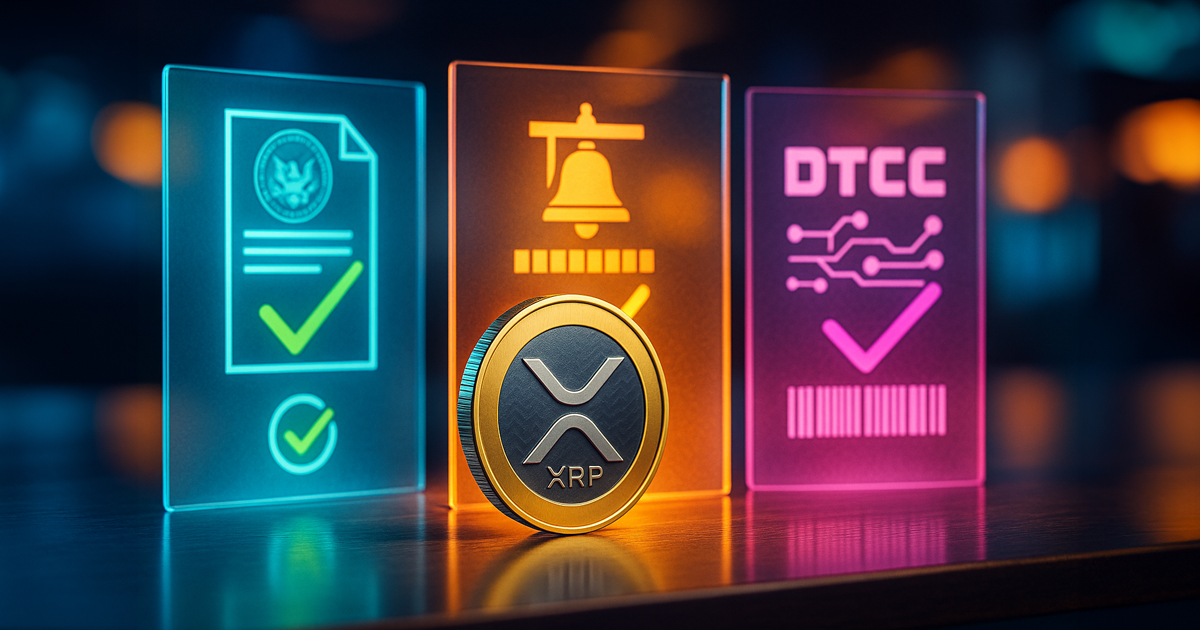

This analytical report elucidates the operational dynamics surrounding the listing of Exchange-Traded Funds (ETFs) in the context of regulatory frameworks established by the Securities and Exchange Commission (SEC) and the Depository Trust & Clearing Corporation (DTCC). It underscores the differentiation between operational preparations and formal approvals, particularly regarding the emerging market for XRP ETFs.
Operational Framework and Regulatory Paradigm Shift
Despite prevalent narratives within social media circles, particularly on platforms such as Crypto Twitter, it is imperative to ground our understanding in the operational realities as articulated by DTCC documentation. The presence of XRP ETFs on DTCC pages signifies procedural readiness rather than regulatory approval. This indicates that the underlying infrastructure for clearing and settlement is being established in anticipation of a potential fund launch, rather than signifying endorsement from the SEC.
The SEC’s recent transition to a generic-listing framework marks a pivotal evolution in the approval process for commodity-based trust shares. This regulatory paradigm allows exchanges such as NYSE Arca, Nasdaq, and Cboe BZX to list eligible spot commodity Exchange-Traded Products (ETPs) without necessitating laborious product-specific 19b-4 approvals.
- Issuers are mandated to possess an effective registration statement, typically an S-1, prior to initiating trading activities.
- The SEC’s revised exchange rules effectively reallocate the bottleneck from exchange approvals to the comprehensiveness of disclosure statements and operational readiness.
For XRP specifically, this regulatory landscape suggests that a straightforward spot trust that adheres to generic standards could proceed to listing once its S-1 is deemed effective and a corresponding listing circular has been published by the exchange.
Complexity of Novel Financial Instruments
It is critical to note that financial instruments exhibiting leveraged characteristics or innovative designs may not qualify under this generic framework and would still necessitate a bespoke examination through a traditional 19b-4 review process.
Establishing an Approval Protocol for XRP ETFs
The approval process for XRP ETFs now follows a clearly delineated sequence that stakeholders can verify expeditiously:
- The SEC must officially declare the S-1 effective, thereby finalizing essential elements such as fees, creation unit size, custody arrangements, and risk disclosures, which frequently include references to Authorized Participant agreements.
- The respective listing exchange must issue a public notice establishing both the ticker symbol and the anticipated listing date.
- Operational confirmations must be obtained, which encompass DTC eligibility, readiness from the National Securities Clearing Corporation (NSCC), and assignment of a CUSIP number—these elements are critical for settlement but do not independently indicate approval.
While there are legitimate XRP filings accessible via EDGAR that have been submitted recently, it is crucial to emphasize that none currently constitutes formal approval:
- Grayscale submitted an S-1 for Grayscale XRP Trust in August, with subsequent amendments reflecting NYSE Arca listing mechanics.
- Franklin’s S-1 includes a notable counsel exhibit linked to its registration number dated November 4.
- CoinShares has filed an S-1 detailing considerations for forks and airdrops.
- Teucrium referenced a leveraged daily XRP product in its filings from April, while ProShares provided updates on its Ultra and Short XRP materials during the same period—these products are likely outside the purview of new generic standards due to their complexity.
The prevailing marketplace rumor suggesting that multiple XRP ETFs are already “on DTCC” conflates genuine operational observations with erroneous conclusions. Entries may appear on DTCC listings while issuers and exchanges finalize requisite documentation, conduct participant testing for basket creation, and establish custodial chains. It is vital to underscore that operational status as indicated by DTCC does not serve as a leading indicator of SEC approvals. Consequently, any tally of entries should be approached with skepticism until corroborated by an effective S-1 alongside a public listing circular.
Temporal Dynamics Under Generic Listing Standards
With respect to timing under the new generic-listing structure, once an S-1 is declared effective, the procedural timeline accelerates significantly. A fast-track scenario may involve:
- Exchanges disseminating a circular within mere days;
- Authorized Participants swiftly seeding the fund;
- The NSCC processing creations without undue delay.
A base-case timeline generally extends over several weeks if onboarding processes or final documentation require refinement. Lengthier paths will emerge should leverage mechanisms or non-standard features necessitate additional scrutiny.
Implications of DTCC Constraints Post Launch
The implications of market structure constraints imposed by DTCC merit consideration. Historical precedents indicate that DTCC has previously established limits regarding collateral treatment for crypto-linked ETFs; while these constraints do not directly influence approval status, they significantly affect financing strategies and prime services related to funds subsequent to their launch.
Investors can navigate through this complex landscape by adhering to a methodological verification strategy based on three critical receipts:
- Verify EDGAR records for an S-1 that explicitly states “has been declared effective.”
- Consult the exchange’s website for a listing circular that specifies both ticker symbol and listing date.
- Finally, examine DTCC or DTC records for eligibility confirmation and CUSIP assignment. Should steps one and two remain unfulfilled, no approval can be claimed.
| Issuer / Fund | Filing Type | Last Filing Date | Notes | Source |
|---|---|---|---|---|
| Grayscale XRP Trust | S-1 and amendments | Nov 3, 2025 | AP references; NYSE Arca path stated | S-1/A |
| Franklin XRP Trust | S-1, counsel exhibit | Nov 4, 2025 | Tied to Reg. No. 333-285706 | SEC |
| CoinShares XRP ETF | S-1 | 2025 | Airdrop handling disclosed | SEC |
| Teucrium XRP ETFs | N-1A and correspondence | Apr 7, 2025 | Diversified product outside generic lane | SEC |
| ProShares Ultra/Short XRP | N-1A post-effective amendments | Apr 30, 2025 | Bespoke review required for leverage products | SEC |
| Bitwise XRP ETF | S-1 and amendments | Oct 31, 2025 | S-1 amendment under commodity-based trust standards | SEC |
| Canary XRP ETF | S-1 and amendments | Oct 24, 2025 | S-1/A with updated prospectus submitted for expert review | SEC |
| 21Shares XRP ETF | S-1 and amendments | Nov 7, 2025 | Cboe BZX-listed spot trust; latest filing updates noted | |
The overarching conclusion remains consistent within this generically standardized environment: while DTCC entries signify readiness for settlement contingent upon broader operational preparedness of funds, they do not serve as proxies for SEC decisions. The definitive indicators are encapsulated within an effective S-1 alongside a publicly announced listing circular detailing both ticker symbol and launch date. In their absence, no XRP ETF can be asserted to exist legitimately.
