


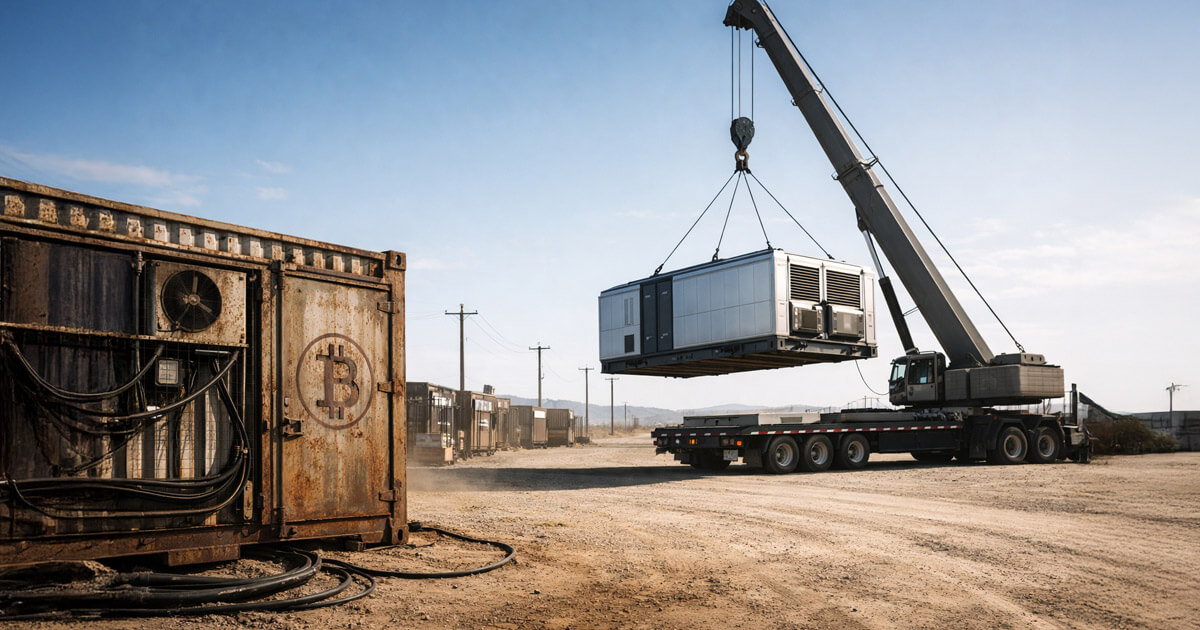
Investment Dynamics in the Bitcoin Mining Sector: A Strategic Shift Towards High-Performance Computing
The contemporary financial landscape reveals a profound paradigm shift as institutional investors on Wall Street allocate significant capital—amounting to billions—towards public Bitcoin mining enterprises. Notably, the underlying investment rationale diverges from the anticipated trajectory of the cryptocurrency sector; rather, these firms are increasingly perceived as pivotal components of power and permitting infrastructure. This is particularly salient in the context of an artificial intelligence (AI) boom, where the primary constraint is not a deficit of advanced semiconductor technology, but an acute scarcity of electrical supply.
Structural Transformations in Financing and Operations
Recent months have witnessed a surge in substantial financing and leasing arrangements, marking a critical transformation within the Bitcoin mining landscape. Investors and prominent banking institutions are advocating a straightforward arbitrage strategy: many large-scale Bitcoin miners possess strategic assets, including coveted grid interconnections, extensive land holdings, and operational teams adept at managing industrial power loads. By repurposing these facilities for high-performance computing applications, miners can exchange the inherent volatility associated with cryptocurrency block rewards for stable, long-term cash flows that are amenable to traditional lending frameworks.
This pronounced re-evaluation is evidenced by deal structures that align more closely with conventional digital infrastructure financing paradigms than speculative cryptocurrency investments. A pertinent case study is Core Scientific’s recent completion of an initial closing on a $500 million loan facility from Morgan Stanley, with potential expansions reaching $1 billion. The allocation of these funds is explicitly directed towards data center development, real estate procurement, and energy acquisition.
The Interplay Between AI Demand and Bitcoin Mining
The macroeconomic conditions propelling this convergence are starkly evident. The electricity consumption of U.S. data centers is escalating at an unprecedented rate, while the national grid remains inadequately equipped to accommodate such sudden demand surges. According to projections by the Electric Power Research Institute (EPRI), U.S. data centers are expected to consume up to 192 terawatt-hours in 2024, with estimates suggesting an increase to nearly 790 terawatt-hours by 2030. Such growth could elevate data centers’ share of total U.S. electricity generation to an alarming 17%.
This burgeoning demand collides with the protracted realities associated with transmission infrastructure development and utility interconnection delays. A recent report from Bloom Energy has highlighted a widening disparity between regional utilities’ feasibility assessments and hyperscalers’ expectations, revealing that utilities project timelines for power availability that exceed developers’ anticipations by approximately 1.5 to two years. In this constrained environment, competitive advantage hinges not merely on land acquisition or server procurement but fundamentally on possessing immediately accessible electrical capacity.
In essence, Bitcoin miners who control fully licensed and grid-connected sites represent a valuable resource amid this scarcity.
Market Pressures Induced by Halving Events
The migration towards AI applications among Bitcoin miners is not solely opportunistic; it also constitutes a strategic survival maneuver amidst deteriorating mining economics exacerbated by the recent April 2024 halving event, which significantly curtailed block subsidies. Concurrently, a relentless increase in global network hashrate has intensified competition for diminishing rewards.
Data from CryptoQuant indicates that the average cash cost for publicly listed miners to produce one Bitcoin surged past $70,000 in the fourth quarter of 2025. When accounting for non-cash expenditures such as depreciation and stock-based compensation, the total production costs may be substantially higher. As of the latest available data, Bitcoin trades at approximately $70,500; thus, profit margins per mined BTC are severely constrained—yielding merely $500 at best.
These margin pressures are particularly pronounced given Bitcoin’s fluctuating price trajectory; from its October peak of $126,000, it has since retraced approximately 40%, settling around $71,194 at present. As hash price compresses—a trend that has been notably observed—Bitcoin miners become acutely sensitive to fluctuations in electricity costs.
While miners lack control over network difficulty or market pricing dynamics, they can strategically manage their tenant relationships. Thus, engaging in AI computing presents an alternative revenue model predicated on partnerships with creditworthy clients and fixed lease agreements that assure uptime.
The Challenges of Infrastructure Retrofit
Despite the prevailing optimism surrounding this market shift, significant execution risks loom large over the landscape. Transitioning from traditional Bitcoin mining operations to robust AI data centers necessitates far more than a straightforward hardware upgrade.
Conventional cryptocurrency mines typically consist of rudimentary structures such as metal sheds or repurposed shipping containers utilizing basic evaporative cooling systems and consumer-grade internet connectivity. In contrast, a Tier-3 AI data center demands highly sophisticated infrastructure characterized by:
- Pristine weatherproofed buildings
- Direct-to-chip liquid cooling systems
- Highly redundant dark-fiber networking solutions
- Extensive backup generator systems to ensure uptime levels exceeding 99.999%
The capital expenditure required to bridge this infrastructural chasm is substantial. In circumstances where miners are unable to secure hundreds of millions in necessary capital expenditures for retrofitting initiatives, their theoretical megawatt capacities become irrelevant to prospective AI developers.
Navigating Financial Viability through Hyperscaler Backstops
The industry is increasingly reliant on an emerging financial mechanism known as hyperscaler backstops to address this capital expenditure gap. When a miner enters into leasing agreements with AI infrastructure providers, technology giants such as Google often guarantee underlying payments—an arrangement notably exemplified by Google’s backing of approximately $5 billion worth of such deals.
This guarantee effectively transforms volatile mining enterprises into creditworthy landlords capable of securing project financing with loan-to-cost ratios potentially reaching 85%. Such deal structures facilitate AI clientele in obtaining powered infrastructure without enduring prolonged waits—often extending up to seven years—for new electrical substations to become operational.
As a result, numerous publicly traded miners including Bitfarms, TeraWulf, CleanSpark, and Hut 8 have initiated strategic pivots towards AI offerings. CoinShares reports that these entities have collectively announced over $43 billion in contracts pertaining to AI and high-performance computing within the preceding year.
The Sustainability of This Business Model: A Critical Examination
The paramount inquiry confronting Wall Street pertains to the sustainability of this emergent business model versus its potential transformation into an oversaturated trade environment. Should power supply challenges persist unabated, miners adept at executing seamless retrofits while securing reputable tenants may effectively transition into regulated utility operators.
This strategic pivot engenders a complex valuation identity crisis; equity markets currently assess Bitcoin miners akin to high-beta technology stocks. However, successful transitions toward predictable rental income streams would likely compress their valuation multiples analogous to established real estate investment trusts or regional utility firms.
Moreover, should demand for AI services wane significantly, miners burdened with substantial debt incurred during costly conversion projects may confront dire refinancing challenges. The forecast from NextEra Energy anticipates an imperative need for an additional 15 to 30 gigawatts of generation capacity by 2035 to support burgeoning data center requirements—a reality underscoring that this transition extends beyond mere cryptocurrency considerations.
In conclusion, while the Bitcoin mining sector did not originally aspire to occupy a central role within conventional grid planning frameworks, it has inadvertently positioned itself therein amidst an economy increasingly defined by megawatts and artificial intelligence innovations. Consequently, traditional financial actors appear increasingly willing to underwrite these ventures as they evolve into essential components of modern infrastructure.
