


Impact of Recent Winter Storm on Bitcoin Mining Operations
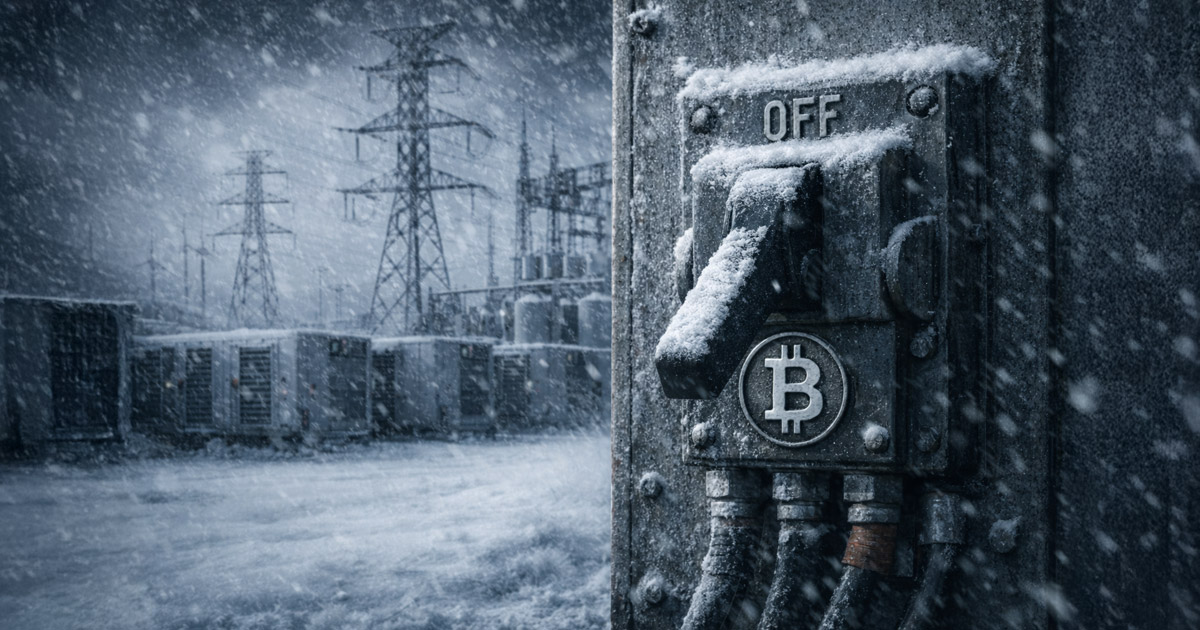
In the preceding week, a significant winter storm traversed the United States, compelling Bitcoin miners to implement curtailments, which resulted in a substantial reduction of computational power from the network within a remarkably short timeframe. Empirical data indicates a striking 40% decline in hashrate during the period spanning from January 23 to January 25, with approximately 455 EH/s ceasing operations. Consequently, block production experienced a marked deceleration, averaging around 12 minutes per block during this interval.
The most pronounced contraction in hashrate originated from Foundry USA, the predominant mining pool with a significant presence in the United States, suggesting that the observed dip was primarily attributable to operational curtailments.

Understanding the Mechanisms Behind Rapid Curtailment
The phenomenon of curtailment raises pertinent questions about its underlying mechanics: What enables miners to swiftly deactivate their operations? What motivations drive this decision-making process? Furthermore, how do these choices influence Bitcoin’s security budget, transaction throughput, and the overarching dynamics of integrating large industrial demands into electrical grids that may be strained during extreme cold weather?
Curtailment Dynamics: A Flexible Load Approach
Curtailment can be succinctly defined as the reduction of electricity consumption by miners—either partially or entirely—due to factors such as scarcity of power, elevated costs, or contractual obligations that render it more economically advantageous to sell back electricity to the grid rather than consume it for mining operations.
In the United States, and particularly in Texas, this strategic choice has evolved into a well-established business model. The Electric Reliability Council of Texas (ERCOT) has explicitly designed mechanisms tailored for “large flexible customers,” which include Bitcoin mining facilities recognized as critical examples capable of modulating load during periods of peak demand.
The rationale is straightforward: if a load can be reduced quickly and reliably, grid operators can utilize it as a pressure-release mechanism during times of heightened demand.
Categories of Curtailment in Mining Operations
Within operational mining fleets, curtailment typically manifests in three distinct categories:
– **Economic**: Miners continually assess the economic spread between revenue generated per unit of hash and the comprehensive cost associated with generating that hash. In instances where real-time energy prices surge, opting to halt hashing can become the most economical decision.
– **Contractual**: Certain miners engage in demand-response agreements wherein their ability to curtail serves as an integral component of their service offerings. Texas provides multiple avenues for flexible load participation in reliability programs, resulting in numerous documented cases where miners have capitalized financially by either curtailing operations or selling contracted power back into the market during critical stress events.
– For instance, Riot’s August 2023 operational update delineated earnings comprising $24.2 million from “power credits,” representing revenues accrued from selling curtailed power back into ERCOT at prevailing market prices. Additionally, Riot reported $7.4 million attributed to “demand response credits,” reflecting participation in ERCOT’s demand response initiatives.
– Similarly, Iris Energy’s investor communication indicated that its Texas facility achieved approximately $2.3 million in “power sales,” driven predominantly by voluntary curtailments linked to hedge contracts corresponding with ERCOT’s real-time pricing.
– **Emergency or Regulatory Requirements**: Recent regulatory frameworks have mandated that new large-scale loads must demonstrate readiness for curtailment as a precondition for grid interconnection in emergencies. Crypto miners and data centers are specifically identified within these parameters.
A Case Study: Winter Storms as Catalysts for Evaluating Mining Flexibility
This week’s winter storm serves as an illustrative case highlighting how incentives align within operational contexts. Cold weather events invariably elevate heating demands, thereby constricting reserve margins and often triggering conservation alerts across energy systems.
The recent storm inflicted significant disruption upon the U.S. energy infrastructure, resulting in price surges and operational challenges across multiple regions. For miners operating under flexible load arrangements, curtailment emerges as a logical response to an energy grid suddenly valuing megawatts more than terahashes.
This rapid response mechanism elucidates why abrupt changes at the pool level can manifest swiftly; when operators located heavily within the United States implement curtailments, their respective pools register these adjustments almost instantaneously. The recent decline in hashrate was most prominently observed through Foundry’s diminished output and the consequential slowdown in block production.
Bitcoin’s Difficulty Adjustment Mechanism: Implications of Slow Block Production
A sudden shock to hashrate often incites concern regarding network security; however, this perception is limited and narrowly focused. While it is true that fewer hashes per second reduce the brute-force cost associated with compromising the chain’s integrity, a more substantive operational inquiry relates to Bitcoin’s adaptive mechanisms when faced with rapid fluctuations in hashing power.
Bitcoin’s protocol incorporates a built-in recalibration mechanism characterized by a delay: while targeting an average block creation time of roughly ten minutes, difficulty adjustments occur every 2016 blocks based on the cumulative time taken to mine those blocks.
This structural design engenders what may be termed as a “storm tax.” In instances where numerous miners cease operations simultaneously due to external pressures—such as adverse weather conditions—blocks will naturally take longer to produce until sufficient blocks are mined for difficulty recalibration.
During this week’s event, CoinWarz’s difficulty monitoring dashboard reflected average block times exceeding target expectations; indeed, block production extended beyond twelve minutes—a tangible manifestation of this lag characterized by fewer blocks generated per hour and protracted confirmation timelines.
The Economic Implications of Slow Block Production
It is essential to recognize that slower block production does not signify systemic failure within Bitcoin; rather, it represents a temporal cost imposed upon users and miners due to abrupt changes in hash supply dynamics. Should miner operations resume promptly following price stabilization and alleviation of grid stressors, it is conceivable that no difficulty adjustment will be necessitated. Conversely, if disruptions persist over time, subsequent adjustments will decrease mining difficulty and realign block timing towards established targets.
The fee market dynamics further complicate perceptions surrounding slow block production; transient periods characterized by slower block generation can engender varying fee pressures depending on transaction demand fluctuations within the mempool.
Historical Context: Winter Storms as Stress Tests for Bitcoin Infrastructure
This recent event marks yet another instance wherein winter weather conditions have perturbed Bitcoin mining operations; however, it is crucial to acknowledge how these circumstances differ from prior occurrences concerning industry maturity and regulatory integration within grid management frameworks.
Start with Winter Storm Uri in February 2021—the modern benchmark for examining stress on Texas’s electrical grid—where an unprecedented surge in demand coincided with widespread generation failures across fuel types.
This episode led not only to widespread outages but also instigated considerable political scrutiny surrounding energy policies.
At that juncture, large-scale Bitcoin mining was considerably less integrated into Texas’s reliability planning infrastructure; thus far less equipped to respond dynamically relative to today’s operational environment where curtailment strategies are both common and more easily coordinated.
The Evolution of Flexible Load Dynamics Since Winter Storm Uri
The implications stemming from Uri have delineated a political landscape where any prospective large-scale electricity consumer is scrutinized against their potential impact on future emergencies within grid stability contexts.
The subsequent Winter Storm Elliott in December 2022 observed similar patterns where miners enacted curtailments amounting up to approximately 100 EH/s—a figure corresponding to roughly forty percent of network hashrate at that time—effectively stabilizing grid operations.
Elliott stands out because it underscored two pivotal insights: first, large miners possess the capacity for rapid shutdowns under extreme climatic conditions; second, once integrated into commercial contracts as part of standard operating procedures, such curtailments become expected behaviors rather than exceptions.
The Broader Landscape for Bitcoin Mining Operations Moving Forward
The year 2026 introduces additional dimensions whereby flexible load considerations extend beyond cryptocurrency miners alone; they now encompass an array of substantial compute loads including but not limited to AI data centers competing for similar interconnection capacities during peak demand scenarios.
The U.S. Energy Information Administration categorizes Texas as an epicenter for burgeoning electricity demands attributed significantly to both cryptocurrency mining and data center operations—prompting ERCOT’s task-force oversight mechanisms tailored toward managing substantial loads effectively.
This evolution implies shifting political considerations surrounding flexible loads; no longer can miners position themselves as unique entities demanding preferential treatment during crises when such flexibility becomes commonplace across various sectors vying for priority access during grid stress events.
The media coverage surrounding recent storms illustrates this evolving narrative emphasizing how large industrial consumers—including both crypto-miners and data centers—adaptively reduced power consumption in response to emergent conditions while ERCOT recalibrated its expectations accordingly.
Conclusion: Navigating Future Challenges in Bitcoin Mining
The recent decline in hashrate should be interpreted not merely as an isolated incident but rather as a precursor indicative of future trends where winter weather phenomena will continue imposing short-lived disruptions upon network performance due primarily to concentrated U.S.-based mining operations coupled with increasing compute load scales across diverse sectors. While Bitcoin’s inherent design accommodates such fluctuations through its difficulty adjustment mechanism enabling survivability amidst transient operational challenges—the broader political landscape remains less amenable toward accepting these dynamic shifts without rigorous scrutiny regarding regulatory compliance alongside public sentiment toward energy resource allocation amid crisis scenarios.
