


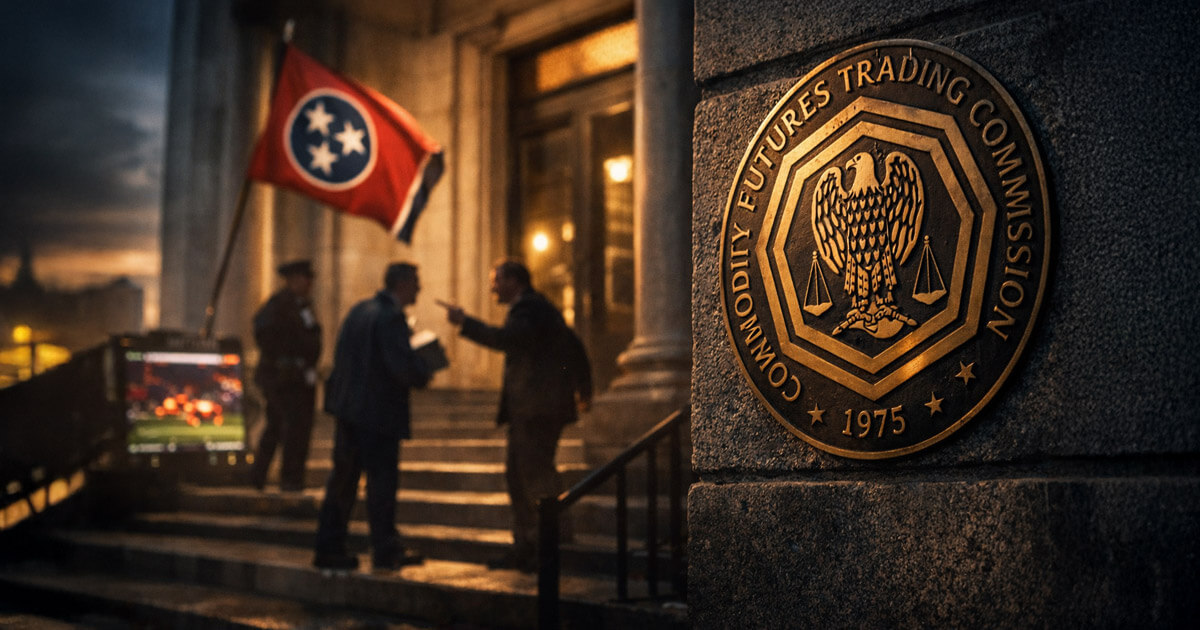
The Regulatory Conundrum: Analyzing the Tennessee Sports Betting Regulatory Actions
On January 9, 2026, the Tennessee Sports Betting Regulator disseminated a series of communications that initially appeared to be routine regulatory correspondence but have since evolved into a significant legal and operational issue for several prominent entities operating at the intersection of finance and gambling. The directive was unequivocal: cease the offering of sports-related event contracts to residents of Tennessee, nullify any outstanding positions, and initiate refunds to consumers by January 31, 2026.
Entities Involved: Kalshi, Polymarket, and Crypto.com
The companies implicated in this regulatory action—Kalshi, Polymarket, and Crypto.com—occupy a precarious position straddling the domains of financial derivatives and gambling. A binary trade contingent upon the outcome of a sporting event can be construed as either a federally regulated derivative under the auspices of the Commodity Futures Trading Commission (CFTC) or as an unlicensed sportsbook activity subject to state regulation.
In swift response to this regulatory enforcement, litigation ensued. A U.S. District Judge in Nashville, Aleta Trauger, granted a temporary restraining order, thereby prohibiting Tennessee from implementing its cease-and-desist order against Kalshi pending further judicial review. A subsequent hearing is scheduled for January 26, 2026, to consider the potential for a longer-lasting injunction.
Legal Arguments: A Clash of Jurisdictional Authority
The crux of the immediate conflict lies in Tennessee’s assertion that Kalshi operates an illegal gambling enterprise devoid of appropriate state licensing and facilitates underage betting. Conversely, Kalshi contends that Tennessee’s actions represent an attempt to regulate products that fall squarely within the exclusive jurisdiction of the CFTC.
The overarching narrative extends beyond this specific instance; it serves as a jurisdictional stress test: Can a state sports wagering authority delineate the boundaries governing contracts that a federally designated exchange asserts it has the right to list across the nation? Should states persist in their regulatory encroachments, significant implications arise for what has emerged as one of cryptocurrency’s most dynamic retail channels—a platform that transforms current events into tradable contracts.
Dissecting Jurisdictional Claims: The Legal Framework
Both Kalshi and Tennessee articulate plausible legal theories that lend credence to their respective positions. Kalshi maintains that it operates not as a sportsbook but rather as a designated contract market—a term defined by the CFTC to describe exchanges regulated under the Commodity Exchange Act. This designation is analogous to traditional futures markets accessible to retail participants.
The CFTC has publicly characterized designated contract markets as entities functioning under its jurisdictional oversight. In 2020, Kalshi was awarded an official designation as a contract market by the CFTC. This legal stance is bolstered by a compelling clause within federal commodities law asserting that the CFTC possesses “exclusive jurisdiction” over certain derivatives transactions executed on designated contract markets—a provision intended to establish uniformity across jurisdictions rather than allowing for disparate state regulations.
From Tennessee’s perspective, however, this federal framework holds little weight if the essence of the product is deemed sports wagering. The Tennessee Sports Wagering Council (SWC) governs sports betting in accordance with state law, which encompasses criteria regarding eligibility, consumer protections, and tax obligations for licensed operators.
The SWC has accused these platforms of offering sports contracts without requisite licenses, violating state regulations concerning player eligibility, and neglecting mandated consumer safeguards. This framing positions event contracts as pressing consumer protection issues rather than innovations within financial markets.
The intersection of prediction markets with America’s complex regulatory landscape reveals an inherent dichotomy: derivatives are predominantly subject to federal oversight whereas gambling regulation is primarily enforced at the state level. Given that sports betting is particularly localized in its governance, products capable of being classified as either derivatives or wagers prompt critical inquiries about which regulatory framework supersedes.
Tennessee’s actions are compounded by a recent ruling in Nevada where a federal judge concluded that Kalshi was subject to state gaming regulations—a decision that Kalshi has appealed. This ruling diminishes the notion of “federal preemption” and empowers states seeking to regulate sports contracts perceived as circumventions of established licensing frameworks.
The Role of Regulatory Mixed Signals
Complicating these matters further are the mixed signals emanating from the CFTC itself. On its official website, the agency delineates event contracts as derivatives whose payouts depend on specified occurrences—such as economic indicators or weather events—while simultaneously prohibiting event contracts referencing gaming or unlawful activities under both federal and state law.
Given this regulatory ambiguity, platforms like Kalshi face dual challenges: navigating compliance with both federal and state mandates while also addressing public sentiment regarding their operational legitimacy. The recent advisory from the CFTC indicated an acknowledgment that sports-related event contracts could be listed through self-certification processes but also implied potential future scrutiny on these listings.
Thus, when Tennessee issues its regulatory mandates, it does not merely confront Kalshi or its counterparts; it fundamentally tests whether the federal framework will uphold the premise that a nationally regulated derivatives exchange can offer sports-related contracts without succumbing to state-level restrictions and whether the CFTC will tolerate this category evolving into a de facto sportsbook model.
Compliance Challenges in a Fragmented Regulatory Landscape
In contemporary discourse surrounding compliance frameworks, there exists an oversimplified interpretation that equates compliance with mere procedural adherence—following rules and filing necessary documentation. However, prediction markets operate within a convoluted jurisdictional overlap that necessitates nuanced compliance behaviors.
This phenomenon may be characterized as “compliance theater,” suggesting an element of performative compliance rather than mere technical adherence to regulations. Every action taken—whether geofencing states post-cease-and-desist letter or refunding users—sends implicit signals about perceived authority amidst conflicting regulatory environments.
Options available to platforms include:
– Immediate compliance through geofencing and refunds
– Litigation against state enforcement actions
– Strategic adaptation of product offerings
For instance, should a platform opt for immediate compliance by geofencing Tennessee users while refunding outstanding positions, it mitigates legal exposure but effectively acknowledges enforceability of state regulations. Conversely, opting against compliance preserves legal standing but risks escalated enforcement actions including civil penalties or criminal referrals.
Kalshi’s decision to pursue litigation reflects confidence in its constitutional arguments against Tennessee’s actions. Notably, reports indicate potential civil penalties could reach $25,000 per infraction for noncompliance with state directives.
The issuance of a temporary restraining order by Judge Trauger implies preliminary judicial recognition of Kalshi’s substantive legal position; however, even success in court incurs costs—litigation is inherently protracted while markets operate on expedited timelines.
If an exchange finds itself embroiled in multiple legal battles across various jurisdictions concurrently—as indicated by reports concerning Kalshi—the resultant operational uncertainty becomes increasingly untenable. Compliance teams must contend with evolving legal landscapes while product roadmaps adapt to shifting regulatory climates.
This performative aspect extends into product design decisions made by platforms; adjustments such as increasing minimum ages or enhancing responsible gambling mechanisms may be interpreted variably by regulators depending on context—either reinforcing perceptions of gambling activity or indicating maturity akin to traditional market operators adhering to risk management protocols.
The implications arising from Tennessee’s correspondence transcend mere regional significance; they encapsulate broader themes regarding market fragmentation instigated by disparate enforcement methodologies across states. Such fragmentation undermines liquidity pools while deteriorating user experiences and complicating affiliate distribution efforts—transforming what could be perceived as a cohesive national marketplace into fifty distinct iterations susceptible to localized regulation.
The Identity Crisis: Information Market Versus Sports Betting
In assessing products within financial regulation frameworks, economic purpose alongside market structure serves as pivotal determinants for classification. Futures and options are not solely instruments for speculation; they provide mechanisms for hedging risk exposure and price discovery.
Conversely, gambling statutes prioritize safeguarding consumers against potential harm while maintaining game integrity standards. Event contracts exhibit capacity for hedging when tied to economic indicators—such as inflation metrics—but face scrutiny when applied within sporting contexts where economic rationales become tenuous at best.
Proponents argue that markets based on sporting events serve critical functions by aggregating dispersed information (e.g., player injuries or weather conditions) thereby acting as high-signal prediction tools; critics retort with an unvarnished perspective—that they merely represent wagers framed within an innovative structure designed to circumvent conventional sportsbook licensing requirements.
Legal anticipations exist surrounding these contentions; notably CFTC Regulation 40.11 expressly restricts event contracts associated with gaming activities alongside those deemed unlawful under existing statutes—a provision leveraged by Tennessee in its assertions against these platforms.
For companies operating within this space—even if they assert their positioning around sports contracts aligns with permissible derivatives—the prevailing public policy arguments are inherently weaker compared to those applicable for election-related odds or inflation-based instruments.
This discrepancy gains significance given that CFTC authority encompasses not solely statutory interpretation but also public interest considerations reflecting broader societal implications surrounding these products’ legitimacy. Reports indicate ongoing deliberations within CFTC regarding necessary adjustments to event contract regulations amid mounting legal pressures demanding clearer rationales justifying why specific categories conflict with public interest guidelines.
With cryptocurrency intertwining dynamics further complicating matters—the retail sector demands intuitive products offering immediacy without necessitating deep dives into complex mechanisms such as automated market makers (AMMs) or intricate whitepapers—sports event contracts emerge as attractive alternatives capturing attention without disengaging users from core functionalities associated with digital assets.
Consequently, regulatory bodies exhibit heightened awareness towards these developments; should federally regulated exchanges offer adjacent products circumventing established licensing requirements imposed at state levels—this poses existential threats towards traditional gatekeeping models reliant upon consumer protections alongside taxation frameworks predicated upon controlled operator lists.
Even if “event contracts” currently represent nascent market scales relative to established sports betting operations—the precedent set forth carries profound ramifications extending beyond individual transactions into broader regulatory frameworks governing derivative classifications nationally.
Anticipating Future Outcomes
Should Kalshi prevail in its legal battle within Tennessee and akin states pursuing regulatory enforcement actions against similar platforms—the category will gain substantial legitimacy moving forward. Subsequently, focus will pivot towards CFTC obligations necessitating clarification regarding compatibility between sports contracts and its overarching public-interest mandate.
Conversely, if states continue achieving favorable outcomes within courtroom settings—platforms may retreat into localized compliance measures effectively transforming national liquidity paradigms into confined regional pools while inadvertently steering users towards less traceable workarounds circumventing monitoring capabilities deployed by regulators.
The most plausible near-term scenario does not entail decisive victories favoring either federal supremacy nor total cessation imposed by states; instead anticipate an intricate middle ground characterized by sporadic enforcement actions paired alongside ongoing identity debates wherein differentiation between “information markets” versus “sports betting” oscillates depending on jurisdictional interpretations prevalent within courtrooms nationwide.
Ultimately—and more consequential than impending refund deadlines set forth by January 31—is how Tennessee’s correspondence frames critical structural narratives impacting industry stakeholders grappling with essential questions surrounding classification: In America today—is a tradable yes/no contract associated with athletic contests primarily regarded as financial instrumentality or merely rebranded gambling masquerading under heightened user experience paradigms?
