


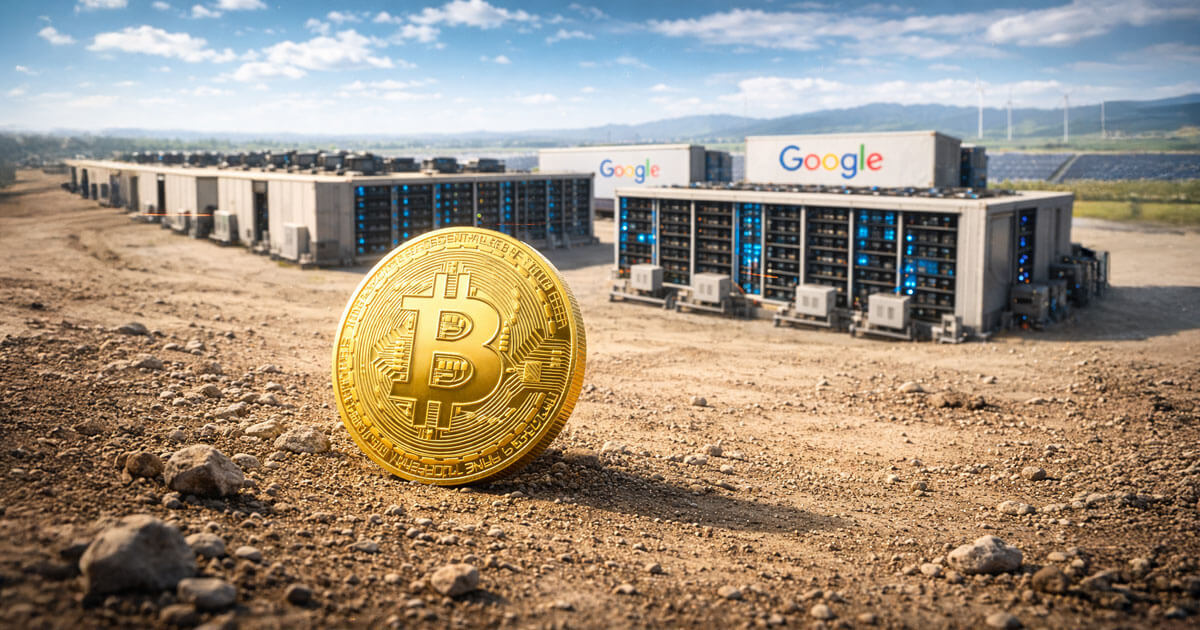
Google’s Strategic Influence in Bitcoin Mining Through AI Integration
The preeminence of Google, a subsidiary of Alphabet Inc., in the realm of technological innovation has manifested in a significant and strategic shift within the Bitcoin mining sector. This report delineates Google’s role as a pivotal architect facilitating Bitcoin miners’ transition towards artificial intelligence (AI) initiatives, revealing an intricate landscape of financial engineering rather than conventional acquisitions.
Rather than pursuing direct ownership of mining enterprises, Google has extended credit support exceeding $5 billion to a select group of Bitcoin miners engaged in AI project development. This financial backing is often characterized in the marketplace as technology partnerships; however, a closer analysis reveals that these arrangements are fundamentally structured as credit engineering mechanisms.
Google’s investment serves to reclassify historically unrated mining companies into viable counterparties for lenders, thereby allowing financial institutions to regard them akin to infrastructure sponsors rather than mere commodity producers. This strategic repositioning is particularly noteworthy in the context of evolving economic pressures on the mining industry.
Mechanics of Google’s Financial Support
The operational framework underpinning these arrangements involves several key components:
- Bitcoin miners contribute essential resources such as energized land, high-voltage interconnections, and infrastructure facilities.
- Fluidstack, an established data-center operator, enters into multi-year colocation leases with these miners specifically for the critical IT load that powers AI servers.
- Google provides a backstop for Fluidstack’s lease commitments, thereby enabling risk-averse commercial banks to classify these projects under infrastructure debt rather than speculative crypto financing.
The Precedent Set by TeraWulf
TeraWulf’s Lake Mariner campus in New York exemplifies this structural precedent, having announced a substantial expansion that elevates its total contracted capacity beyond 360 megawatts. The miner appraises this expansion at $6.7 billion in contracted revenue, with potential extensions pushing the valuation to approximately $16 billion.
Significantly, terms associated with this deal indicate an increase in Google’s backstop to $3.2 billion, concurrently augmenting its warrant-derived equity stake to approximately 14%. The implications of such backing are profound for TeraWulf’s financial standing and operational viability.
Further exemplifying Google’s influence is Cipher Mining, which secured a long-term AI hosting agreement with Fluidstack at its Barber Creek facility. This arrangement encompasses a 10-year lease for 168 megawatts of capacity, with Cipher projecting approximately $3 billion in contracted revenue. Central to this financial model is Google’s commitment to backstop $1.4 billion of lease obligations, resulting in Google acquiring warrants convertible into roughly a 5.4% equity stake in Cipher Mining.
Hut 8 Corp.’s Expansion and Financial Structuring
Hut 8 Corp. further scaled this model by announcing a 15-year lease agreement for 245 megawatts of IT capacity at its River Bend campus in Louisiana. Valued at $7 billion, this contract is being financially structured by prominent institutions such as JP Morgan and Goldman Sachs—an endeavor made feasible exclusively due to Google’s financial backing of the lease obligations.
The Economic Shift: From Bitcoin Margins to AI Leases
The structural pivot observed among these miners is largely a response to deteriorating economic conditions within the Bitcoin mining sector. According to data from CoinShares, the average cash cost for producing one Bitcoin among publicly listed miners stands at approximately $74,600; when including non-cash items like depreciation, this figure escalates to around $137,800.
With Bitcoin trading at approximately $90,000, profit margins for traditional miners remain constricted. Consequently, mining boards are actively pursuing more stable revenue streams through ventures into AI and high-performance computing (HPC). Over the past year alone, public miners have announced contracts exceeding $43 billion related to AI and HPC development.
This strategic realignment enhances their standing with financial institutions since banks can assess a 10 or 15-year AI capacity lease as recurring revenue—contrasting sharply with the volatile nature of Bitcoin mining income which fluctuates based on network difficulty and block rewards.
The Role of Google as a Credit Enhancer
Google’s involvement serves as a crucial credit enhancement mechanism that reduces the perceived risk associated with these projects. By facilitating access to capital under terms akin to those available to traditional data center developers, Google significantly improves capital efficiency across the board. Rather than incurring the full costs associated with constructing data center shells or navigating interconnection delays independently, Google strategically secures future access to compute-ready power through Fluidstack while retaining equity optionality via warrants.
Operational Risks and Counterparty Dependencies
Despite the apparent financial logic governing these arrangements, operational execution introduces distinct complexities and risks. Historically, Bitcoin miners have optimized their operations around securing the most cost-effective and easily curtailed power sources. In stark contrast, AI clients necessitate data-center-grade conditions characterized by stringent environmental controls and rigorous service-level agreements.
This transition from a “best-effort” model inherent in Bitcoin mining to one that demands near-continuous reliability necessitates profound alterations in both operational culture and physical infrastructure. Should cooling retrofits exceed budgetary constraints or if interconnection upgrades encounter delays, miners may face contractual breaches rather than merely opportunity costs.
Furthermore, these arrangements engender significant counterparty concentration risk. The economic chain heavily relies on Fluidstack functioning effectively as an intermediary; consequently, cash flows are contingent upon Fluidstack’s ability to retain AI tenants and ultimately hinge on Google’s willingness to honor its decade-long backstop commitments. In scenarios where market enthusiasm for AI diminishes or where tenants demand lease renegotiations, such dependencies create vulnerabilities within this financial architecture.
Broader Implications: Competition Policy and Bitcoin Security
The ramifications of these financial constructs extend beyond mere project finance considerations into critical domains such as competition policy and the long-term security framework supporting Bitcoin’s network integrity. By leveraging credit backstops instead of pursuing direct acquisitions, Google effectively aggregates access to vital resources—energized land and power—essential for AI expansion while circumventing regulatory scrutiny typically associated with large asset purchases.
However, should this operational template proliferate across various campuses, critics may assert that Google has established a “virtual utility.” While lacking direct ownership over physical assets, Google’s influence would still dictate who can deploy large-scale computing capabilities on those grids, potentially inviting regulatory examination concerning antitrust implications.
From a Bitcoin perspective, the inherent trade-off remains clear: any megawatt allocated from mining operations towards AI ventures reduces the available energy pool necessary for securing the network’s integrity. Historically assumed correlations suggesting that hashrate would increase proportionately with price based on improved rig efficiency and additional capital influx may no longer hold true if top-tier operators systematically redirect their optimal sites towards lucrative AI contracts. This shift constrains hashrate growth while inflating associated costs—thereby relegating block production increasingly towards stranded or suboptimal power assets.
